What is PT-141?
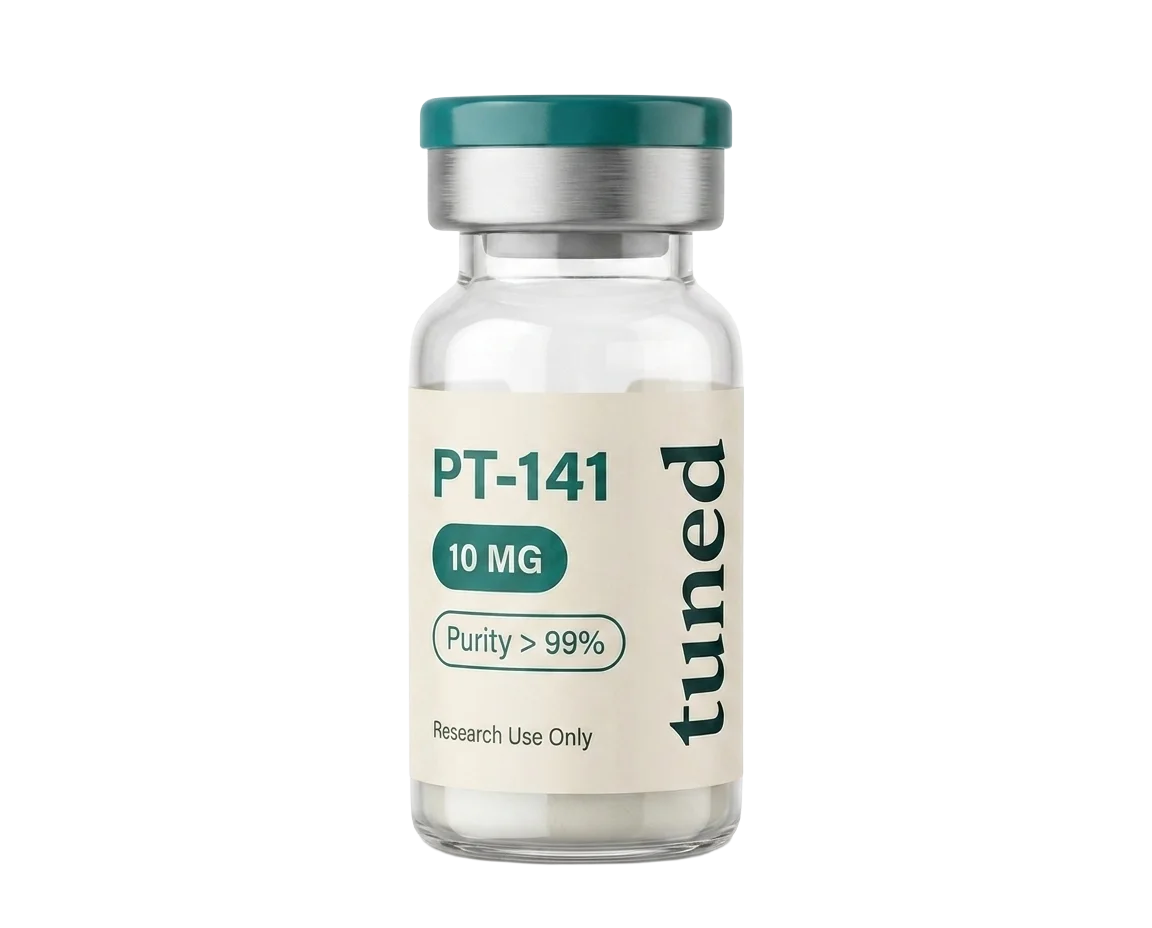
PT-141 is a melanocortin-receptor agonist — the peptide also known as bremelanotide.[1] What makes it distinctive is where it acts: on melanocortin (chiefly MC4R) pathways in the central nervous system involved in sexual response, rather than on blood flow the way the PDE5 drugs (e.g. sildenafil) do.[4] Its strongest evidence is in women: as the drug Vyleesi it is FDA-approved for hypoactive sexual desire disorder (HSDD) in premenopausal women, based on Phase 3 trials.[2] The research-chemical "PT-141" is not that approved product.
What is PT-141, exactly?
PT-141 is a synthetic peptide and melanocortin agonist, developed from the same family as the tanning peptide melanotan, but selected for its effects on sexual-response pathways.[1] Its drug name is bremelanotide.
It belongs to the melanocortin system — a set of brain signalling pathways that influence appetite, inflammation, pigmentation and sexual arousal. PT-141 acts as an agonist primarily at the MC4 receptor, the subtype most tied to sexual response.[4]
What is PT-141 peptide?
So "PT-141 peptide" and "bremelanotide" refer to the same molecule. It is supplied as a lyophilized powder and, like other peptides here, studied as an injectable; it was also studied historically as an intranasal spray (covered in the dedicated PT-141 nasal spray guide). The key framing throughout: the approved product is the pharmaceutical bremelanotide (Vyleesi), and the research-chemical "PT-141" is not that drug.
What does PT-141 do, and how does it work?
PT-141 acts centrally. Rather than relaxing blood vessels to increase genital blood flow (the PDE5-inhibitor mechanism), it activates melanocortin pathways in the brain that are upstream of sexual desire and arousal.[4][6]
The melanocortin (MC4R) mechanism
The neurobiology work describes bremelanotide stimulating MC4 receptors in hypothalamic circuits that govern sexual motivation, which is why its effect is framed as acting on desire/arousal rather than purely on the mechanics of erection.[4] That central mechanism is also the reason its development pivoted from erectile dysfunction toward female HSDD — the desire pathway is shared, and the central action suited the HSDD indication.[1][6] It is a fundamentally different mechanism from the vascular ED drugs, not a substitute mechanism for the same target. That distinction also explains why PT-141 is often discussed for situations where blood-flow drugs alone fall short: it engages an upstream desire pathway rather than the downstream plumbing, so the two mechanisms are complementary in principle rather than interchangeable.
PT-141 benefits
The PT-141 benefits described in research center on sexual desire and arousal, and — unusually for this catalogue — the central one is backed by randomized controlled trials in a defined population:
- Improved sexual desire in HSDD — two Phase 3 randomized trials (RECONNECT) in premenopausal women with HSDD supported the bremelanotide approval.[2]
- Reduced distress related to low desire — a co-measured outcome in those trials.[2]
- Central melanocortin action — the development program studied effects on desire-related neural pathways.[4]
- Historical ED signal — earlier melanocortin work explored male sexual dysfunction, though that development was not completed.[5][6]
The honest boundary: the trial-backed benefit is specifically HSDD in premenopausal women, where bremelanotide is approved as Vyleesi.[2] Broader or male-use benefits rest on older, incomplete development and anecdote, and the research-chemical "PT-141" is not the approved drug.
PT-141 in men: the erectile-dysfunction research
The "PT-141 for men" interest reflects its origin: the melanocortin agonist was first explored for male erectile dysfunction in early-phase studies, including an intranasal formulation and a trial combining low-dose intranasal PT-141 with sildenafil.[5] The central mechanism was of interest for cases where vascular drugs alone were insufficient.
Where the male evidence actually stands
The crucial honesty: that male/ED development was not carried to approval — the program pivoted to female HSDD, where bremelanotide ultimately gained its randomized-trial approval.[1][6] So the male research rests on early-phase studies rather than the Phase 3 randomized evidence that backs the female indication, and bremelanotide is not approved for men. The mechanism is not sex-specific in principle, but the controlled outcome data are in women. This describes the research record, not a recommendation to use the research-chemical material.
How long does PT-141 last?
The regulated development program characterised PT-141's pharmacokinetics and limited effect window under defined clinical conditions.[4][5] Those findings are not instructions for research material.
Why the duration question matters
Duration findings belong to the approved-product studies and label context. This page does not translate them into timing or administration guidance.
Is PT-141 safe and FDA approved?
This needs a precise answer. Bremelanotide is FDA-approved as Vyleesi (2019) for acquired, generalized HSDD in premenopausal women, on the strength of the RECONNECT Phase 3 trials,[2] and its safety was characterised across the clinical development program.[3] But that approval is specific to that indication and population — it is not approved for men or for general use, and the research-chemical "PT-141" is not the approved product.
PT-141 side effects
Across the regulated trials, commonly reported effects included nausea, flushing, headache and local reactions.[3] The development program also documented transient cardiovascular effects, which are addressed in the approved product label.[3][5] These findings concern the approved drug and do not establish guidance for research material.
How to choose PT-141
For research material, quality is the dominant variable: a batch-specific Certificate of Analysis (UPLC purity, identity, endotoxin) does more for safety than any convention, and the research-chemical version is distinct from the approved Vyleesi drug.
Common questions
What is PT-141?
How does PT-141 work?
Is PT-141 FDA approved?
Is PT-141 used for men?
What effects were reported in the regulated trials?
PT-141 guides
This page is the overview. These guides go deeper on the most-searched angles:
References
- Molinoff PB, Shadiack AM, Earle D, et al. PT-141: a melanocortin agonist for the treatment of sexual dysfunction. Ann N Y Acad Sci, 2003;994:96–102. PMID 12851303. (Identity, melanocortin mechanism, early development.)
- Kingsberg SA, Clayton AH, Portman D, et al. Bremelanotide for the Treatment of Hypoactive Sexual Desire Disorder: Two Randomized Phase 3 Trials. Obstet Gynecol, 2019;134(5):899–908. PMID 31599840. (RECONNECT — basis of Vyleesi approval.)
- Clayton AH, Kingsberg SA, Goldstein I, et al. Safety Profile of Bremelanotide Across the Clinical Development Program. J Womens Health, 2022;31(2):171–182. PMID 35147466. (Adverse effects; transient blood-pressure change.)
- Pfaus JG, Sadiq A, Spana C, et al. The neurobiology of bremelanotide for the treatment of hypoactive sexual desire disorder in premenopausal women. CNS Spectr, 2021;1–9. PMID 33455598. (MC4R central mechanism.)
- Diamond LE, Earle DC, Heiman JR, et al. Double-blind, placebo-controlled evaluation of the safety, pharmacokinetics and pharmacodynamics of intranasal PT-141. Int J Impot Res, 2004;16(1):51–59. PMID 14963471. (Intranasal ED development; PK/safety.)
- Shadiack AM, Sharma SD, Earle DC, et al. Melanocortins in the treatment of male and female sexual dysfunction. Curr Top Med Chem, 2007;7(11):1137–1144. PMID 17584134. (Mechanistic overview, both sexes.)
PT-141 (bremelanotide) is a melanocortin (MC4R) agonist acting centrally on sexual-response pathways [1][4][6]; two Phase 3 RCTs in premenopausal women with HSDD supported its approval as Vyleesi [2], with safety characterised across development [3] — common effects nausea/flushing/headache and a transient blood-pressure rise [3]. It originated in intranasal ED research that was not completed [5]. The approval is indication-specific (HSDD, premenopausal women); it is not approved for men or general use, and the research-chemical "PT-141" is not the approved drug. No research dose is provided here. Not medical advice.
For research use only. Not for human consumption. This page summarises published research for educational purposes. It is not medical advice and is not intended to diagnose, treat, cure, or prevent any disease.