PT-141 in women: what the HSDD trials show
The female indication is where PT-141 has its strongest clinical-trial evidence. As the drug bremelanotide (Vyleesi), it is FDA-approved for hypoactive sexual desire disorder (HSDD) in premenopausal women, on the basis of two Phase 3 randomized, placebo-controlled trials (RECONNECT).[1] Those trials measured central effects on the melanocortin (MC4R) desire pathway, not on blood flow.[4] This page describes that clinical research and the approved drug — it is not a recommendation to use the research-chemical "PT-141," which is not the approved Vyleesi product.
PT-141 research in women
PT-141 is the rare peptide in this catalogue whose primary research is specifically in women — the basis for searches like "PT-141 for women." The melanocortin agonist was developed and approved as a drug for a female condition: hypoactive sexual desire disorder (HSDD).[1]
HSDD is defined as persistent, distressing low sexual desire not better explained by another cause. Because the melanocortin mechanism acts on central desire pathways rather than the vascular mechanics targeted by men's ED drugs, the development concentrated on premenopausal women with acquired, generalized HSDD.[4]
What the trials measured in women
In the randomized, placebo-controlled research, bremelanotide improved measures of sexual desire and reduced the distress associated with low desire relative to placebo.[1][2] These are clinical-trial findings in a defined population describing the approved drug, not use or timing guidance for research material.
PT-141 and HSDD: the trial evidence
The HSDD evidence is unusually solid for a compound sold in research channels, because it went through the full process. Two Phase 3 randomized, placebo-controlled trials — the RECONNECT studies — evaluated bremelanotide in premenopausal women with HSDD and supported its FDA approval as Vyleesi.[1]
What the RECONNECT trials showed
Across the program, bremelanotide produced statistically significant improvements in desire and in HSDD-related distress versus placebo, with earlier randomized work pointing the same direction,[2] and prespecified subgroup analyses exploring who responded.[5] The neurobiology work explains the plausibility — MC4R activation in desire-related circuits.[4] The boundaries to keep in view: the evidence is in premenopausal women with HSDD specifically (not all women, not postmenopausal use, not a general arousal aid), and it describes the approved pharmaceutical bremelanotide — the research-chemical "PT-141" is not that product.
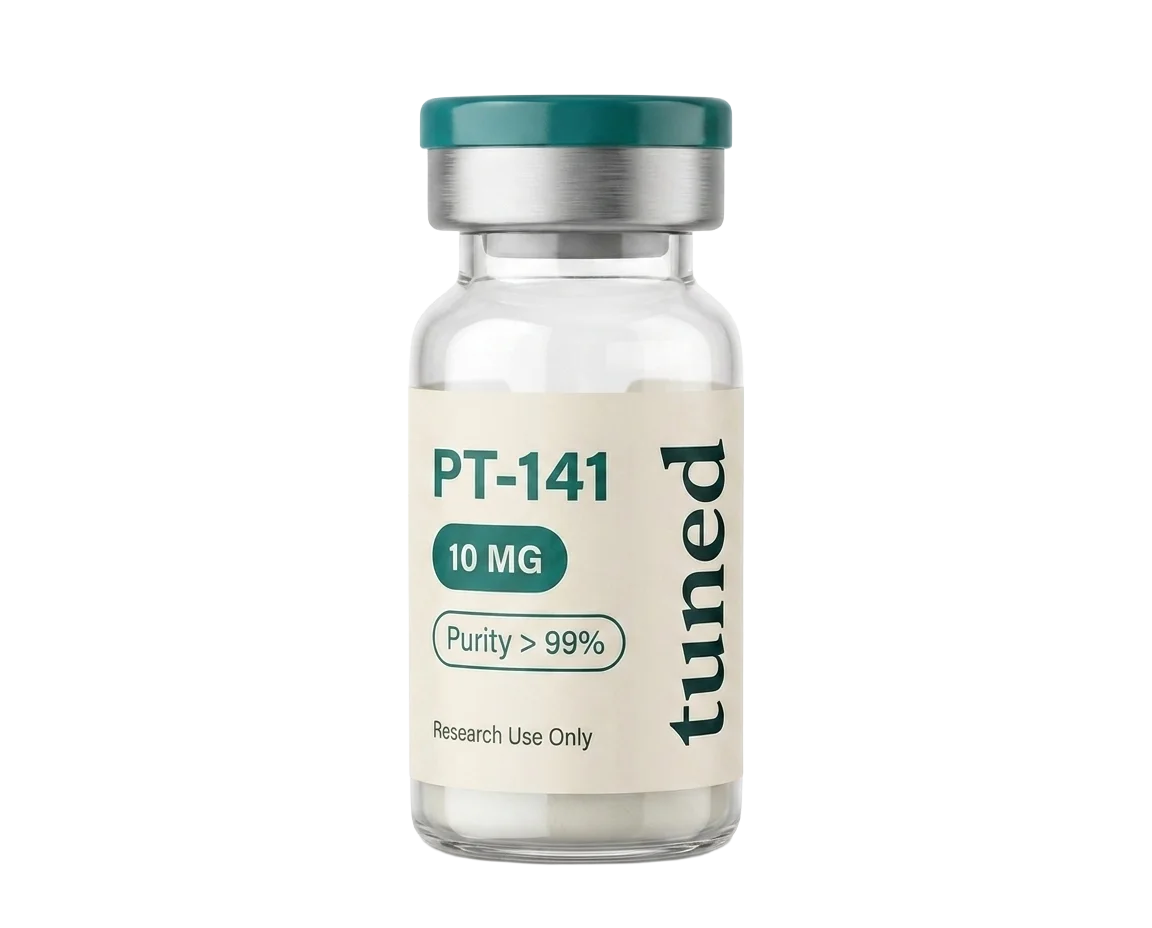
tuned PT-141
For laboratory research use only · available to researchers. Specifications, pricing & Certificate of Analysis on the product page.
PT-141 safety in the female research
Safety was characterised across the bremelanotide development program. The most common reported effects were nausea, flushing and headache, with injection-site reactions for the subcutaneous form.[3]
The blood-pressure consideration
The regulated development program documented transient cardiovascular effects, which are addressed in the approved product label.[3] That safety characterisation concerns the approved drug in its studied population; the research-chemical material is not the approved product.
Common questions
What does PT-141 do for women?
Is PT-141 approved for women?
How strong is the evidence for PT-141 in women?
What are the side effects in women?
Is the research-chemical PT-141 the same as Vyleesi?
References
- Kingsberg SA, Clayton AH, Portman D, et al. Bremelanotide for the Treatment of Hypoactive Sexual Desire Disorder: Two Randomized Phase 3 Trials. Obstet Gynecol, 2019;134(5):899–908. PMID 31599840. (RECONNECT — basis of Vyleesi approval.)
- Clayton AH, Althof SE, Kingsberg S, et al. Bremelanotide for female sexual dysfunctions in premenopausal women: a randomized, placebo-controlled dose-finding trial. Womens Health (Lond), 2016;12(3):325–337. PMID 27181790. (Earlier randomized evidence.)
- Clayton AH, Kingsberg SA, Goldstein I, et al. Safety Profile of Bremelanotide Across the Clinical Development Program. J Womens Health, 2022;31(2):171–182. PMID 35147466. (Adverse effects; transient blood-pressure change.)
- Pfaus JG, Sadiq A, Spana C, et al. The neurobiology of bremelanotide for the treatment of hypoactive sexual desire disorder in premenopausal women. CNS Spectr, 2021;1–9. PMID 33455598. (MC4R central mechanism.)
- Simon JA, Kingsberg SA, Portman D, et al. Prespecified and Integrated Subgroup Analyses from the RECONNECT Phase 3 Studies of Bremelanotide. J Womens Health, 2022;31(3):391–400. PMID 35230162. (Subgroup response analyses.)
PT-141 (bremelanotide) has its strongest evidence in premenopausal women with HSDD: two Phase 3 RCTs (RECONNECT) [1] plus earlier randomized work [2] showed improved desire and reduced distress, with safety characterised across development [3] and an MC4R central mechanism [4]; subgroup analyses explored response [5]. It is FDA-approved as Vyleesi for that specific indication and population only; it is not a general libido aid, and the research-chemical "PT-141" is not the approved product. No research dose is provided here. Not medical advice.
For research use only. Not for human consumption. This page summarises published research for educational purposes. It is not medical advice and is not intended to diagnose, treat, cure, or prevent any disease.