PT-141 nasal spray
The PT-141 nasal spray is the original form: the melanocortin agonist was first developed as an intranasal product and studied for erectile dysfunction, including a trial combining low-dose intranasal PT-141 with sildenafil.[1][2] That intranasal route was ultimately set aside — a documented transient rise in blood pressure was a key factor — and the molecule was developed instead as the subcutaneous drug bremelanotide (Vyleesi).[3] This page describes the form and its research history, not how to use it.
PT-141 nasal spray
PT-141's first formulation was intranasal. In its early development the melanocortin agonist was delivered as a nasal spray and evaluated in double-blind, placebo-controlled studies for sexual dysfunction.[1]
Early intranasal studies characterised the formulation's safety, pharmacokinetics and pharmacodynamics.[1] Those findings belong to the investigational product and study conditions; they are not preparation or administration guidance for research material.
PT-141 peptide nasal spray and "spray" searches
So "PT-141 peptide nasal spray," "PT-141 spray" and similar searches all point at this same original intranasal form. It genuinely existed and was studied — the meaningful questions are how it compares to the injectable and why development moved away from it, both covered below. This guide describes the form and the research; it does not provide preparation or administration instructions.
Why the intranasal program ended
The intranasal development program was discontinued after safety concerns, including transient blood-pressure effects, while a different regulated formulation proceeded through later clinical development.[3][5]
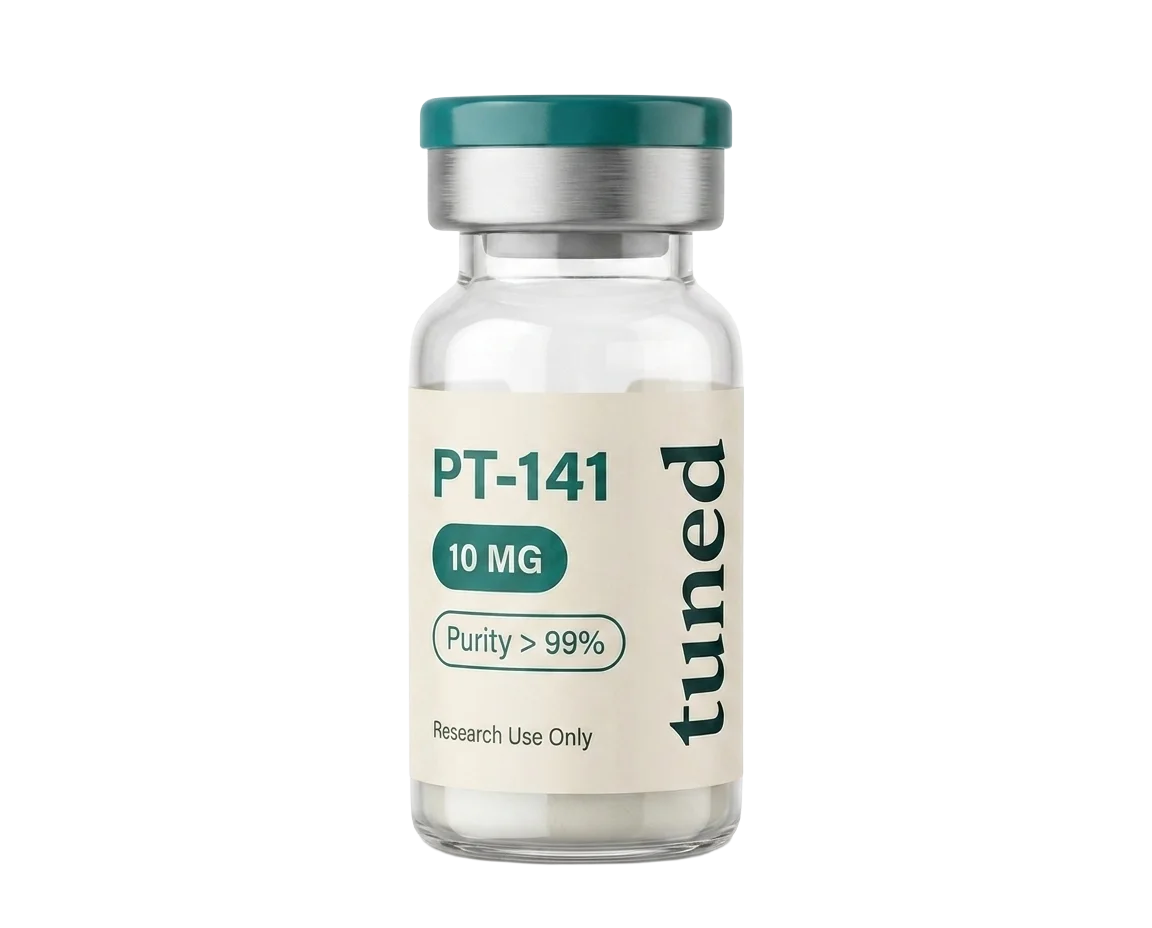
tuned PT-141
For laboratory research use only · available to researchers. Specifications, pricing & Certificate of Analysis on the product page.
Why the intranasal PT-141 program was discontinued
The arc of PT-141 explains why a "nasal spray" is so searched yet not the approved product. The intranasal melanocortin agonist showed activity in early sexual-dysfunction studies,[1] but the development pivoted: the cardiovascular signal (transient blood-pressure elevation) was difficult to manage with the nasal route, and the company moved the molecule to a subcutaneous formulation and a different primary indication — female HSDD.[3][5]
What that means for "PT-141 nasal spray" today
Practically, the approved, trial-validated product is the subcutaneous drug; the intranasal "PT-141 nasal spray" sold in research-chemical channels is the older format, not a pharmaceutical product, and its absorption and blood-pressure profile by that route are exactly the things the development program flagged.[3] The research-chemical material — by any route — is not the approved bremelanotide (Vyleesi), and this page does not provide instructions for preparing or administering it.
The broader lesson is a useful one for reading any peptide "form" claim. A formulation existing in the literature is not the same as that formulation being validated; the intranasal PT-141 was real and studied, yet it was the route the developers ultimately moved away from, while the subcutaneous form is the one that carried the molecule to approval.[1][3] So a "nasal spray" being available says nothing about whether that route reproduces the trial-validated result — and here, the documented history actively points the other way.
Common questions
Is PT-141 a nasal spray?
Why was the intranasal PT-141 program discontinued?
Is PT-141 nasal spray a pharmaceutical product?
References
- Diamond LE, Earle DC, Heiman JR, et al. Double-blind, placebo-controlled evaluation of the safety, pharmacokinetics and pharmacodynamics of intranasal PT-141. Int J Impot Res, 2004;16(1):51–59. PMID 14963471. (Intranasal form; safety/PK/PD.)
- Diamond LE, Earle DC, Garcia WD, et al. Co-administration of low doses of intranasal PT-141, a melanocortin receptor agonist, and sildenafil to men with erectile dysfunction. Urology, 2005;65(4):755–759. PMID 15833522. (Intranasal + sildenafil, ED.)
- Clayton AH, Kingsberg SA, Goldstein I, et al. Safety Profile of Bremelanotide Across the Clinical Development Program. J Womens Health, 2022;31(2):171–182. PMID 35147466. (Subcutaneous approval; transient blood-pressure effect.)
- Molinoff PB, Shadiack AM, Earle D, et al. PT-141: a melanocortin agonist for the treatment of sexual dysfunction. Ann N Y Acad Sci, 2003;994:96–102. PMID 12851303. (Mechanism and development history.)
- Shadiack AM, Sharma SD, Earle DC, et al. Melanocortins in the treatment of male and female sexual dysfunction. Curr Top Med Chem, 2007;7(11):1137–1144. PMID 17584134. (Development overview.)
PT-141's intranasal form was the original, studied in early sexual-dysfunction trials including with sildenafil [1][2], but the molecule was approved as a subcutaneous drug (bremelanotide / Vyleesi); a transient blood-pressure rise was a factor in setting the intranasal route aside [3][5]. The research-chemical "PT-141 nasal spray" is the older format, not a pharmaceutical product. This page describes the form and research history, not preparation or administration. Not medical advice.
For research use only. Not for human consumption. This page summarises published research for educational purposes. It is not medical advice and is not intended to diagnose, treat, cure, or prevent any disease.