≥99% purity, third-party verified ·Free shipment protection on every order ·CoA with every batch ·For research use only
Home/Peptides/Sermorelin/Tablets & oral
Sermorelin · Forms

Sermorelin tablets, pills & sublingual

What oral and sublingual sermorelin forms are, how they compare to injection, and the bioavailability catch that makes peptides hard to absorb by mouth.
In short

Sermorelin is marketed in tablet, pill, sublingual and troche forms as well as the classic injectable. The catch is biological: sermorelin is a 29-amino-acid peptide, and peptides are notoriously poorly absorbed through the gut — they're degraded by stomach acid and enzymes and cross the intestinal wall poorly.[2] That's the central reason the studied, approved form was injectable,[3] and why oral-form effectiveness is the real question — not whether the products exist.

01 — Tablets & pills

Sermorelin tablets

Sermorelin tablets and pills are oral formulations marketed as a needle-free alternative to injection. They exist and are sold — the meaningful question is how much of the peptide actually reaches the bloodstream intact.[2]

The original, evidence-backed sermorelin (Geref) was a subcutaneous injection, and the human studies establishing its GH/IGF-1 effects used the injectable route.[3] Oral tablets are a later, convenience-driven format. Because no controlled trial has shown an oral sermorelin tablet reproduces the GH response of the injectable, the honest framing is that oral tablets are a delivery convenience whose effectiveness isn't established, not a proven equivalent. (Sermorelin is not a currently marketed US medicine, and the research-chemical version is not the pharmaceutical-grade product either way.)

Sermorelin pills and pills for sale

"Sermorelin pills" and "pills for sale" describe the same oral category, often from compounding pharmacies or supplement sellers. The same caveat applies to all of them: the format is real, the absorption is the issue, and marketing claims of equivalence to injection are not backed by controlled head-to-head data.

02 — Sublingual & troches

Oral sermorelin and sublingual forms

Sublingual sermorelin (dissolved under the tongue) and troches (slow-dissolving lozenges) are attempts to bypass the gut. The logic is sound in principle: the tissue under the tongue and inside the cheek is thin and well-supplied with blood, so some peptides and hormones can be absorbed there directly, avoiding stomach acid and first-pass liver metabolism.[3]

Sermorelin oral vs injection

Even so, "sermorelin oral vs injection" comes down to a predictable trade-off. Injection delivers a known, complete dose directly — which is why the research was done that way. Sublingual and troche routes are gentler and needle-free but deliver a variable and generally smaller fraction of the peptide, and the amount absorbed across the mucosa for a molecule this size has not been established for sermorelin specifically.[2] So oral and sublingual forms trade certainty for convenience.

The honest read: injectable sermorelin is the form with research behind it; tablets, pills, sublingual and troche forms are convenience formats whose absorption — and therefore effectiveness — isn't established for this peptide.[2][3]
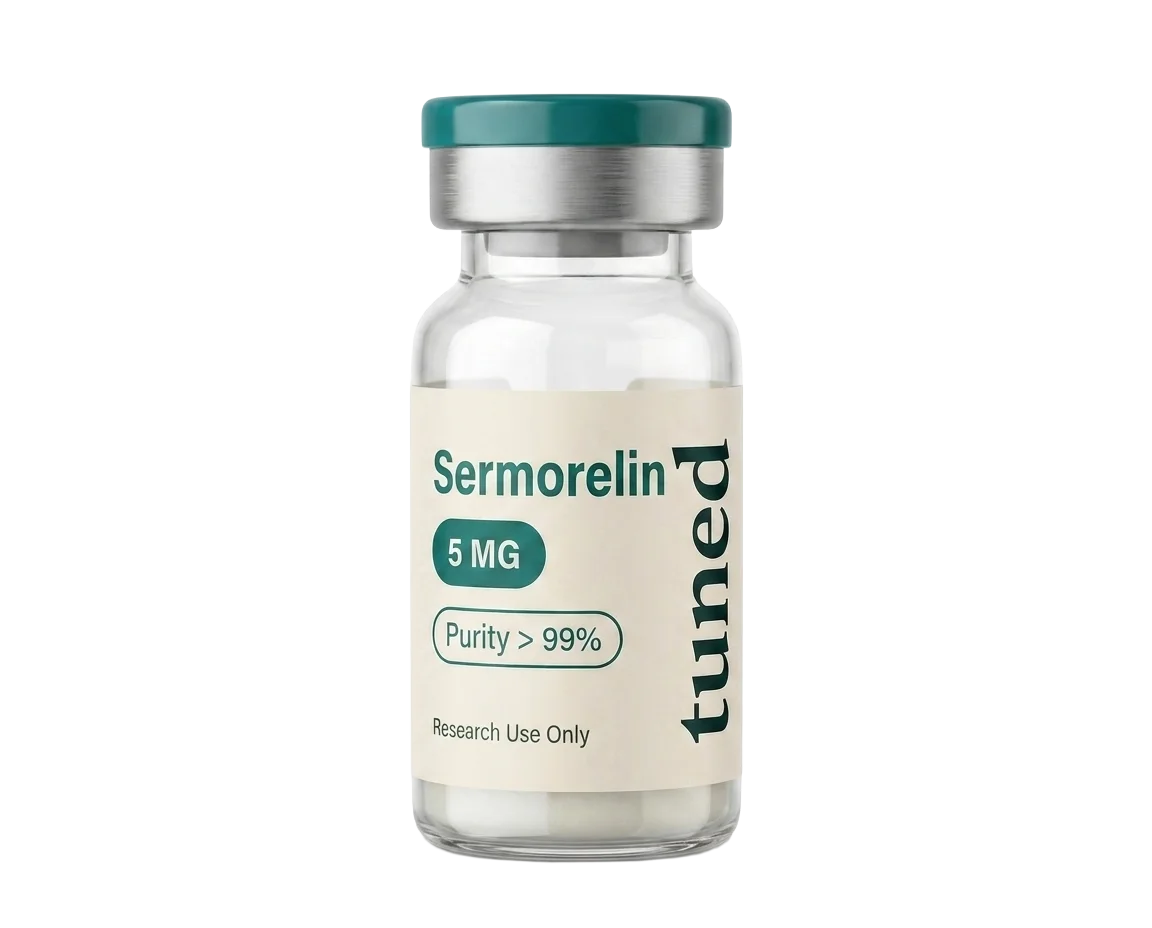
Growth hormonetuned Sermorelin research vial
Research-grade · ≥99% purity

tuned Sermorelin

5 MG lyophilized · batch-specific Certificate of Analysis
99% purity guaranteed
Same-day dispatch before 2 PM ET
Free shipment protection
3rd-party tested in the U.S.

For laboratory research use only · available to researchers. Specifications, pricing & Certificate of Analysis on the product page.

03 — The absorption catch

Why oral peptide absorption is the catch

The reason this whole question exists is a well-known problem in pharmacology: peptides are hard to deliver by mouth. Two barriers stand in the way — enzymatic degradation (stomach acid and gut enzymes break peptide bonds) and poor permeability (large, water-loving peptide molecules don't cross the intestinal lining easily).[2]

What this means for sermorelin tablets and sublingual forms

For a 29-amino-acid peptide like sermorelin, those barriers are significant, which is why injectable and (to a lesser extent) mucosal routes have been the serious delivery strategies for peptide hormones.[3] It doesn't mean oral or sublingual forms do nothing — it means the fraction reaching the bloodstream is uncertain and likely lower, and that any product claiming oral-equals-injection equivalence is making a claim the published science doesn't support for sermorelin. The practical takeaway for a researcher: route matters, and the form with documented GH/IGF-1 effects is the injectable one.

There's a broader context worth knowing. Oral peptide delivery is an active pharmaceutical research field precisely because the prize — needle-free peptides — is large and the problem is hard; the handful of orally available peptide drugs that exist required substantial formulation engineering to protect the molecule and coax it across the gut wall.[2] A generic compounded sermorelin tablet is not that. So the honest position isn't "oral sermorelin is fake," but rather "oral and sublingual sermorelin are unproven formats for a molecule that is genuinely difficult to deliver by those routes, and their absorption hasn't been characterised." For anyone weighing forms, that uncertainty is the single most important fact.

04 — FAQ

Common questions

Do sermorelin tablets work as well as injections?
There's no controlled head-to-head data showing oral sermorelin tablets reproduce the GH/IGF-1 response of the injectable. The studied, approved form was injectable. Tablets are a convenience format whose absorption — and therefore effectiveness — isn't established, because peptides are poorly absorbed through the gut.
What's the difference between sermorelin oral and injection?
Injection delivers a known, complete dose directly, which is how the research was done. Oral and sublingual routes are needle-free and gentler but deliver a variable, generally smaller fraction of the peptide, and the absorbed amount hasn't been established for sermorelin. It's a trade of certainty for convenience.
Is sublingual sermorelin better than tablets?
Sublingual and troche forms aim to bypass the gut by absorbing across the tissue under the tongue, which avoids stomach acid and first-pass liver metabolism — so in principle they may absorb better than swallowed tablets. But the fraction absorbed for a peptide this size isn't established for sermorelin, so neither is a proven equivalent to injection.
Why are peptides hard to take orally?
Two barriers: enzymatic degradation (stomach acid and gut enzymes break peptide bonds) and poor permeability (large, water-loving peptides don't cross the intestinal lining easily). That's why injectable and mucosal routes have been the serious delivery strategies for peptide hormones like sermorelin.
Which sermorelin form has research behind it?
The injectable. The human studies establishing sermorelin's GH/IGF-1 effects, and the approved product (Geref), used subcutaneous injection. Oral tablets, pills, sublingual and troche forms are later convenience formats whose effectiveness for this peptide isn't established by controlled trials.
Related sermorelin guides
Sources

References

  1. Prakash A, Goa KL. Sermorelin: a review of its use in the diagnosis and treatment of children with idiopathic growth hormone deficiency. BioDrugs, 1999;12(2):139–157. PMID 18031173. (Injectable GHRH(1-29); clinical history.)
  2. Shah RB, Ahsan F. Oral delivery of proteins: progress and prognostication. Crit Rev Ther Drug Carrier Syst, 2002;19(2):135–169. PMID 12197608. (Enzymatic degradation + poor permeability limit oral peptide absorption.)
  3. Pontiroli AE. Peptide hormones: review of current and emerging uses by nasal delivery. Adv Drug Deliv Rev, 1998;29(1–2):81–87. PMID 10837581. (Mucosal delivery of peptide hormones — feasibility and limits.)

Sermorelin's documented GH/IGF-1 effects and approved product used the injectable route [1]; oral peptide delivery is limited by enzymatic degradation and poor intestinal permeability [2], and mucosal (sublingual/nasal) delivery captures only a partial, variable fraction [3]. No controlled trial establishes that oral/sublingual sermorelin reproduces the injectable response. Claims of oral-equals-injection equivalence are unsupported for this peptide. Sermorelin is not a currently marketed US medicine, and the research-chemical material sold to laboratories is not a pharmaceutical-grade product. This page describes forms and absorption, not how to prepare or administer anything. Not medical advice.

For research use only. Not for human consumption. This page summarises published research for educational purposes. It is not medical advice and is not intended to diagnose, treat, cure, or prevent any disease.