What is AOD-9604?
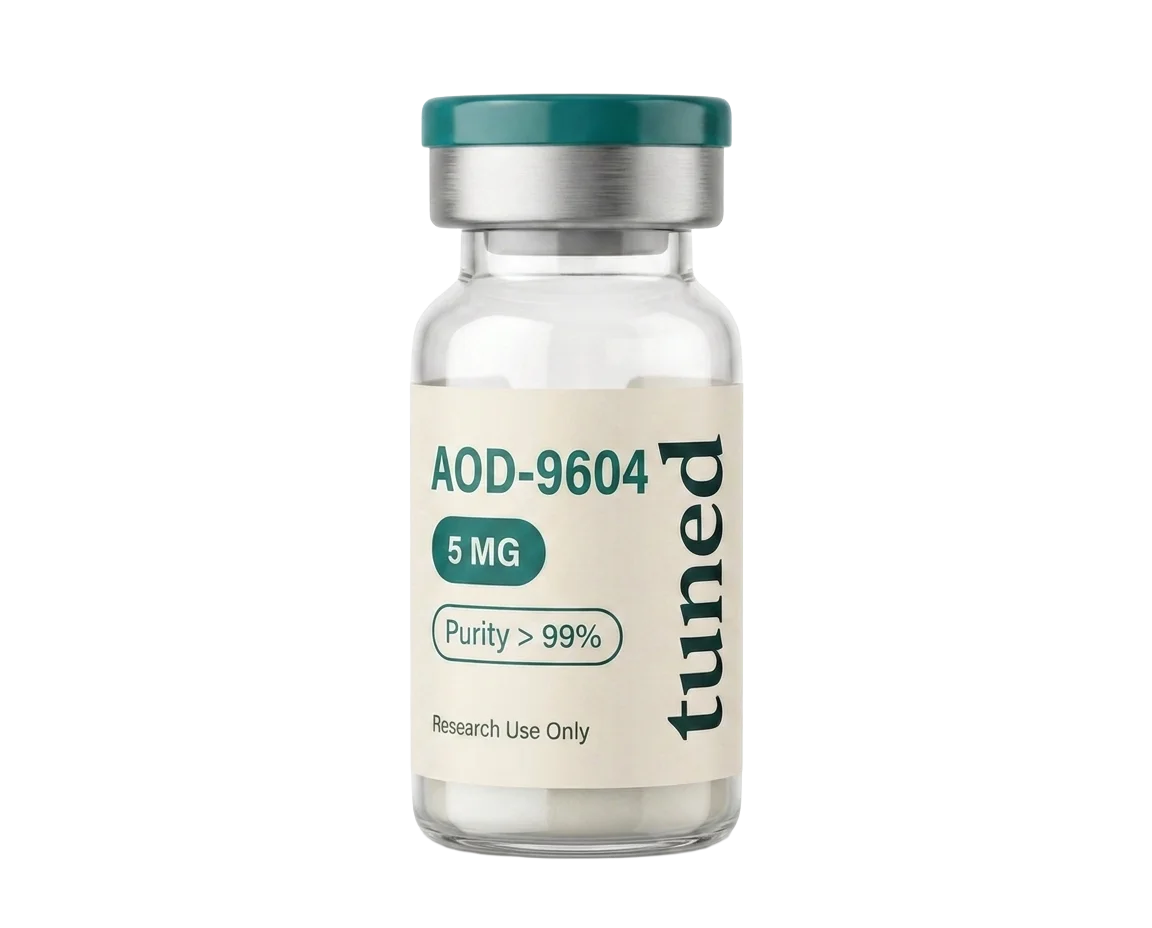
AOD-9604 is a small synthetic peptide based on the C-terminal "lipolytic" fragment of human growth hormone (residues 176-191).[1] Its appeal is selectivity: in animals it stimulated fat breakdown and weight loss without growth hormone's effects on growth or blood sugar.[2][3] The honest catch is the part most pages skip: that striking animal fat-loss result was not reproduced in human obesity development, and AOD-9604 never became an approved weight-loss drug.[4]
What is AOD-9604, exactly?
AOD-9604 is a synthetic peptide engineered from the last part of the growth-hormone molecule — amino acids 176-191, the region linked to GH's fat-metabolising activity — with a small modification (an added tyrosine) for stability.[1]
The idea behind it was elegant: growth hormone has many actions, only some of which involve burning fat. AOD-9604 (also called the hGH fragment 176-191) isolates the lipolytic domain in the hope of getting the fat effect on its own.[1] It was developed by Metabolic Pharmaceuticals as an investigational anti-obesity compound.[4]
Is AOD-9604 a peptide, and what is the hGH fragment 176-191?
What does AOD-9604 do, and how does it work?
In the laboratory, AOD-9604 does two complementary things to fat tissue: it stimulates lipolysis (the breakdown of stored fat) and inhibits lipogenesis (the formation of new fat), increasing fat oxidation.[2][3]
The lipolytic mechanism — fat effect without the GH effects
The distinctive claim, supported by the animal work, is selectivity: AOD-9604 reproduced growth hormone's fat-reducing action without raising IGF-1 or impairing insulin sensitivity the way full GH can, and the effect did not appear to depend on the classic GH receptor in the same way.[3] In obese mice, chronic treatment increased fat oxidation and reduced body weight.[2] That clean, fat-specific profile in animals is the entire basis of AOD-9604's reputation — and the reason the gap to human results matters so much.
AOD-9604 benefits
The AOD-9604 benefits discussed in research all flow from that animal lipolytic profile — but they must be read against the animal-to-human gap, which is the defining feature of this compound:
- Fat breakdown & oxidation — demonstrated in cells and animals.[2][3]
- Weight loss — shown in obese mice with chronic treatment.[2]
- No GH/IGF-1 or blood-sugar penalty — the selectivity claim, from the animal work.[3]
- Later non-obesity interest — AOD-9604 has been explored in connective-tissue/musculoskeletal contexts, separate from the obesity story.
Why the human results matter most
Here is the honesty other pages skip: AOD-9604 was taken into human obesity development, but the dramatic fat-loss seen in animals was not reproduced as an approved human therapy, and the obesity program did not yield a marketed drug.[4] So the benefits are best described as strong in animals, unproven in humans. The popular "fat-loss peptide" framing rests on the animal data and anecdote, not on controlled human efficacy, and AOD-9604 is not an approved treatment for obesity or weight loss.
This animal-to-human gap is worth dwelling on, because it is the single most useful fact about AOD-9604 and the one most often left out. Promising rodent metabolic results frequently fail to scale to humans — differences in dose, metabolism and the complexity of human body-weight regulation all intervene — and AOD-9604 is a textbook example: a clean, selective fat effect in mice that did not translate into an approved human weight-loss therapy.[2][4] Reading the compound honestly means holding both halves at once — the genuine, well-characterised mechanism, and the absence of human efficacy behind the marketing.
AOD-9604 before and after
"AOD-9604 before and after" reports shared online are anecdotal — self-reported changes in body fat, usually alongside diet and training, with unverified material. They are not controlled data and cannot establish that the peptide caused the change.
What documented results actually exist
The documented "before and after" for AOD-9604 is the animal result: increased fat oxidation and reduced body weight in obese mice over chronic treatment.[2] No controlled human trial established a comparable body-composition outcome, which is exactly why human "results" should be read cautiously. The mechanism is real in the lab; the human transformation claims run ahead of the evidence.
AOD-9604 side effects
Because AOD-9604 lacks the broad growth-hormone actions, its theoretical side-effect profile is comparatively narrow — the animal and early human work did not show the IGF-1 elevation or insulin-sensitivity penalty associated with full GH.[3] Reported considerations are mostly the practical ones for any injectable peptide (injection-site reactions) plus the general uncertainty of a compound without long-term human safety data.
What "favourable in animals" does and doesn't mean
A clean profile in animal studies is encouraging but is not the same as established human safety. AOD-9604 has not completed the long-term human safety evaluation an approved medicine carries, and the research-chemical material is not a pharmaceutical product. As with any research peptide, the most controllable real-world risk is material quality — a batch-specific Certificate of Analysis (UPLC purity, identity, endotoxin) does more for safety than any community convention.
AOD-9604 vs and with tesamorelin
A common comparison is "AOD-9604 vs tesamorelin," since both are growth-hormone-related and discussed for fat. They are quite different: tesamorelin is a GHRH analog that raises the whole GH/IGF-1 axis and has randomized-trial evidence for reducing visceral fat in a specific approved indication, whereas AOD-9604 is a GH fragment aiming for a direct lipolytic effect without raising GH/IGF-1, whose human efficacy was not established.[3]
Combining the two
Community "stacking" discussion pairs them on the theory of hitting fat metabolism by two routes, but there is no controlled trial of an AOD-9604/tesamorelin combination, and this page does not provide combination protocols or study protocol. For the trial-backed compound, see the tesamorelin guide. (Searches pairing AOD-9604 with restricted weight-loss compounds are not covered here.)
Common questions
What is AOD-9604?
Does AOD-9604 actually work for fat loss?
How does AOD-9604 work?
What are the side effects of AOD-9604?
AOD-9604 vs tesamorelin — what's the difference?
Related growth-hormone & metabolic guides
References
- Ng FM, Sun J, Sharma L, et al. Metabolic studies of a synthetic lipolytic domain (AOD9604) of human growth hormone. Horm Res, 2000;53(6):274–278. PMID 11146367. (The 176-191 lipolytic-domain peptide; mechanism.)
- Heffernan MA, Thorburn AW, Fam B, et al. Increase of fat oxidation and weight loss in obese mice caused by chronic treatment with human growth hormone fragment AOD9604. Int J Obes Relat Metab Disord, 2001;25(10):1442–1449. PMID 11673763. (Fat oxidation + weight loss, obese mice.)
- Heffernan M, Summers RJ, Ng FM, et al. The effects of human GH and its lipolytic fragment (AOD9604) on lipid metabolism following chronic treatment in obese mice and β3-AR knock-out mice. Endocrinology, 2001;142(12):5182–5189. PMID 11713213. (Lipolytic effect; selectivity vs full GH.)
- Halford JCG. Obesity drugs in clinical development. Curr Opin Investig Drugs, 2006;7(4):312–318. PMID 16625817. (AOD-9604 as an investigational anti-obesity compound.)
AOD-9604 is a synthetic hGH 176-191 lipolytic-domain peptide [1] that increased fat oxidation and reduced weight in obese mice [2] with a fat-specific action that did not raise IGF-1 or impair insulin sensitivity like full GH [3]. It was an investigational anti-obesity compound [4], but the animal fat-loss result was not reproduced as an approved human therapy and AOD-9604 is not an approved weight-loss drug. The research-chemical version is not a pharmaceutical product, and no established human dose is provided here. Community "before and after," research evidence and stacking claims are unverified. Not medical advice.
For research use only. Not for human consumption. This page summarises published research for educational purposes. It is not medical advice and is not intended to diagnose, treat, cure, or prevent any disease.
The compounds researchers reach for
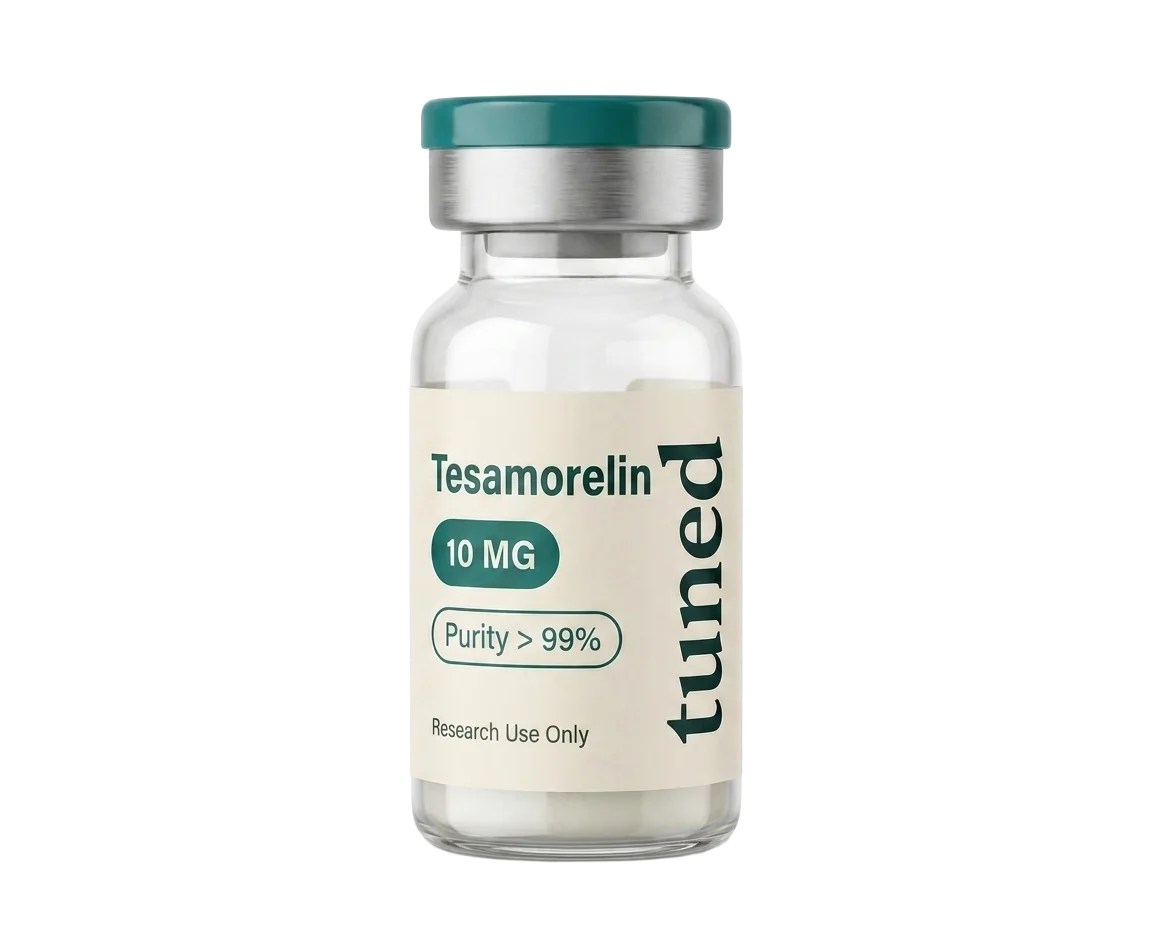
Tesamorelin
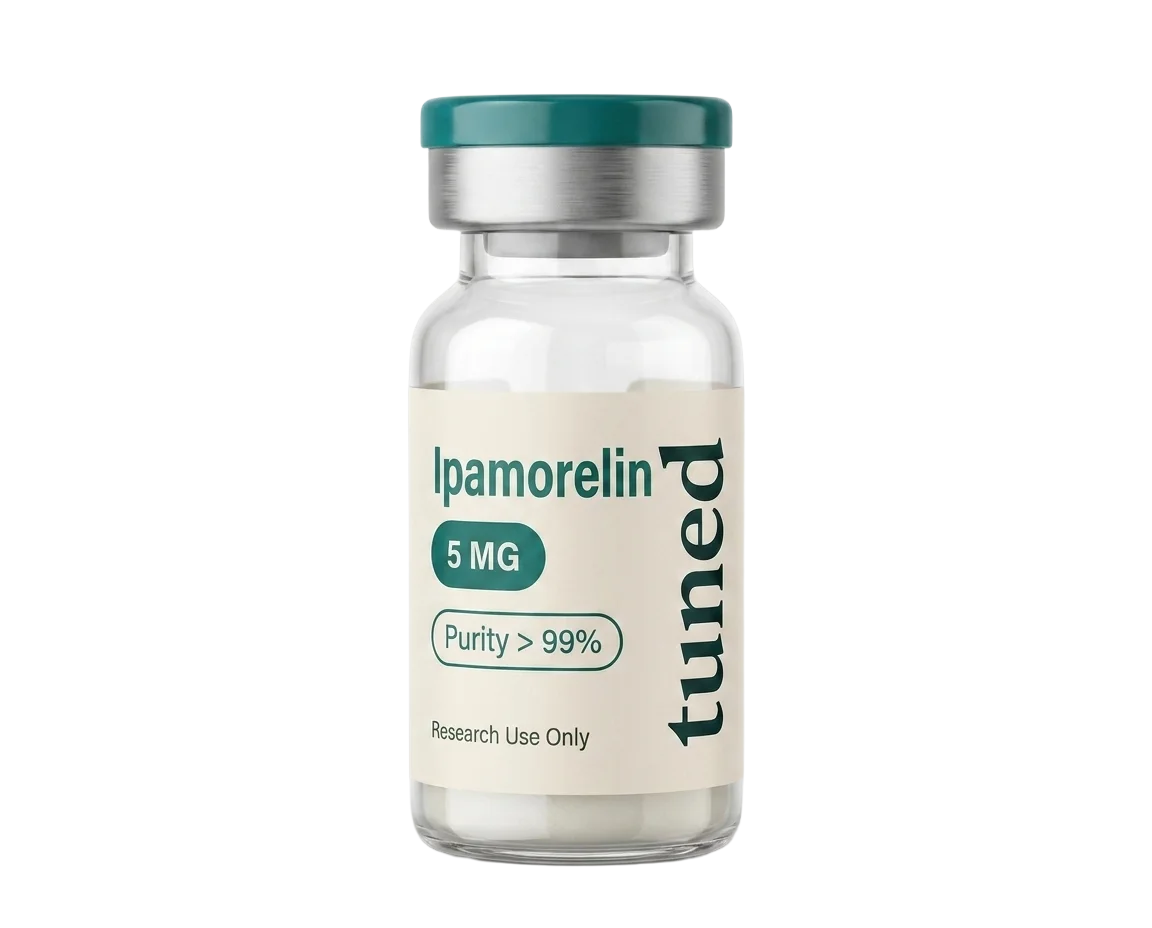
Ipamorelin
BPC-157