What is ipamorelin?
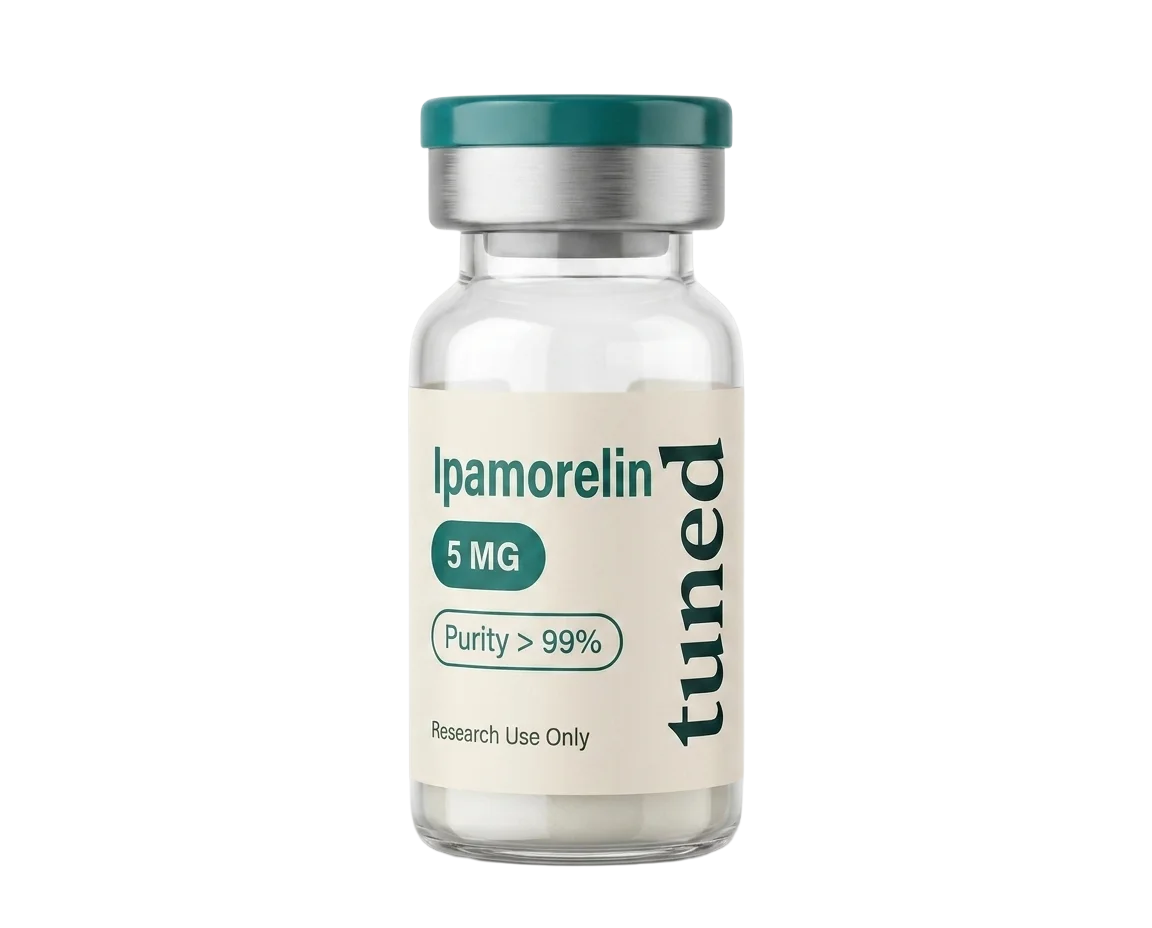
Ipamorelin is a selective growth-hormone (GH) secretagogue — a pentapeptide that switches on the ghrelin/GH-secretagogue receptor (GHSR) to trigger a pulse of the body's own growth hormone.[1] Its defining trait is selectivity: in the original pharmacology it raised GH about as strongly as older peptides like GHRP-6, but without the spike in cortisol, ACTH or prolactin they cause.[1] Most of its evidence is preclinical (cells and animals); controlled human data are limited.
What is ipamorelin, exactly?
Ipamorelin is a small synthetic pentapeptide — a chain of five amino acids (Aib-His-D-2-Nal-D-Phe-Lys-NH₂) — designed to make the pituitary release growth hormone.[1] It belongs to a class called growth-hormone secretagogues (GHS), or growth-hormone-releasing peptides (GHRPs), which mimic the natural hunger hormone ghrelin at its receptor.
It was first described in 1998 by a Novo Nordisk group and introduced as "the first selective growth hormone secretagogue."[1] That word — selective — is the whole story of ipamorelin. Earlier secretagogues released GH but also nudged stress hormones; ipamorelin was engineered to release GH cleanly.
So ipamorelin isn't growth hormone itself, and it isn't a steroid. It's an upstream signal — a research peptide that asks the pituitary to do its own job, producing GH in natural-shaped pulses rather than flooding the system with hormone from outside.
Is ipamorelin a peptide?
Yes — ipamorelin is a peptide. Specifically a pentapeptide: five amino acids joined in a short chain, with a couple of non-natural residues (Aib and D-amino acids) that make it more stable than an ordinary sequence.[1]
What is ipamorelin for men?
Search interest in "ipamorelin for men" reflects its popularity in male body-composition and recovery circles, where the GH–IGF-1 axis is of interest. The honest picture: ipamorelin's GH-releasing action is not sex-specific in the underlying pharmacology, and the controlled human evidence is limited for anyone. Any sex-specific framing online is community lore, not a finding from trials.
What does ipamorelin do?
The consistent theme across ipamorelin research is stimulating a pulse of growth hormone, and through it the downstream insulin-like growth factor 1 (IGF-1). The actions described in the literature are:
- Releases growth hormone via the ghrelin receptor. Ipamorelin activates GHSR on pituitary cells, releasing GH with potency and efficacy comparable to GHRP-6 in the original animal and cell work.[1]
- Does it selectively. Unlike GHRP-6 and GHRP-2, it did not meaningfully raise ACTH or cortisol even far above the GH-effective range — a cleaner hormonal profile.[1]
- Counters muscle and bone loss in catabolic models. In steroid-treated rats it improved nitrogen balance and offset glucocorticoid-driven losses; in adult rats it counteracted steroid-induced declines in bone formation.[3][4]
- Acts as a ghrelin mimetic on the gut. Its ghrelin-receptor activity has also been studied for gastrointestinal motility, e.g. in a rodent post-operative ileus model.[5]
The key caveat — stated plainly — is that the strongest data are in animals and cells. Ipamorelin reliably does something real to GH signalling in those models; whether that produces a given outcome in humans is a separate question that controlled trials have not closely answered.
How does ipamorelin work?
Ipamorelin works at one specific switch: the growth-hormone-secretagogue receptor (GHSR) — the same receptor the hunger hormone ghrelin uses — on the GH-producing cells of the pituitary.
The selective GH-release mechanism
When ipamorelin binds GHSR, it triggers the pituitary's somatotrophs to release stored growth hormone in a pulse, which then drives IGF-1 production mainly in the liver.[1] Because it amplifies the body's own pulsatile rhythm rather than supplying a constant external hormone, the GH it releases follows a more natural shape. Research has mapped this across the GH–IGF-1 axis and the somatostatin receptors that normally brake GH.
Ipamorelin vs GHRP-6: the selectivity difference
This is the point that sets ipamorelin apart from older GHRPs. GHRP-6 and GHRP-2 release GH but also raise appetite and stress hormones (ACTH and cortisol). In the founding study, ipamorelin matched their GH-releasing efficacy while leaving ACTH and cortisol essentially unchanged — the basis for calling it the first selective secretagogue.[1] That cleaner profile is the main reason it remains a reference GHS in research.
tuned Ipamorelin
For laboratory research use only · available to researchers. Specifications, pricing & Certificate of Analysis on the product page.
Ipamorelin benefits
The ipamorelin peptide benefits discussed in research all follow from one upstream action — a cleaner pulse of growth hormone and IGF-1 — and they are best read as research-stage, weighted toward preclinical evidence:
- Lean mass & anti-catabolic signalling. In catabolic (steroid-treated) animal models, ipamorelin improved nitrogen balance and helped preserve tissue — a GH-mediated, anti-wasting effect.[3]
- Bone. It induced longitudinal bone growth in young rats and counteracted glucocorticoid-driven loss of bone formation in adult rats.[2][4]
- Recovery & sleep interest. Because GH is released in pulses tied to deep sleep, ipamorelin is popular in recovery and sleep-quality discussion — though this is mechanism-led extrapolation, not a proven clinical outcome.
- Cleaner side-effect profile than older GHRPs. Its selectivity for GH over cortisol/ACTH is itself often framed as a benefit versus GHRP-6/2.[1]
Ipamorelin for muscle, recovery and sleep
The everyday framing of ipamorelin as a "lean muscle, recovery and sleep" peptide is consistent with GH biology, but it runs ahead of the human evidence. The controlled data sit largely in animals; the popular benefit claims are reasonable hypotheses, not validated results, and ipamorelin is not an approved treatment for any of them.
Ipamorelin before and after
"Ipamorelin before and after" results shared online are anecdotal — self-reported changes in body composition, recovery or sleep, often alongside training, diet changes or other compounds. They are not controlled data, the material and methods are unverified, and individual reports cannot establish cause and effect.
Female ipamorelin before and after
The same applies to "female ipamorelin before and after" reports. Ipamorelin's pharmacology isn't sex-specific in the founding research, and there is no controlled human trial isolating before-and-after outcomes by sex. We present this as community context, clearly separated from the peer-reviewed mechanism above — useful for understanding interest, not for predicting an outcome.
Is ipamorelin safe?
The most honest answer is that safety in humans is not well established. Ipamorelin is a research chemical, not an approved drug; it has not been through the long-term human safety studies a medicine requires. Its theoretical appeal is the selectivity shown in early work — GH release without the cortisol and ACTH rise of older GHRPs — but a clean hormonal signature in animals is not the same as proven human safety.[1]
Ipamorelin side effects
Effects discussed in connection with GH secretagogues include water retention, headache, lightheadedness and changes in appetite or blood-sugar handling, reflecting GH/IGF-1 physiology; injection-site reactions are the practical risk for any injectable peptide. Most of this is mechanism-based or anecdotal rather than from controlled ipamorelin trials. For a fuller treatment, see the dedicated ipamorelin side effects guide.
How to choose ipamorelin
For a research peptide, material quality is the dominant variable — endotoxin and impurities, not the molecule, are the realistic risks. A batch-specific Certificate of Analysis (UPLC purity, identity by mass spec, endotoxin) does more for safety than any community convention; the absence of a recent, lot-matched CoA is itself a risk signal. On sport: GH secretagogues are prohibited in competition by WADA, so athletes should assume ipamorelin is banned and verify with their anti-doping authority.
Common questions
What is ipamorelin?
Is ipamorelin a peptide?
What does ipamorelin do?
How is ipamorelin different from GHRP-6?
Is ipamorelin safe or FDA approved?
Ipamorelin guides & comparisons
This page is the overview. These guides go deeper on the questions researchers ask most:
Related GH-secretagogue guides
References
- Raun K, Hansen BS, Johansen NL, et al. Ipamorelin, the first selective growth hormone secretagogue. Eur J Endocrinol, 1998;139(5):552–561. PMID 9849822. (Founding pharmacology; GH release via GHRP/ghrelin receptor without ACTH/cortisol rise.)
- Johansen PB, Nowak J, Skjærbæk C, et al. Ipamorelin, a new growth-hormone-releasing peptide, induces longitudinal bone growth in rats. Growth Horm IGF Res, 1999;9(2):106–113. PMID 10373343. (Bone growth, rats.)
- Aagaard NK, Grøfte T, Greisen J, et al. Growth hormone and growth hormone secretagogue effects on nitrogen balance and urea synthesis in steroid treated rats. Growth Horm IGF Res, 2009;19(5):426–431. PMID 19231263. (Anti-catabolic nitrogen balance.)
- Andersen NB, Malmlöf K, Johansen PB, et al. The growth hormone secretagogue ipamorelin counteracts glucocorticoid-induced decrease in bone formation of adult rats. Growth Horm IGF Res, 2001;11(5):266–272. PMID 11735244. (Bone formation under glucocorticoid.)
- Venkova K, Mann W, Nelson R, et al. Efficacy of ipamorelin, a novel ghrelin mimetic, in a rodent model of postoperative ileus. J Pharmacol Exp Ther, 2009;329(3):1110–1116. PMID 19289567. (Ghrelin-mimetic GI motility.)
Ipamorelin is a selective GH secretagogue (pentapeptide) that activates GHSR to release growth hormone with a potency similar to GHRP-6 but without raising ACTH/cortisol [1]; preclinical work shows bone growth [2], anti-catabolic nitrogen balance [3], bone formation under glucocorticoid [4] and ghrelin-mimetic gut motility [5]. Controlled human efficacy and long-term safety data are limited; it is not FDA approved. Community "before and after" and community claims are unverified. GH secretagogues are prohibited in sport by WADA. Not medical advice.
For research use only. Not for human consumption. This page summarises published research for educational purposes. It is not medical advice and is not intended to diagnose, treat, cure, or prevent any disease.