Ipamorelin vs sermorelin
Ipamorelin and sermorelin both raise growth hormone, but through different receptors. Sermorelin is a GHRH analog — a fragment of growth-hormone-releasing hormone that tells the pituitary to make GH,[2] and it once held FDA approval (as Geref). Ipamorelin is a selective GH secretagogue that acts on the ghrelin receptor to fire a clean GH pulse without raising cortisol.[1] Different door, similar destination — and they're often discussed as a pair, not rivals.
Ipamorelin vs sermorelin
The simplest way to hold ipamorelin vs sermorelin in your head: they pull the same lever — pituitary growth-hormone release — from two different handles.[1][2]
Sermorelin is GHRH(1-29), the active fragment of the body's own growth-hormone-releasing hormone. It binds the GHRH receptor on the pituitary and asks it to release GH — the same physiological pathway the hypothalamus uses.[2] It is well-characterised enough to have been an approved diagnostic and pediatric growth-hormone-deficiency treatment.[2]
Ipamorelin is a ghrelin/GH-secretagogue-receptor agonist — a synthetic pentapeptide that mimics ghrelin at the GHSR, triggering a GH pulse on a separate receptor system,[1] and doing so selectively, without the cortisol/ACTH rise of older GHRPs.
Sermorelin vs ipamorelin: receptor and rhythm
Because they hit different receptors, the two have slightly different "feel" in theory. A GHRH analog like sermorelin supports the natural pulsatile pattern set by the hypothalamus; a secretagogue like ipamorelin adds an independent pulse through the ghrelin pathway. Neither is straightforwardly "stronger" — they're complementary, which is exactly why they (and the closely related CJC-1295) are so often combined rather than chosen against each other.
Both are also short-acting peptides in practical terms: each produces a relatively brief stimulus rather than a sustained, days-long elevation, which is part of why they appeal to researchers interested in mimicking natural GH pulses rather than flooding the system. That short action is one reason the longer-acting GHRH analogs (tesamorelin, or CJC-1295 with DAC) are sometimes preferred when a steadier baseline is the goal — a trade-off of physiological rhythm against duration.
How ipamorelin and sermorelin differ
The practical differences come down to drug class, receptor, track record and legal status. This table summarises the research-relevant contrasts:
| Ipamorelin | Sermorelin | |
|---|---|---|
| Class | GH secretagogue (GHRP) | GHRH analog |
| Receptor | Ghrelin / GHSR | GHRH receptor |
| Structure | Pentapeptide (5 aa) | GHRH(1-29) fragment (29 aa) |
| Signature | Selective GH; no cortisol/ACTH rise[1] | Mimics natural GHRH pulse[2] |
| Regulatory history | Never approved; research chemical | Formerly FDA-approved (Geref); US-withdrawn 2008, now compounded[2] |
Which has more evidence?
On formal track record, sermorelin leads: it was studied and approved for diagnosing and treating growth-hormone deficiency, so it has a genuine clinical history.[2] Ipamorelin's edge is pharmacological elegance — its selectivity — demonstrated in strong preclinical and early human work but without the same clinical pedigree.[1] Neither, as sold to researchers today, is an approved product, and the research-chemical versions are not the pharmaceutical-grade materials those histories were built on.
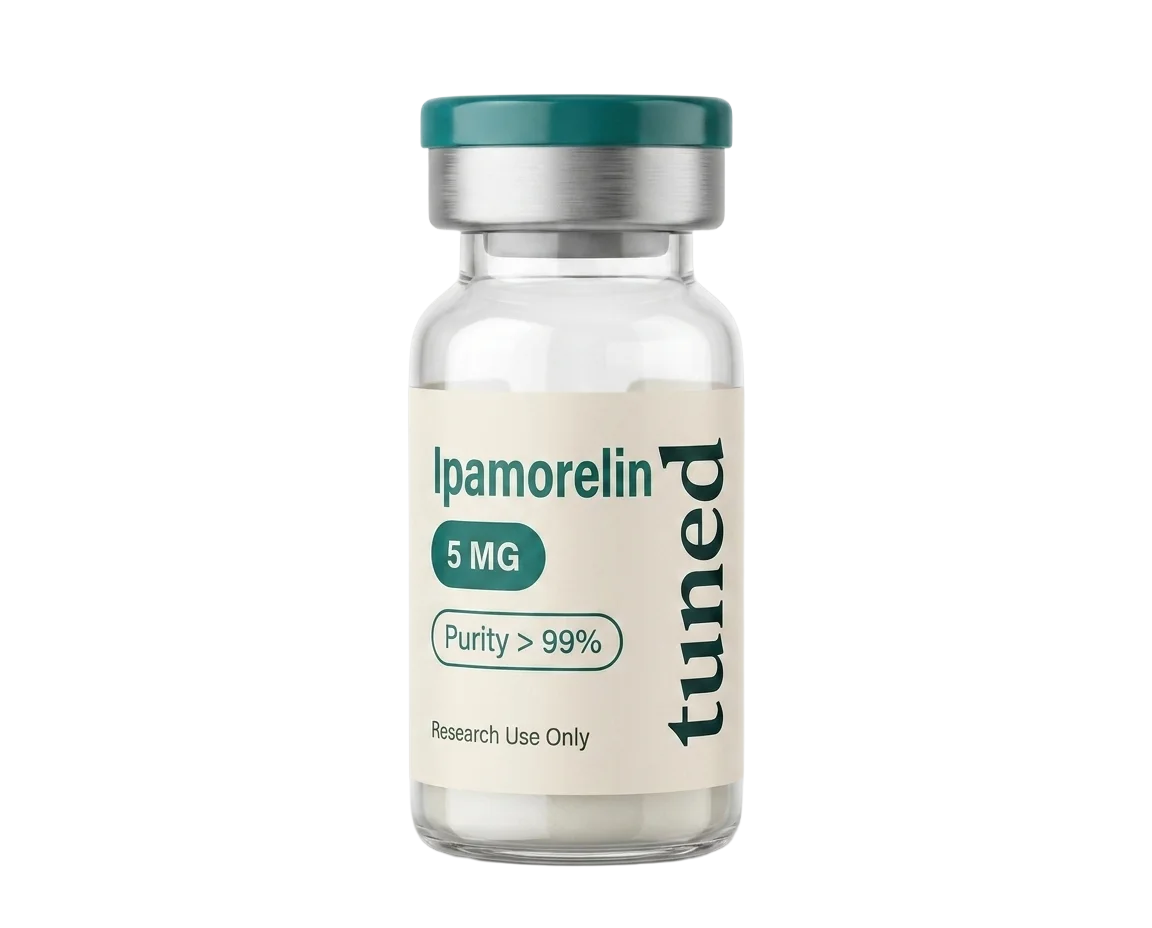
tuned Ipamorelin
For laboratory research use only · available to researchers. Specifications, pricing & Certificate of Analysis on the product page.
Sermorelin and ipamorelin together
Because they work on different receptors, sermorelin and ipamorelin are frequently discussed as a blend rather than as competitors — the same logic behind the CJC-1295 + ipamorelin pairing. A GHRH analog supplies the "release GH" instruction while the secretagogue adds an independent ghrelin-pathway pulse, and in pituitary physiology those two signals can reinforce each other.
What is sermorelin ipamorelin blend peptide for men?
"Sermorelin ipamorelin blend peptide for men" is a popular search because the pairing is marketed toward male body-composition and recovery goals. The honest framing: the mechanism for combining a GHRH analog with a secretagogue is sound, but there is no controlled human trial of a sermorelin/ipamorelin blend establishing a specific benefit, dose or sex-specific effect. It is a community and clinic protocol, not a validated drug regimen, and the pharmacology is not sex-specific. For the same reasoning applied to the more common pairing, see the CJC-1295 + ipamorelin guide.
Common questions
What's the difference between ipamorelin and sermorelin?
Is ipamorelin or sermorelin better?
Can you take sermorelin and ipamorelin together?
What is the sermorelin ipamorelin blend for men?
Which has more side effects, ipamorelin or sermorelin?
References
- Raun K, Hansen BS, Johansen NL, et al. Ipamorelin, the first selective growth hormone secretagogue. Eur J Endocrinol, 1998;139(5):552–561. PMID 9849822. (Ghrelin/GHSR agonist; selective GH release.)
- Prakash A, Goa KL. Sermorelin: a review of its use in the diagnosis and treatment of children with idiopathic growth hormone deficiency. BioDrugs, 1999;12(2):139–157. PMID 18031173. (GHRH analog; approved diagnostic/treatment history.)
- Grossman A, Savage MO, Besser GM. Growth hormone releasing hormone. Clin Endocrinol Metab, 1986;15(3):607–627. PMID 2429796. (GHRH physiology.)
- Garin MC, Burns CM, Kaul S, et al. Clinical review: The human experience with ghrelin administration. J Clin Endocrinol Metab, 2013;98(5):1826–1837. PMID 23533240. (Ghrelin-class human tolerability.)
Ipamorelin is a ghrelin/GHSR-acting selective GH secretagogue [1]; sermorelin is a GHRH(1-29) analog with an approved diagnostic/treatment history (Geref, US-withdrawn 2008) [2][3]. They act on different receptors and are often combined rather than ranked; no controlled human trial validates a sermorelin/ipamorelin blend. As sold to researchers, neither is an approved product. GH secretagogues are prohibited in sport by WADA. Community blend and "for men" framings are unverified. Not medical advice.
For research use only. Not for human consumption. This page summarises published research for educational purposes. It is not medical advice and is not intended to diagnose, treat, cure, or prevent any disease.