CJC-1295 + ipamorelin
CJC-1295 and ipamorelin are paired because they push growth hormone through two different doors at once: CJC-1295 is a long-acting GHRH analog that raises the baseline GH/IGF-1 signal,[1] while ipamorelin is a selective GH secretagogue that triggers a clean ghrelin-receptor pulse without spiking cortisol.[3] Each is studied individually; the combination itself has no dedicated controlled trial — its popularity is a mechanistic and community rationale, not a proven protocol.
CJC-1295 and ipamorelin
CJC-1295 and ipamorelin are two different kinds of growth-hormone peptide that researchers combine because their mechanisms are complementary rather than redundant.[1][3]
CJC-1295 is an analog of growth-hormone-releasing hormone (GHRH). In healthy adults it produced a prolonged rise in GH and IGF-1, because the long-acting version binds serum albumin and keeps the GHRH signal switched on for days.[1] Ipamorelin works on a separate receptor — the ghrelin / GH-secretagogue receptor (GHSR) — to trigger a discrete GH pulse, and it does so selectively, without the cortisol and ACTH rise of older secretagogues.[3]
Why CJC-1295 and ipamorelin are combined
The rationale is additive signalling: GHRH analogs and GH secretagogues act on different receptors and, in pituitary physiology, can amplify each other's GH release. The idea is that CJC-1295 raises the overall GH/IGF-1 set-point while ipamorelin adds a clean, pulsatile spike on top — a bigger, more natural-shaped GH release than either alone. Importantly, that synergy is well-described for the GHRH-plus-secretagogue concept in pituitary research, but the specific CJC-1295 + ipamorelin blend sold to labs has not been validated in a controlled human trial. Neither compound is an approved medicine, and the research-chemical versions are not pharmaceutical-grade products.
CJC-1295 ipamorelin benefits
The CJC-1295 ipamorelin benefits discussed in research and community settings all flow from a larger, sustained GH/IGF-1 signal — and should be read as research-stage, weighted toward mechanism and anecdote rather than blend-specific trials:
| Reported benefit | Mechanistic basis | Evidence |
|---|---|---|
| Lean mass / recovery | Higher GH/IGF-1 supports protein turnover and repair | Mechanism[1] |
| Sleep quality | GH is released in deep sleep; secretagogues tie into that rhythm | Mechanism / anecdotal |
| Body composition / fat | GH has lipolytic effects | GH-class |
| Skin / connective tissue | IGF-1 supports collagen-producing cells | Mechanism |
What researchers actually report
The most defensible statement is narrow: CJC-1295 reliably raises GH and IGF-1 in people,[1] and ipamorelin reliably triggers a clean GH pulse in the founding pharmacology.[3] Whether stacking them produces the body-composition and recovery outcomes people want is not established by controlled trials of the blend. The popular benefit list is a reasonable extrapolation from GH biology, not a set of proven results, and neither compound is an approved treatment.
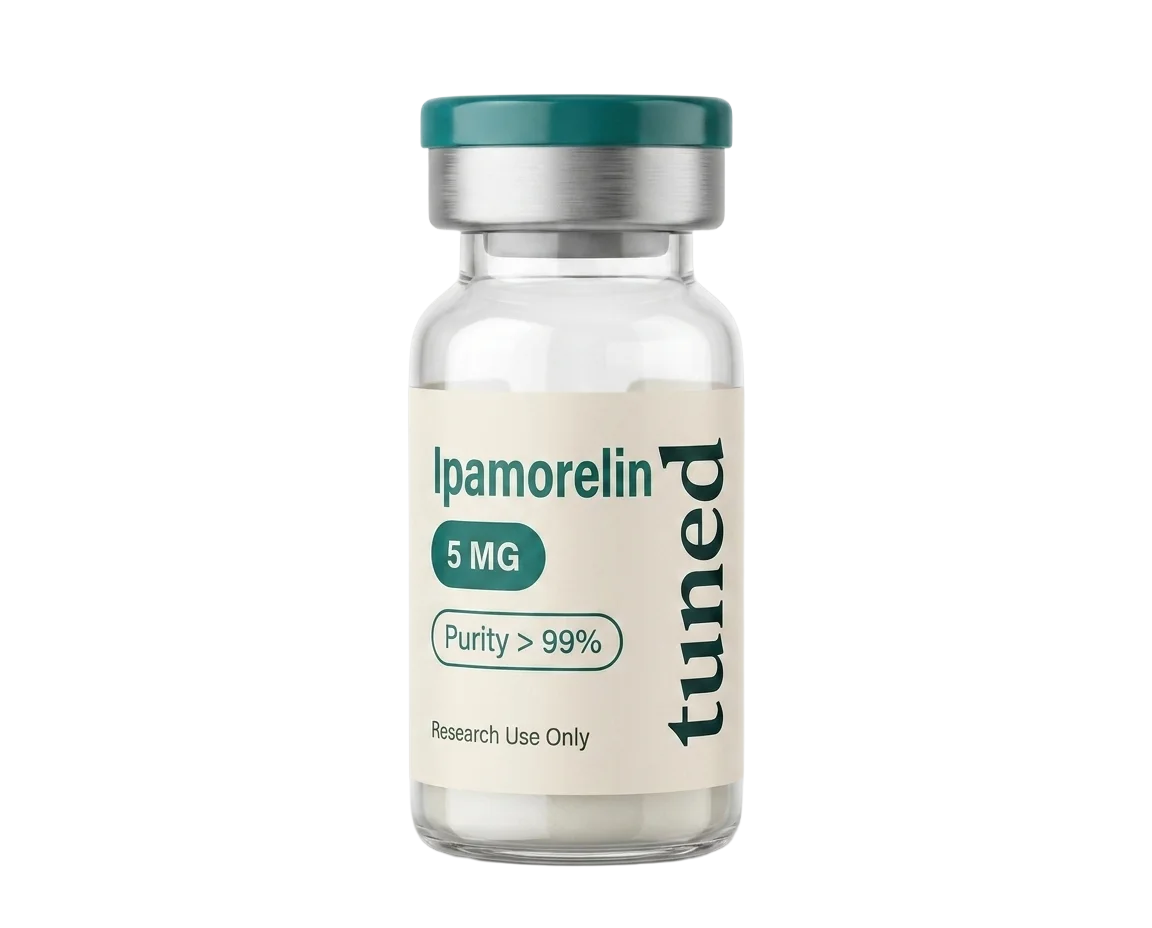
tuned Ipamorelin
For laboratory research use only · available to researchers. Specifications, pricing & Certificate of Analysis on the product page.
CJC-1295 ipamorelin side effects
Because the combination raises GH and IGF-1 more than either compound alone, the plausible CJC-1295 ipamorelin side effects are the GH-class ones — amplified by the stack rather than new in kind: water retention and mild swelling, headache or light-headedness, tingling or numbness in the hands (a GH-related effect), and transient shifts in blood-sugar handling.[5] Injection-site reactions apply to any subcutaneous peptide.
How the two compounds' side effects differ
Ipamorelin's contribution is comparatively clean — its selectivity means it adds GH without the cortisol/ACTH and intense hunger of GHRP-6.[3] CJC-1295's contribution is duration: because the long-acting form keeps GH/IGF-1 elevated for days,[1] any GH-related effect (fluid retention, insulin-sensitivity changes) has a longer window to appear. The honest caveat is that none of this comes from a controlled safety study of the blend; it is inferred from each compound's pharmacology and the broader human GH/ghrelin literature.[5]
CJC-1295 ipamorelin before and after
"CJC-1295 ipamorelin before and after" reports online are anecdotal — self-reported changes in recovery, sleep, body composition or skin, usually alongside training and diet. They are not controlled data, the materials are unverified, and they can't establish cause and effect. What research can say is narrower: the underlying GH/IGF-1 signal rises measurably with CJC-1295,[1] which is the biological basis people are extrapolating from.
CJC-1295 ipamorelin results timeline — how long to see results
There is no validated timeline for the blend. In the human CJC-1295 work, IGF-1 rose over days and stayed elevated, reflecting the long-acting GHRH signal,[1] while ipamorelin's GH pulse is rapid and short-lived.[3] Community "results timelines" that promise specific changes by specific weeks are not evidence-based; biological markers and lived outcomes are different things, and the latter have not been measured for this combination in a trial.
CJC-1295 no DAC with ipamorelin
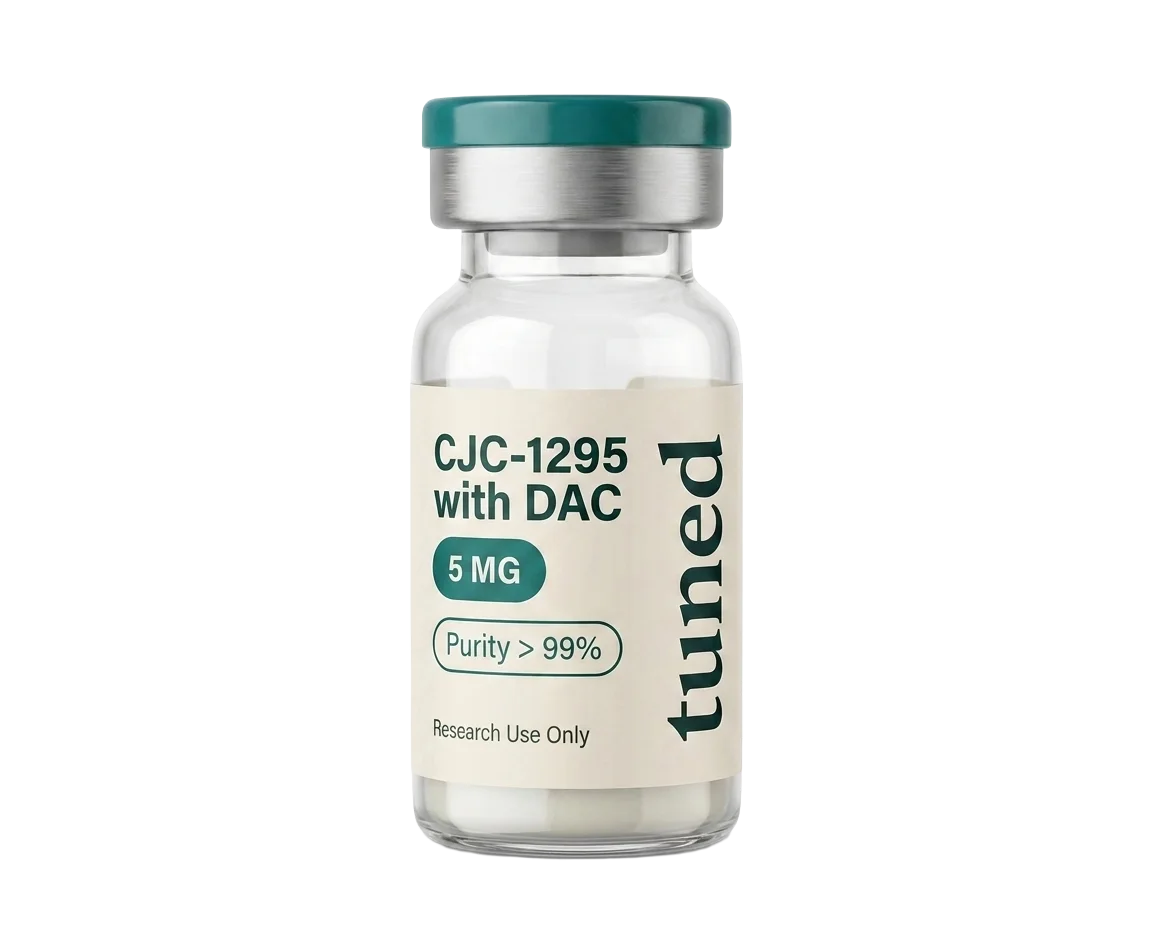
A frequent question is the difference between CJC-1295 with DAC and no DAC when paired with ipamorelin. DAC stands for Drug Affinity Complex — a chemical group that lets CJC-1295 bind serum albumin, extending its action to days; that's the version studied in the prolonged GH/IGF-1 human work.[1]
DAC vs no-DAC, and what it changes
"No-DAC" CJC-1295 (often called modified GRF 1-29) lacks that albumin-binding group, so it is short-acting — a brief GHRH pulse rather than a sustained elevation. In the community rationale, the no-DAC form is paired with ipamorelin to keep both signals pulsatile and closer to natural GH rhythm, while the DAC form is chosen for a steadier baseline. Both are GHRH-analog strategies; the meaningful distinction is duration of action, and again, the comparative effect of each pairing has not been settled in controlled human trials.
Common questions
Why are CJC-1295 and ipamorelin used together?
What are the benefits of the CJC-1295 ipamorelin combo?
What's the difference between CJC-1295 with DAC and no DAC?
What are the side effects of CJC-1295 and ipamorelin?
How does CJC-1295/ipamorelin compare to MK-677?
References
- Teichman SL, Neale A, Lawrence B, et al. Prolonged stimulation of growth hormone (GH) and insulin-like growth factor I secretion by CJC-1295, a long-acting analog of GH-releasing hormone, in healthy adults. J Clin Endocrinol Metab, 2006;91(3):799–805. PMID 16352683. (Human GH/IGF-1 rise; albumin-binding long action.)
- Ionescu M, Frohman LA. Pulsatile secretion of growth hormone (GH) persists during continuous stimulation by CJC-1295, a long-acting GH-releasing hormone analog. J Clin Endocrinol Metab, 2006;91(12):4792–4797. PMID 17018654. (GH pulsatility preserved.)
- Raun K, Hansen BS, Johansen NL, et al. Ipamorelin, the first selective growth hormone secretagogue. Eur J Endocrinol, 1998;139(5):552–561. PMID 9849822. (Selective GH pulse without cortisol/ACTH.)
- Sackmann-Sala L, Ding J, Frohman LA, et al. Activation of the GH/IGF-1 axis by CJC-1295, a long-acting GHRH analog, results in serum protein profile changes in normal adult subjects. Growth Horm IGF Res, 2009;19(6):471–477. PMID 19386527.
- Garin MC, Burns CM, Kaul S, et al. Clinical review: The human experience with ghrelin administration. J Clin Endocrinol Metab, 2013;98(5):1826–1837. PMID 23533240. (Ghrelin-class human tolerability.)
CJC-1295 is a long-acting GHRH analog that raises GH/IGF-1 for days in healthy adults [1] while preserving GH pulsatility [2]; ipamorelin is a selective GH secretagogue [3]. The two are combined on a mechanistic, complementary-pathway rationale, but the specific blend has no dedicated controlled human trial — benefits, results timelines and side effects are extrapolated from each compound's pharmacology [1][3][4] and the broader human ghrelin literature [5]. Neither CJC-1295 nor ipamorelin is an FDA-approved medicine, and the research-chemical materials sold to laboratories are not pharmaceutical-grade products; GH secretagogues are prohibited in sport by WADA. Community study protocol and "before and after" claims are unverified. Not medical advice.
For research use only. Not for human consumption. This page summarises published research for educational purposes. It is not medical advice and is not intended to diagnose, treat, cure, or prevent any disease.