Tesamorelin vs ipamorelin
Tesamorelin and ipamorelin both raise growth hormone, but they sit at opposite ends of the evidence spectrum. Tesamorelin is a stabilized GHRH analog — FDA-approved (as Egrifta) with real randomized-trial data for reducing visceral fat.[2][3] Ipamorelin is a selective GH secretagogue acting on the ghrelin receptor, prized for a clean GH pulse but without that clinical track record.[1] Different receptors, very different proof.
Tesamorelin vs ipamorelin
Tesamorelin vs ipamorelin is really a contrast between a proven drug and a promising research peptide — two ways to raise GH, with very different amounts of human evidence behind them.[1][2]
Tesamorelin is a stabilized analog of GHRH — growth-hormone-releasing hormone — engineered to resist breakdown. It binds the GHRH receptor on the pituitary to raise GH and IGF-1, and it carries genuine clinical weight: it is FDA-approved as Egrifta for reducing excess visceral abdominal fat in people with HIV-associated lipodystrophy, on the strength of randomized controlled trials.[2][3]
Ipamorelin works on the other side of the GH switch — the ghrelin / GH-secretagogue receptor — releasing a clean GH pulse without the cortisol or ACTH rise of older GHRPs.[1] Its appeal is selectivity and tolerability, but it has no approval and no comparable trial record.
Ipamorelin vs tesamorelin: receptor and proof
So the receptor difference (GHRH receptor vs ghrelin receptor) matters less, day to day, than the evidence difference. Tesamorelin has been through the rigorous trials a medicine requires for a defined population; ipamorelin's case rests on elegant pharmacology and limited human data. When people ask which is "better," they're usually really asking which is better-proven — and on that axis, tesamorelin clearly leads.
It helps to be concrete about that gap. Tesamorelin has been studied across a substantial body of randomized and long-term clinical work in its approved population,[2][3] whereas the published human record for ipamorelin is largely short pharmacokinetic and mechanistic work.[1] That is not a knock on ipamorelin's design — it is simply a difference in how far each has been carried through formal testing, and it is the single most useful thing to keep in mind when weighing the two.
How tesamorelin and ipamorelin differ
The contrasts that matter for research are class, receptor, evidence and regulatory status:
| Tesamorelin | Ipamorelin | |
|---|---|---|
| Class | GHRH analog (stabilized) | GH secretagogue (GHRP) |
| Receptor | GHRH receptor | Ghrelin / GHSR |
| Best evidence | RCTs; visceral-fat reduction in HIV lipodystrophy[3][4] | Preclinical + limited human PK[1] |
| Regulatory status | FDA-approved (Egrifta) for a specific indication[2] | Not approved; research chemical |
| Signature | Trial-backed visceral-fat effect | Selective GH; no cortisol rise[1] |
Which has more evidence?
Tesamorelin, clearly. A randomized placebo-controlled trial showed it reduced visceral abdominal fat in HIV-associated lipodystrophy with a safety extension,[3] and reductions in visceral adiposity tracked with an improved metabolic profile.[4] That is a real, approved, trial-backed effect — for a specific medical population. The important honesty: that evidence does not automatically transfer to general "fat loss" or anti-aging use, and the research-chemical "tesamorelin" sold to labs is not the approved Egrifta product. Ipamorelin, by contrast, has strong mechanism but thin human outcome data.
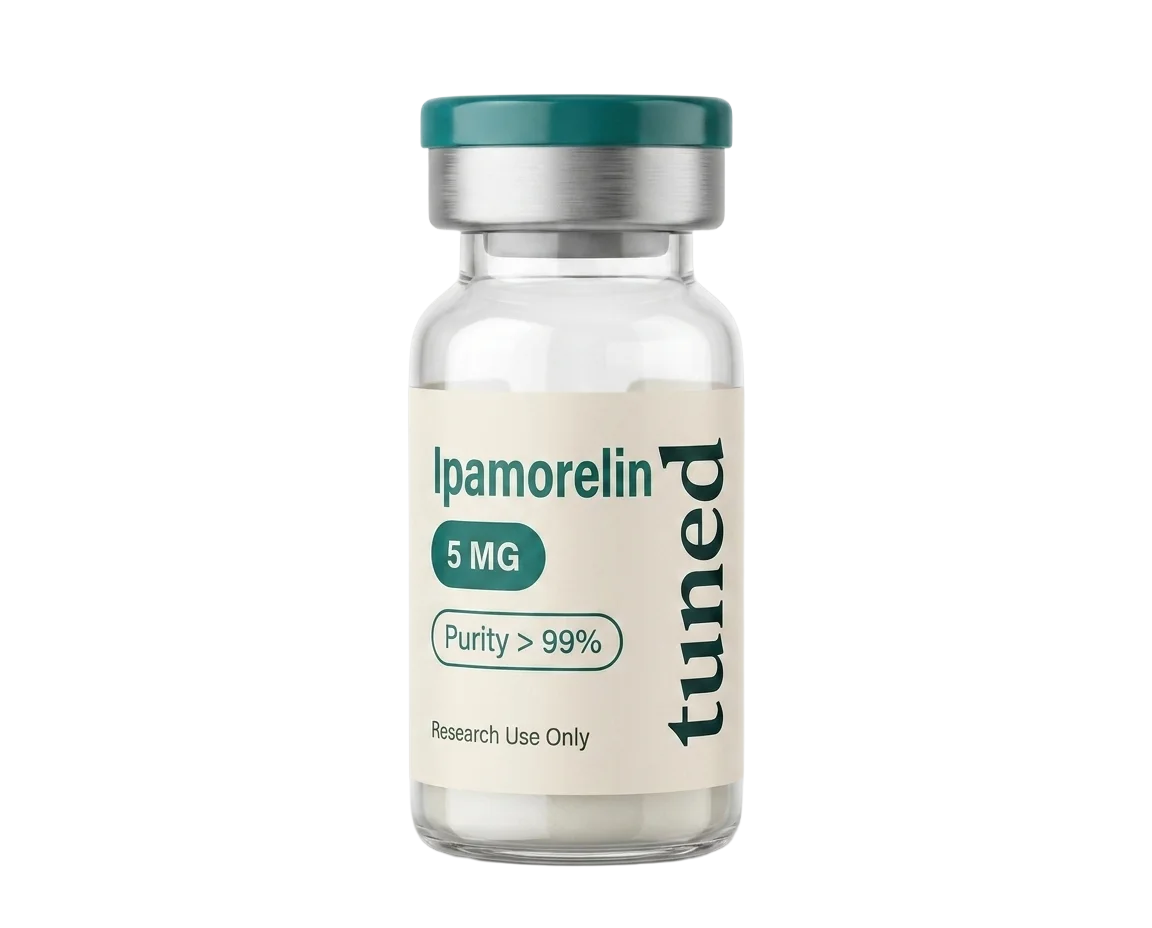
tuned Ipamorelin
For laboratory research use only · available to researchers. Specifications, pricing & Certificate of Analysis on the product page.
Tesamorelin and ipamorelin blend
Like the other GH peptides, tesamorelin and ipamorelin are sometimes discussed as a stack rather than alternatives — a GHRH analog to raise the GH/IGF-1 set-point plus a secretagogue to add a ghrelin-pathway pulse. The mechanistic logic is the same one behind CJC-1295 + ipamorelin, and it's the rationale people cite for "tesamorelin ipamorelin blend" protocols.
Tesamorelin, sermorelin and ipamorelin — the three-way question
Searches like "tesamorelin vs sermorelin vs ipamorelin" are really asking how the family sorts out. The clean way to hold it: tesamorelin and sermorelin are both GHRH analogs (tesamorelin the more stable, trial-backed one; sermorelin the shorter-acting, historically approved one), while ipamorelin is the secretagogue on a different receptor. That's why a GHRH analog is so often paired with ipamorelin rather than against it. The honest limit applies throughout: no controlled human trial validates these blends, and we don't provide protocols or study protocol for any of them. For the most common pairing, see the CJC-1295 + ipamorelin guide.
Common questions
What's the difference between tesamorelin and ipamorelin?
Is tesamorelin or ipamorelin better?
Can you stack tesamorelin and ipamorelin?
Does tesamorelin's fat-loss evidence apply to everyone?
How do tesamorelin, sermorelin and ipamorelin compare?
References
- Raun K, Hansen BS, Johansen NL, et al. Ipamorelin, the first selective growth hormone secretagogue. Eur J Endocrinol, 1998;139(5):552–561. PMID 9849822. (Ghrelin/GHSR agonist; selective GH release.)
- Dhillon S. Tesamorelin: a review of its use in the management of HIV-associated lipodystrophy. Drugs, 2011;71(8):1071–1091. PMID 21668043. (Stabilized GHRH analog; FDA-approved Egrifta.)
- Falutz J, Potvin D, Mamputu JC, et al. Effects of tesamorelin, a growth hormone-releasing factor, in HIV-infected patients with abdominal fat accumulation: a randomized placebo-controlled trial with a safety extension. J Acquir Immune Defic Syndr, 2010;53(3):311–322. PMID 20101189.
- Stanley TL, Falutz J, Marsolais C, et al. Reduction in visceral adiposity is associated with an improved metabolic profile in HIV-infected patients receiving tesamorelin. Clin Infect Dis, 2012;54(11):1642–1651. PMID 22495074.
- Garin MC, Burns CM, Kaul S, et al. Clinical review: The human experience with ghrelin administration. J Clin Endocrinol Metab, 2013;98(5):1826–1837. PMID 23533240. (Ghrelin-class human tolerability.)
Tesamorelin is a stabilized GHRH analog, FDA-approved (Egrifta) with RCT evidence for reducing visceral fat in HIV-associated lipodystrophy [2][3][4]; ipamorelin is a selective ghrelin/GHSR secretagogue with strong mechanism but limited human outcome data [1]. Tesamorelin's trial evidence is indication-specific and does not transfer to general use; the research-chemical versions are not the approved products. No controlled trial validates a tesamorelin/ipamorelin blend. GH secretagogues are prohibited in sport by WADA. Not medical advice.
For research use only. Not for human consumption. This page summarises published research for educational purposes. It is not medical advice and is not intended to diagnose, treat, cure, or prevent any disease.