What is tesamorelin?
Tesamorelin is a stabilized analog of growth-hormone-releasing hormone (GHRH) that prompts the pituitary to release its own growth hormone, raising IGF-1.[1] It stands out as the best-evidenced peptide in the GH family: as the prescription drug Egrifta it is FDA-approved, on the strength of randomized controlled trials, to reduce excess visceral abdominal fat in HIV-associated lipodystrophy.[1][2] That evidence is specific to that condition — and the research-chemical "tesamorelin" is not the approved drug.
What is tesamorelin, exactly?
Tesamorelin is a synthetic, stabilized version of human GHRH — a growth-hormone-releasing factor analog engineered to resist breakdown so it can sustain a GHRH signal to the pituitary.[1][6]
Mechanistically it sits in the same class as sermorelin and CJC-1295 (all GHRH analogs), but it is the one that was carried furthest through formal drug development. Under the brand name Egrifta (tesamorelin acetate), it gained FDA approval in 2010 for a defined medical use, which gives it a clinical-trial record the other research peptides here don't have.[1]
Is tesamorelin FDA approved?
Yes — with an important boundary. Tesamorelin (Egrifta) is FDA-approved specifically to reduce excess visceral abdominal fat in people with HIV-associated lipodystrophy, and that approval rests on randomized controlled trials.[1][2] It is not approved for general weight loss, bodybuilding or anti-aging. And the approved status applies to the pharmaceutical product Egrifta — the research-chemical "tesamorelin" sold to laboratories is not that product and is not manufactured or tested to drug standards.
What does tesamorelin do, and how does it work?
Tesamorelin does what a GHRH analog does: it binds the GHRH receptor on the pituitary and stimulates release of the body's own growth hormone in a natural-shaped pulse, which raises IGF-1.[1] What makes it distinctive is the downstream effect that the trials measured.
The GHRH-analog and visceral-fat mechanism
In the clinical program, restoring GH signalling with tesamorelin selectively reduced visceral adipose tissue — the metabolically active fat around the organs — in patients who had accumulated it.[2] That visceral-fat reduction tracked with an improved metabolic profile (such as lipid measures) in the studied population.[3] The mechanism is the GH axis acting on fat metabolism; the reason tesamorelin's fat effect is taken seriously where other GH peptides' aren't is simply that it was demonstrated in randomized controlled trials, not inferred.
Tesamorelin benefits
Tesamorelin's benefits are unusually well-defined for a peptide in this catalogue, because they were measured rather than extrapolated — but they are also tightly scoped to the studied indication:
- Visceral fat reduction — the central, trial-backed effect, in HIV-associated lipodystrophy.[2]
- Improved metabolic markers — accompanying the visceral-fat reduction in that population.[3]
- GH/IGF-1 restoration — the upstream action common to GHRH analogs.[1]
- Liver-fat signal — meta-analysis of randomized trials has examined body-composition and hepatic-fat outcomes.[5]
Tesamorelin for weight loss
This is where care matters most. Tesamorelin's evidence is for reducing visceral abdominal fat in a specific patient group — it is not a general weight-loss drug, and the trials did not test it as one.[2] The visceral-fat finding does not automatically transfer to general fat loss, body recomposition or anti-aging in healthy people, and tesamorelin is not approved for any of those. Treating "tesamorelin for weight loss" as a proven outcome over-reads what the research shows.
Tesamorelin before and after, and results
The documented "before and after" for tesamorelin is the measured change from its trials: a reduction in visceral adipose tissue over months of the studied regimen, alongside IGF-1 increases.[2] Because the studies imaged abdominal fat directly, this is one of the few peptides where "results" rest on objective measurement rather than self-report.
How long tesamorelin results took in trials
In the controlled studies, the visceral-fat reduction accumulated over a period of months rather than days, consistent with how slowly the GH/IGF-1 axis remodels tissue, and continued in the safety-extension phase.[4] Self-reported "tesamorelin before and after" stories outside that indication are anecdotal and uncontrolled — they describe individuals, often changing diet and training too, not a measured trial outcome. The trustworthy results are the imaged ones in the studied population.
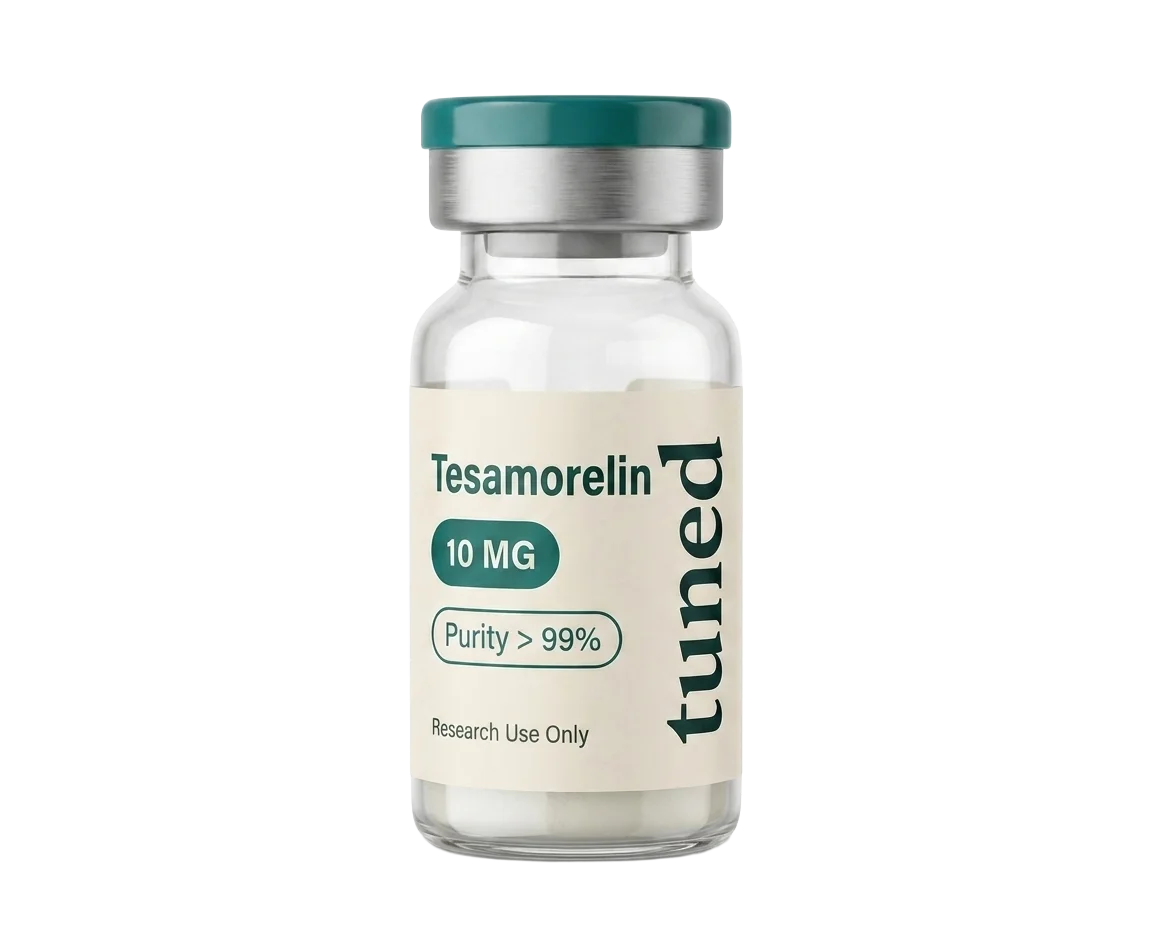
tuned Tesamorelin
For laboratory research use only · available to researchers. Specifications, pricing & Certificate of Analysis on the product page.
Is tesamorelin safe?
Tesamorelin has one of the more complete safety datasets among GH peptides, because the approval program included controlled safety evaluation and a long-term extension.[4] In that program the reported effects were largely consistent with the GH/IGF-1 axis — injection-site reactions, fluid retention, joint-related symptoms (arthralgia), and effects on glucose handling were monitored.[1][4] Even so, that safety picture belongs to the approved drug in its studied population; it does not automatically extend to off-label use or to the research-chemical material.
Tesamorelin side effects
The side effects characterised in the trials reflect raising GH and IGF-1: alongside the items above, the literature treats sustained elevation of the GH/IGF-1 axis as a context warranting caution — for example in relation to malignancy and glucose-metabolism disorders — which is why the approved use is monitored.[1] As a separate point of fact, GH-axis agents are on the WADA prohibited list, in and out of competition.
How to choose tesamorelin
For research material, quality is the dominant variable: a batch-specific Certificate of Analysis (UPLC purity, identity by mass spec, endotoxin) does more for safety than any convention, and the research-chemical version is distinct from the approved Egrifta drug. The absence of a recent, lot-matched CoA is itself a risk signal.
Tesamorelin vs CJC-1295 and the GH family
All three of tesamorelin, sermorelin and CJC-1295 are GHRH analogs working on the same receptor; the differences are stability, duration and evidence. Tesamorelin is the stabilized, trial-backed one; sermorelin is shorter-acting with an older approved history; CJC-1295 (especially with DAC) is engineered for long duration.[1]
Tesamorelin vs CJC-1295
Against CJC-1295 specifically, the contrast is evidence versus duration: tesamorelin has randomized human outcome data (visceral fat) but is not designed for extended action, while CJC-1295's appeal is a long-lasting GH/IGF-1 elevation without comparable outcome trials. For the secretagogue comparison, see tesamorelin vs ipamorelin (GHRH analog vs ghrelin-receptor secretagogue), and for the closest GHRH-analog comparison, tesamorelin vs sermorelin.
Common questions
What is tesamorelin?
Is tesamorelin FDA approved?
Is tesamorelin good for weight loss?
How does tesamorelin compare to sermorelin and CJC-1295?
Is tesamorelin safe?
Tesamorelin comparisons
This page is the overview. These comparison guides go deeper:
Related growth-hormone peptide guides
References
- Dhillon S. Tesamorelin: a review of its use in the management of HIV-associated lipodystrophy. Drugs, 2011;71(8):1071–1091. PMID 21668043. (Stabilized GHRH analog; FDA-approved Egrifta; mechanism, efficacy, tolerability.)
- Falutz J, Potvin D, Mamputu JC, et al. Effects of tesamorelin, a growth hormone-releasing factor, in HIV-infected patients with abdominal fat accumulation: a randomized placebo-controlled trial with a safety extension. J Acquir Immune Defic Syndr, 2010;53(3):311–322. PMID 20101189. (RCT — visceral fat reduction.)
- Stanley TL, Falutz J, Marsolais C, et al. Reduction in visceral adiposity is associated with an improved metabolic profile in HIV-infected patients receiving tesamorelin. Clin Infect Dis, 2012;54(11):1642–1651. PMID 22495074. (Metabolic profile.)
- Falutz J, Allas S, Mamputu JC, et al. Long-term safety and effects of tesamorelin, a growth hormone-releasing factor analogue, in HIV patients with abdominal fat accumulation. AIDS, 2008;22(14):1719–1728. PMID 18690162. (Long-term safety extension.)
- Badran AS, Helal A, Shata KS, et al. Body composition, hepatic fat, metabolic, and safety outcomes of tesamorelin in HIV-associated lipodystrophy: a meta-analysis of randomized controlled trials. Obes Res Clin Pract, 2026. PMID 41545261. (Meta-analysis of RCTs.)
- Wang Y, Tomlinson B. Tesamorelin, a human growth hormone releasing factor analogue. Expert Opin Investig Drugs, 2009;18(3):303–310. PMID 19243281. (GHRF-analog overview.)
Tesamorelin is a stabilized GHRH analog [1][6] that reduced visceral adipose tissue in randomized trials in HIV-associated lipodystrophy [2], with associated metabolic improvement [3], a long-term safety extension [4] and supportive meta-analysis [5]. It is FDA-approved as Egrifta only for that indication; the evidence is indication-specific and does not transfer to general weight loss, bodybuilding or anti-aging, and the research-chemical "tesamorelin" is not the approved drug. No research dose is provided here. GH-axis agents are prohibited in sport by WADA. Not medical advice.
For research use only. Not for human consumption. This page summarises published research for educational purposes. It is not medical advice and is not intended to diagnose, treat, cure, or prevent any disease.
The compounds researchers reach for
Ipamorelin
Sermorelin
BPC-157