Tesamorelin vs sermorelin
Tesamorelin and sermorelin are both GHRH analogs — both prompt the pituitary to release its own growth hormone through the same receptor.[1][4] The differences are stability and evidence: tesamorelin is a stabilized analog with randomized-trial data (as the drug Egrifta, for visceral fat in HIV-associated lipodystrophy),[1][2] while sermorelin is the shorter-acting GHRH(1-29) fragment with an older approved history (Geref, US-withdrawn 2008).[4] Neither research-chemical version is the approved drug.
Tesamorelin vs sermorelin
Because tesamorelin and sermorelin share a mechanism, the comparison isn't about how they work — it's about how stable each molecule is, how long it acts, and how much human evidence stands behind it.[1][4]
Sermorelin is GHRH(1-29), the natural active fragment of growth-hormone-releasing hormone — effective but short-acting and relatively quickly broken down.[4] Tesamorelin is a stabilized GHRH analog, modified to resist that breakdown so the GHRH signal is sustained, which is the form that was carried through modern randomized trials and approved as Egrifta.[1]
Sermorelin vs tesamorelin: the same axis, different track records
Put the other way around, "sermorelin vs tesamorelin" is a contrast between an older, historically approved GHRH analog and a newer, trial-backed one. Sermorelin's clinical pedigree comes from its use in growth-hormone-deficiency diagnosis and treatment;[4] tesamorelin's comes from controlled trials measuring a specific outcome (visceral fat reduction) in a specific population.[2] Both are GHRH analogs — the gap is the strength and recency of the human data, not a difference in how the molecule engages the receptor.
How tesamorelin and sermorelin differ
The research-relevant contrasts come down to structure, duration, evidence and regulatory history:
| Tesamorelin | Sermorelin | |
|---|---|---|
| Class | Stabilized GHRH analog | GHRH(1-29) analog |
| Receptor | GHRH receptor | GHRH receptor |
| Duration | Stabilized against breakdown | Short-acting |
| Best evidence | RCTs — visceral fat in HIV lipodystrophy[2] | GH-deficiency diagnosis/treatment history[4] |
| Regulatory history | FDA-approved (Egrifta), current[1] | Formerly approved (Geref); US-withdrawn 2008[4] |
Which has more evidence?
For modern, controlled outcome data, tesamorelin leads: randomized placebo-controlled trials showed it reduced visceral adipose tissue, with a long-term safety extension and supportive meta-analysis.[2][3] Sermorelin's evidence is older and centred on its growth-hormone-deficiency role rather than body-composition outcomes.[4] The shared caveat: tesamorelin's trial evidence is specific to HIV-associated lipodystrophy and does not transfer to general use, and the research-chemical versions of both are not the approved pharmaceutical products.
It's worth being precise about what "more evidence" does and doesn't mean here. Tesamorelin's randomized data answer a narrow question well — does a stabilized GHRH analog reduce visceral fat in a particular patient group — and the answer was yes.[2] It does not establish that either compound delivers body-composition or anti-aging outcomes in healthy people, which is the use most search interest is really about. Sermorelin's older record, similarly, speaks to growth-hormone-deficiency assessment, not to the physique goals it's often marketed around.[4] So the evidence gap between the two is real, but both sit well short of proving the general-purpose benefits the comparison is usually shopping for.
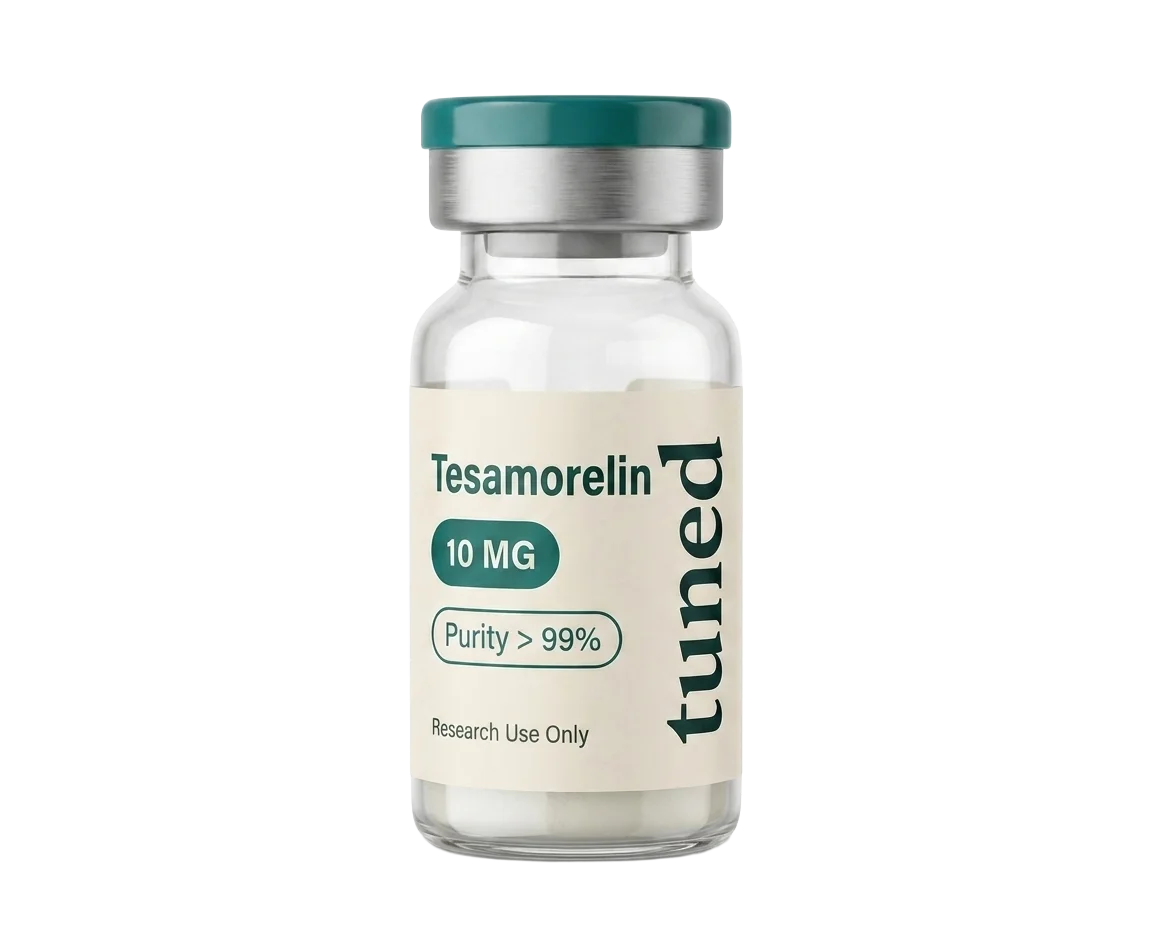
tuned Tesamorelin
For laboratory research use only · available to researchers. Specifications, pricing & Certificate of Analysis on the product page.
Stacking tesamorelin and sermorelin
A recurring question is whether tesamorelin and sermorelin are combined. Mechanistically there's little rationale to pair two GHRH analogs that hit the same receptor — unlike pairing a GHRH analog with a secretagogue (such as CJC-1295 + ipamorelin), which act on different receptors. Stacking two GHRH analogs would largely duplicate the same signal rather than complement it.
Tesamorelin, sermorelin and ipamorelin
That's why three-way framings like "tesamorelin vs sermorelin vs ipamorelin" usually resolve into a simple map: tesamorelin and sermorelin are the two GHRH analogs (differing in stability and evidence), while ipamorelin is the secretagogue on a separate ghrelin receptor — which is the one typically paired with a GHRH analog. No controlled human trial validates any of these blends, and this page does not provide study protocol or combination protocols. For the secretagogue side of the comparison, see tesamorelin vs ipamorelin and the CJC-1295 + ipamorelin guide.
Common questions
What's the difference between tesamorelin and sermorelin?
Is tesamorelin or sermorelin better?
Can tesamorelin and sermorelin be stacked?
How do tesamorelin, sermorelin and ipamorelin compare?
Are tesamorelin and sermorelin FDA approved?
References
- Dhillon S. Tesamorelin: a review of its use in the management of HIV-associated lipodystrophy. Drugs, 2011;71(8):1071–1091. PMID 21668043. (Stabilized GHRH analog; Egrifta.)
- Falutz J, Potvin D, Mamputu JC, et al. Effects of tesamorelin in HIV-infected patients with abdominal fat accumulation: a randomized placebo-controlled trial with a safety extension. J Acquir Immune Defic Syndr, 2010;53(3):311–322. PMID 20101189. (RCT — visceral fat.)
- Stanley TL, Falutz J, Marsolais C, et al. Reduction in visceral adiposity is associated with an improved metabolic profile in HIV-infected patients receiving tesamorelin. Clin Infect Dis, 2012;54(11):1642–1651. PMID 22495074.
- Prakash A, Goa KL. Sermorelin: a review of its use in the diagnosis and treatment of children with idiopathic growth hormone deficiency. BioDrugs, 1999;12(2):139–157. PMID 18031173. (GHRH(1-29); Geref history.)
Tesamorelin and sermorelin are both GHRH-receptor analogs [1][4]; tesamorelin is stabilized with randomized-trial evidence for visceral-fat reduction (as Egrifta) [1][2][3], while sermorelin is the shorter-acting GHRH(1-29) fragment with an older approved history (Geref, US-withdrawn 2008) [4]. Tesamorelin's trial evidence is indication-specific and does not transfer to general use; neither research-chemical version is the approved pharmaceutical product. No controlled trial validates a combination. GH-axis agents are prohibited in sport by WADA. Not medical advice.
For research use only. Not for human consumption. This page summarises published research for educational purposes. It is not medical advice and is not intended to diagnose, treat, cure, or prevent any disease.
The compounds researchers reach for
Ipamorelin
Sermorelin
BPC-157