
Lyophilized Peptides: Storage and Stability
A Certificate of Analysis captures a lyophilized peptide's quality on the day it was tested — not forever. From that moment, temperature, light, moisture, and time can alter the material through well-documented chemical pathways. Those forces are controllable: keeping the material cold, dark, dry and in its dried form helps protect the tested starting state.
Purity is a snapshot, not a promise
It is easy to treat a purity figure as a permanent property of a vial. It isn't. It is a measurement of one batch at one moment — and molecules don't stop reacting the day they're tested.
Compounds and proteins are especially sensitive because their function depends on a precise structure, and that structure can unravel or chemically alter under the right stress.[1] A compound that left the lab at ≥99% can drift downward long before anyone puts it to use — quietly, with no visible change in the vial. Understanding how that happens is what turns storage from guesswork into a controlled variable.
Four ways a molecule comes apart
Degradation isn't one event; it's a handful of distinct chemical reactions, and they can run at the same time. The research on compound and protein stability keeps returning to the same short list:[1][2]
- Oxidation — reactive oxygen attacks vulnerable sites on the molecule. Light and air accelerate it, which is why exposure matters.
- Deamidation and hydrolysis — water-driven reactions that alter or cleave the chain. Moisture is the enabler, so a dry state slows them dramatically.
- Aggregation — molecules clump together into forms that no longer behave like the intact compound. Heat and physical stress encourage it.
- Conformational change — the three-dimensional shape shifts, and because a compound's chemical stability is tied to its conformation, an unfolded molecule is a more fragile one.[1]
Temperature does the most damage
Of all the variables, temperature is the one that moves the needle most, because chemical reactions speed up as things get warmer. In a controlled study of a freeze-dried growth factor, researchers stored the dried formulations at 40, 50 and 60 °C and measured how quickly the protein broke down — degradation tracked clearly with heat and with the physical state of the dried solid.[2] The lesson generalises: the warmer the storage, the faster the clock runs.
This is why cold storage is the default for research materials, and why the exact temperature is a real decision — refrigerated for shorter horizons, frozen for longer ones. There is one important nuance around a property called the glass transition temperature: a freeze-dried solid stays stable as long as it's kept below the temperature at which its glassy structure begins to soften, which is a key parameter chemists design storage around.[3]
Tuned supplies lyophilized peptides with public batch documentation where a current report is available, so the evidence can be checked before selection. Browse lyophilized peptides →
Light, moisture, and repeated thawing
Temperature gets the attention, but three subtler factors do steady damage:
- Light — ultraviolet and visible light supply the energy that drives oxidation. Light exposure is a recognised contributor to instability, which is why materials are kept in the dark or in opaque containers.[4]
- Moisture — water is a reactant in several degradation pathways, so a dry environment is protective. This is the entire point of freeze-drying: remove the water and the fuel for those reactions goes with it.[3]
- Freeze–thaw cycling — repeatedly freezing and thawing a material subjects it to physical stress each time, which can promote aggregation. Fewer cycles is better; small single-use amounts beat one container opened again and again.
What good handling looks like in a lab
None of this requires special equipment — just consistency. The conditions that preserve a research compound follow directly from the mechanisms above:
| Factor | Why it matters | Controlled by |
|---|---|---|
| Temperature | Speeds every reaction | Cold storage; frozen for longer horizons |
| Physical form | Dried is more stable than dissolved | Keep lyophilised until needed |
| Light | Drives oxidation | Dark / opaque storage |
| Moisture | Reactant in breakdown | Sealed, low-humidity environment |
| Handling | Cycling promotes aggregation | Minimise freeze–thaw cycles |
A compound that arrives dried, cold, and sealed — with a certificate stating when it was tested — gives a lab the best possible starting point. What happens to it after that is a matter of respecting the same four forces every step of the way.
General laboratory handling principles for research materials. Specific storage conditions depend on the individual compound and its documentation.
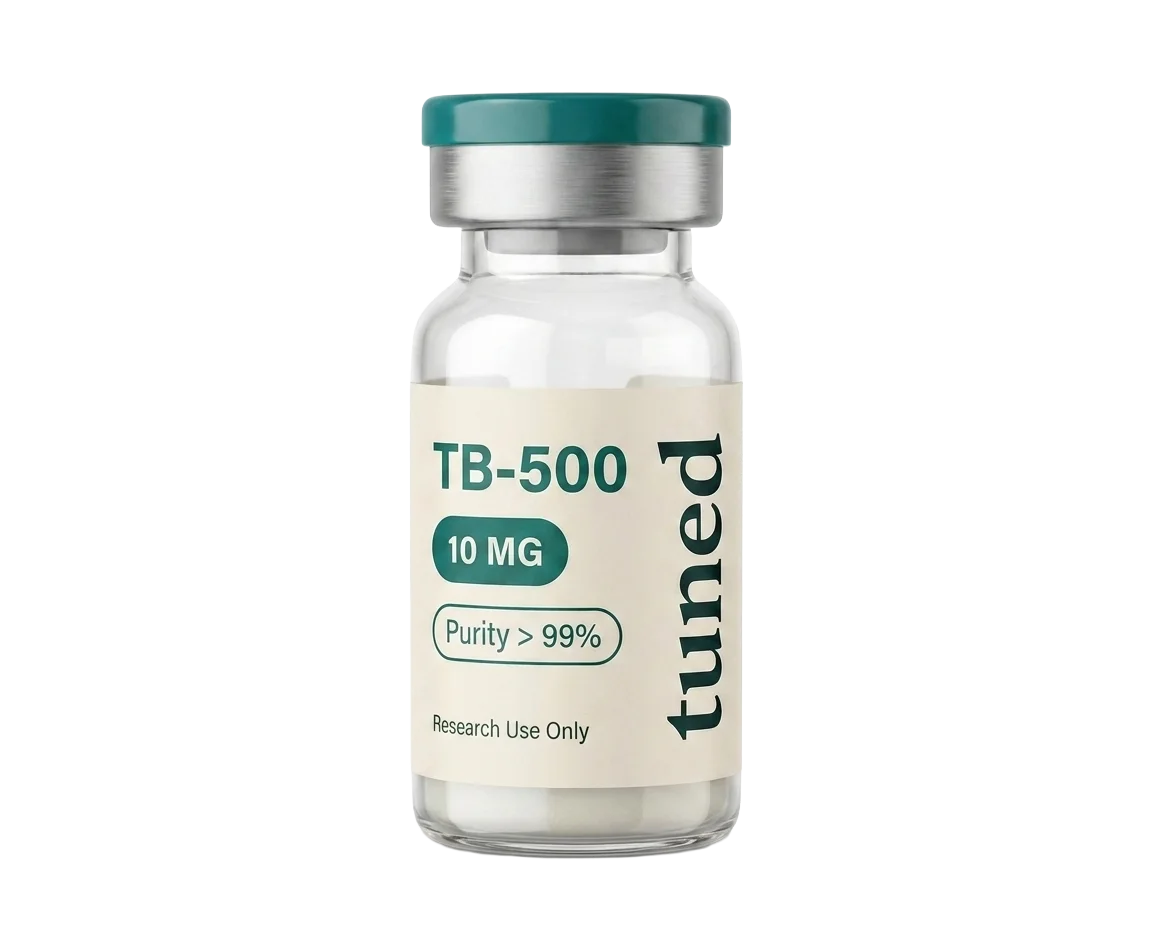
Shipped dried, tested, dated
For laboratory research use only · available to qualified researchers. Not for human or animal consumption.
Stability is a decision, not an accident
A verified compound is a starting condition, not a guarantee. The purity on the certificate describes the batch on its test date; whether it stays that way is decided afterward, by heat, light, moisture, and time. The reassuring part is how tractable those are. Keep a compound dried, cold, dark, and sealed, and handle it as few times as possible — and the same molecule that could quietly degrade on a warm shelf will instead hold the quality it was certified with.
Go deeper
References
- Meyer JD, Ho B, Manning MC. Effects of conformation on the chemical stability of pharmaceutically relevant polypeptides. (Reviews how a compound's three-dimensional conformation governs its chemical stability.) PMID 11987755.
- Devineni D, Gonschorek C, Cicerone MT, Xu Y, Carpenter JF, Randolph TW. Storage stability of keratinocyte growth factor-2 in lyophilized formulations. (Degradation of a freeze-dried protein measured across storage at 40, 50 and 60 °C.) PMID 24859390.
- Ó'Fágáin C, Colliton K. Storage and Lyophilization of Pure Proteins. Methods in Molecular Biology, 2023. (Freeze-drying principles and the role of glass transition temperature in stable storage.) PMID 37647008.
- Fayed B, Luo S, Yassin AEB. Challenges and recent advances in erythropoietin stability. Pharmaceutical Development and Technology, 2024. (Temperature and light exposure as contributors to protein instability.) PMID 39340397.
Sources describe stability and storage of compounds and proteins as laboratory materials. This article concerns handling and quality preservation only.
For research use only. Not for human or animal consumption. This article is provided for educational and laboratory-reference purposes. It describes storage and handling of research materials and makes no medical claims. tuned products are intended for in-vitro research and laboratory use only.