BPC-157 side effects & safety
In research — mostly animal studies plus small early human work — BPC-157 has a notably clean safety profile: no serious toxicity reported, and side effects that are mild and local (injection-site reactions).[1] But injectable human safety isn't established in controlled trials, the biggest real-world risk is material quality, and BPC-157 is not FDA-approved and is WADA-prohibited for athletes.
What are the side effects of BPC-157?
Reported BPC-157 side effects are generally mild and local, and no serious toxicity has been documented at the amounts studied.[1]
Across the (largely animal) literature and small human experience, BPC-157 is described as well-tolerated — preclinical toxicology found no deaths or serious adverse effects, and pilot human exposure reported no notable adverse events.[2] The effects that do come up are the kind associated with the injection itself rather than the molecule being toxic:
| Reported effect | Context |
|---|---|
| Injection-site reactions | Redness, soreness or swelling at the site — common to any subcutaneous injection |
| Mild, transient effects | Occasional reports of lightheadedness or nausea; not well-characterised |
| Serious toxicity | None documented in preclinical studies at studied doses[1] |
Injection-site reactions
The most consistently mentioned effect is local: redness or soreness where the injection is given. Rotating sites and clean technique are the usual ways this is minimised in research — it's a feature of injecting, not of BPC-157 specifically.
Are there systemic side effects?
Reassuringly, BPC-157 hasn't shown the hormonal disruption some peptides do — pilot human work reported no change in cortisol or prolactin.[2] But "no systemic side effects reported" reflects the absence of large human trials as much as genuine safety; injectable BPC-157 simply hasn't been studied at that scale.
BPC-157 side effects in men
There are no male-specific side effects in the literature — BPC-157 isn't hormonal, so the "side effects in men" framing reflects its popularity in male recovery communities, not a different safety profile by sex.
The biggest BPC-157 risk is material quality
For research peptides, the most important safety variable usually isn't the molecule — it's what's actually in the vial. The published safety record comes from controlled, high-grade material; research-chemical supply doesn't always match that.[2]
Contamination & endotoxin
Bacterial endotoxin, impurities and incorrect potency are the realistic risks with lower-grade product, and they're exactly what proper testing screens for. A batch-specific Certificate of Analysis — UPLC purity, mass-spec identity, endotoxin screening — does more for safety than any community rule of thumb. If a supplier can't show a recent, lot-matched CoA, that absence is itself a risk signal.
Is BPC-157 safe?
In the research that exists, BPC-157 looks low-risk: clean preclinical toxicology, mild local side effects, and no serious adverse events in the limited human exposure to date.[1][2]
What we can't claim
That reassuring picture rests on animal studies and small early human work, not large controlled trials. So "is BPC-157 safe?" can't be answered with an unqualified yes for ongoing human use — the long-term safety of injectable BPC-157 simply hasn't been established. Treat confident safety guarantees about it as unverified.
Is BPC-157 FDA approved?
No — BPC-157 is not an FDA-approved drug, and it has no approved therapeutic indication. It also isn't a dietary supplement; it's classed as an unapproved drug, so it can't be legally marketed for human use.
503A compounding & WADA status
In 2023 the FDA placed BPC-157 in Category 2 of its interim 503A bulk-substances review (significant safety risk / insufficient data), effectively barring it from pharmacy compounding. Separately, BPC-157 is on the WADA Prohibited List under class S0 (non-approved substances), so it's banned at all times for tested athletes. These are why tuned sells it strictly for research use only, not as a treatment.
BPC-157 and cancer
"Does BPC-157 cause cancer?" is a common and fair question, and the honest answer is: there's no evidence that it does, but there's a mechanism-based reason for caution in one specific context.
Where the concern comes from
Part of how BPC-157 aids repair is by promoting angiogenesis — the growth of new blood vessels.[1] Tumours also depend on new blood vessels to grow, so in theory a pro-angiogenic compound is something to be cautious about in the presence of an active cancer. This is a precautionary, mechanism-based concern flagged in reviews — not a finding that BPC-157 causes or accelerates cancer.
What the evidence actually shows
No study shows BPC-157 causing cancer; some preclinical work has even explored protective effects in other contexts. The balanced position: there's no demonstrated cancer risk, the angiogenesis mechanism is a reason for theoretical caution with active malignancy, and none of this is settled by human data. It's a "be aware of the mechanism," not a proven hazard — and not medical advice.
Common questions
What are the side effects of BPC-157?
Is BPC-157 safe?
Is BPC-157 FDA approved?
Does BPC-157 cause cancer?
What's the biggest risk with BPC-157?
References
- Gwyer D, Wragg NM, Wilson SL. Gastric pentadecapeptide body protection compound BPC 157 and its role in accelerating musculoskeletal soft tissue healing. Cell and Tissue Research, 2019;377(2):153–159. PMID 30915550.
- Sikiric P, Seiwerth S, Rucman R, et al. Stable gastric pentadecapeptide BPC 157: novel therapy in gastrointestinal tract. Current Pharmaceutical Design, 2011;17(16):1612–1632. PMID 21548867.
Safety statements reflect the cited research, which is predominantly preclinical with limited early human data. Long-term injectable safety is not established in controlled trials; claims to the contrary are unverified. FDA Category-2 / WADA S0 status as of 2026. Not medical advice.
For research use only. Not for human consumption. This page summarises published research for educational purposes. It is not medical advice and is not intended to diagnose, treat, cure, or prevent any disease.
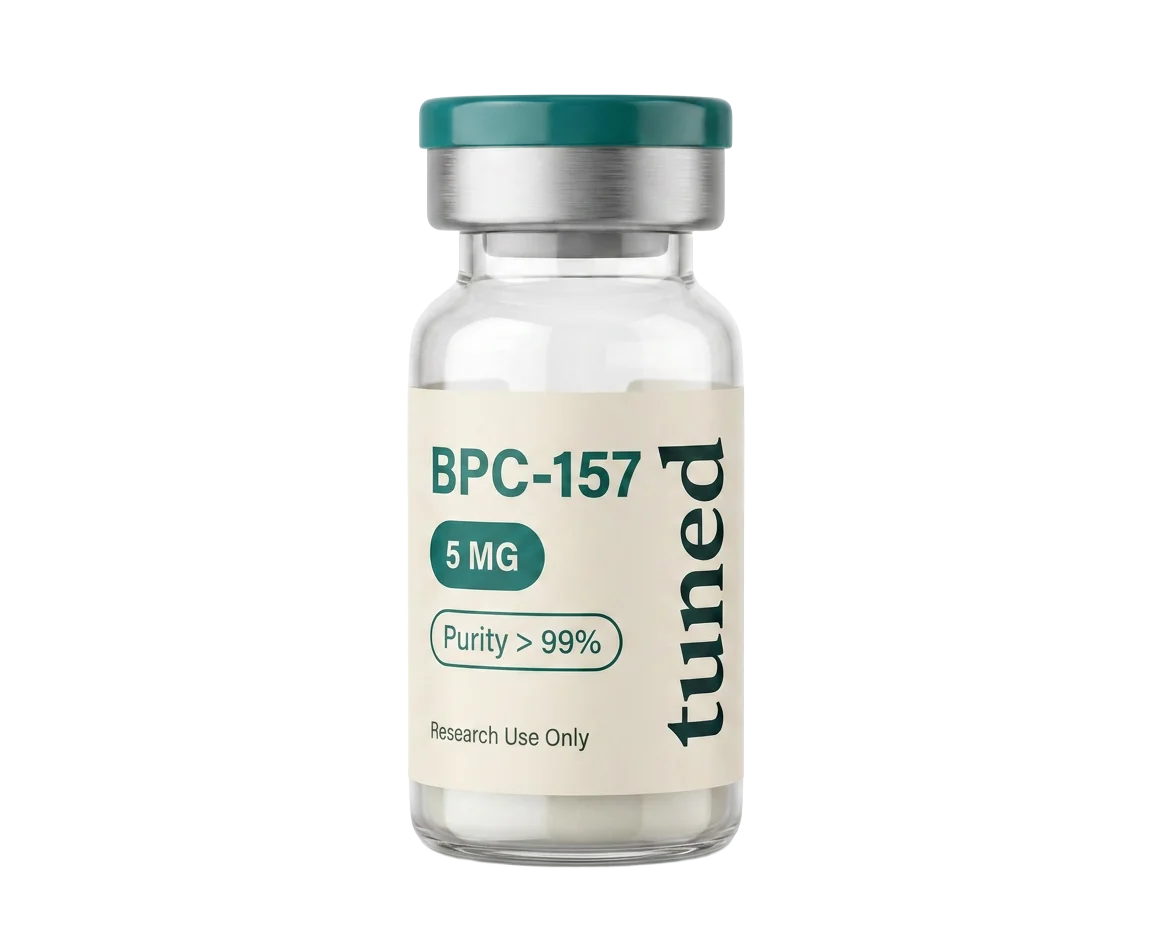
tuned BPC-157
For laboratory research use only · available to researchers. Specifications, pricing & Certificate of Analysis on the product page.