What is BPC-157?
BPC-157 is a 15-amino-acid peptide first identified in a protein found in the stomach. In research, it has been studied mainly for how it helps the body repair tissue — tendons, ligaments, muscle, and the gut lining — by encouraging new blood-vessel growth and dampening inflammation. It has reached early human trials but is not an approved drug.
What is BPC-157, exactly?
BPC-157 stands for "Body Protection Compound-157." It's a short chain of 15 amino acids drawn from a larger protective protein found naturally in human gastric juice.
What makes it unusual is stability. Most peptides fall apart quickly in the harsh, acidic environment of the stomach — BPC-157 holds together. That single property is a big reason researchers have been able to study it given by mouth as well as by injection, and it's shaped much of the interest in it for gut-related research.
It was first characterised by Professor Predrag Sikiric's group at the University of Zagreb in the early 1990s, and that lab has published the bulk of the work on it since.[2]
What does BPC-157 do?
The clearest theme across the research is repair. In animal studies, BPC-157 helps the body grow new blood vessels into damaged areas — and a fresh blood supply is one of the things injured tissue needs most to heal. That same blood-vessel effect is why so much of the work focuses on tendons, ligaments, and the gut lining.
Alongside that, it appears to calm inflammation and protect cells that are under stress, rather than driving any single dramatic effect. Researchers have described several overlapping actions:
- Encourages new blood-vessel growth, helping nutrients and repair signals reach injured tissue.
- Turns down inflammatory signals, so the area can settle and recover.
- Shields cells from oxidative and chemical stress — first noticed in the stomach lining.
- Helps organise collagen as tissue rebuilds, which matters for how well a tendon or ligament heals.
What BPC-157 does for tendons & gut
The two best-studied areas follow directly from that repair signalling: in tendon and ligament research it's tied to better-organised healing tissue, and in the gut its stability in stomach acid plus its protective, anti-inflammatory action are why it's studied for the gut lining.[1][2]
What is BPC-157 used for?
Most published work on BPC-157 is preclinical — done in cell and animal models — with a smaller set of early human reports. With that context, these are the areas it has most often been studied and explored for:
- Tendon, ligament & muscle recovery. The most common reason people look into it — soft-tissue injuries that are slow to heal.
- Gut health. Because it's stable in the stomach, it's been studied for the gut lining and inflammatory bowel conditions. Its furthest-developed form, PL-14736, reached Phase 2 human trials in Europe for ulcerative colitis.[4]
- Wound healing. Studied for how quickly and cleanly tissue closes and rebuilds.
- Nerve and brain protection. Early preclinical models only, but an active area of interest.
It's worth being honest about the evidence: the support is strongest in animals, and human data is still limited and early.
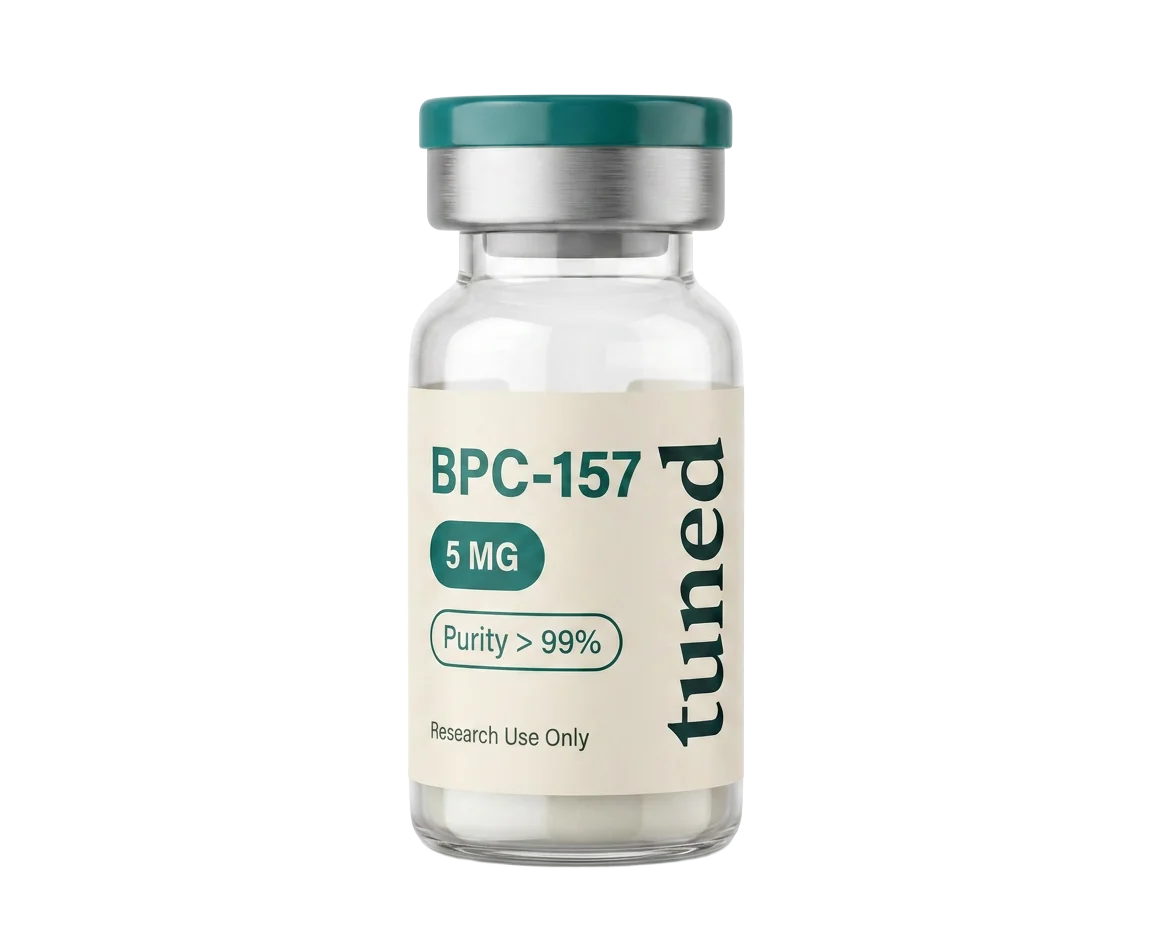
tuned BPC-157
For laboratory research use only · available to researchers. Specifications, pricing & Certificate of Analysis on the product page.
How does BPC-157 work?
BPC-157's effects trace back to a handful of signals it appears to influence. The headline one is a family of growth factors — including VEGF — that tell the body to build new blood vessels. By nudging these signals, BPC-157 helps re-establish blood flow to a damaged area, which is the groundwork for repair.
It also supports the body's nitric-oxide system, which keeps blood vessels relaxed and flowing, and it lowers two of the body's main inflammatory messengers (TNF-α and IL-6). In rodent studies it has even shown effects on mood- and nerve-related signalling, which is what points researchers toward its potential beyond simple tissue repair.
The growth-factor angle (VEGF)
Mechanistically, much of this traces to growth-factor signalling — BPC-157 is linked to VEGF and the nitric-oxide pathway, which together drive new blood-vessel formation into damaged tissue.[2] Restore the blood supply and the rest of the repair toolkit has something to work with.
What is BPC-157's half-life?
In the bloodstream, BPC-157 clears quickly — animal pharmacokinetic studies put its plasma half-life at under about 30 minutes (roughly 15 minutes in rats, ~5 in dogs); no human PK has been published.[3] On its own that sounds brief, but the research suggests its effect on tissue can outlast its time in the blood, because it binds and acts locally at the site it reaches.
Why purity is the part that actually matters
For research peptides, the biggest real-world variable isn't the molecule — it's the quality of the material. The published safety record for BPC-157 is reassuring in studies that used controlled, high-grade material; the risk in the real world comes from contamination, endotoxin, or mislabelled potency in lower-grade supply.
That's the whole reason tuned tests every batch by UPLC and mass spectrometry, confirms identity, screens endotoxin, and ships a batch-specific Certificate of Analysis. You can see exactly what's in the vial you're holding.
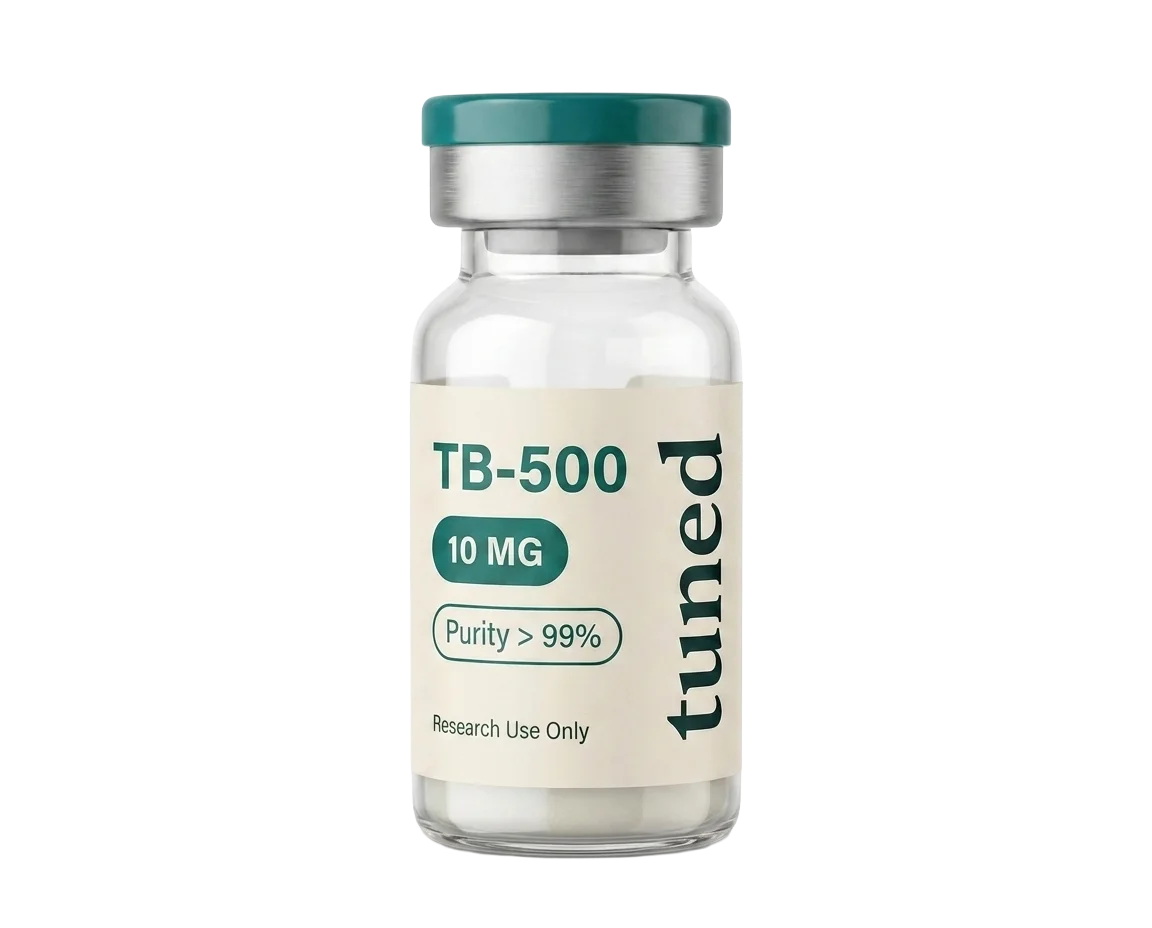
BPC-157 vs TB-500
These two are often mentioned together because both are studied for recovery — but they're different peptides that work in different ways. They're not interchangeable.
| BPC-157 | TB-500 | |
|---|---|---|
| Main research focus | Local tissue & gut repair | Systemic recovery & flexibility |
| How it works | Blood-vessel growth, anti-inflammatory | Actin regulation, cell migration |
| Plasma half-life | < ~30 min | longer |
| Often studied for | Tendon, ligament, gut | Whole-body recovery, mobility |
Common questions
What is BPC-157 used for in research?
What is the half-life of BPC-157?
Is BPC-157 an approved drug?
How do I know the BPC-157 is pure?
BPC-157 research evidence, uses & more
This page is the overview. For the specifics, these guides go deeper:
Related research peptide guides
References
- Gwyer D, Wragg NM, Wilson SL. Gastric pentadecapeptide body protection compound BPC 157 and its role in accelerating musculoskeletal soft tissue healing. Cell and Tissue Research, 2019;377(2):153–159. PMID 30915550.
- Sikiric P, Seiwerth S, Rucman R, et al. Stable gastric pentadecapeptide BPC 157: novel therapy in gastrointestinal tract. Current Pharmaceutical Design, 2011;17(16):1612–1632. PMID 21548867.
- He L, Feng D, Guo H, et al. Pharmacokinetics, distribution, metabolism, and excretion of body-protective compound 157 … in rats and dogs. Frontiers in Pharmacology, 2022;13:1026182. PMID 36588717. (animal PK; plasma half-life <30 min)
- PL-14736 (Pliva) — Phase 2 clinical program for ulcerative colitis (full results not published in a peer-reviewed journal).
Peer-reviewed sources [1–3] are preclinical/animal; half-life data is animal-derived (no human PK published). There is no established human dose; any community figures circulated online are community/vendor conventions, not from these sources or any human trial — unverified. Not medical or use guidance.
For research use only. Not for human consumption. This page summarises published research for educational purposes. It is not medical advice and is not intended to diagnose, treat, cure, or prevent any disease. No established human dose or use guidance exists for this research material.