What is TB-500?
TB-500 is a synthetic peptide — the small actin-binding fragment (Ac-LKKTETQ) of a natural protein called thymosin β-4.[1] In research it's studied for recovery: helping cells migrate, build new blood vessels and repair tissue. The important catch is that almost all of that evidence is on the full thymosin β-4 in animals, not the TB-500 fragment in humans — there are no human trials of TB-500 itself. It is not FDA-approved and is banned in sport (WADA).
What is TB-500, exactly?
TB-500 is a synthetic short peptide based on thymosin β-4 (Tβ4), a natural 43-amino-acid protein found throughout the body that's central to how cells move and repair.[1]
Specifically, TB-500 is the small region of thymosin β-4 that does the key job — the actin-binding motif, commercially made as the acetylated seven-amino-acid fragment Ac-LKKTETQ.[1] "Actin" is the protein scaffolding inside cells; controlling it is how cells change shape, migrate to a wound, and rebuild tissue.
It's marketed mostly around recovery claims involving soft tissue, tendons and injury research. The single most important thing to understand is the evidence gap between the fragment and the full protein.
Is TB-500 the same as thymosin beta-4?
No — TB-500 is not the same as thymosin β-4. TB-500 is a small synthetic fragment (about 7 amino acids); thymosin β-4 is the complete 43-amino-acid protein.[1]
This matters more than it might sound, because of where the evidence lives. The substantial research — actin binding, cell migration, wound healing, angiogenesis, even early human clinical trials — was done on full thymosin β-4, not on the TB-500 fragment.[2][3] The fragment keeps the actin-binding motif, which is why it's hypothesized to share some activity, but a fragment doesn't automatically behave like the whole protein — its absorption, distribution and effects can differ.
So throughout this guide, when we cite research, we attribute it honestly to thymosin β-4 (and note the species). Vendor marketing routinely blurs the two and presents Tβ4 trial data as if it were TB-500 evidence; that's the conflation to watch for.
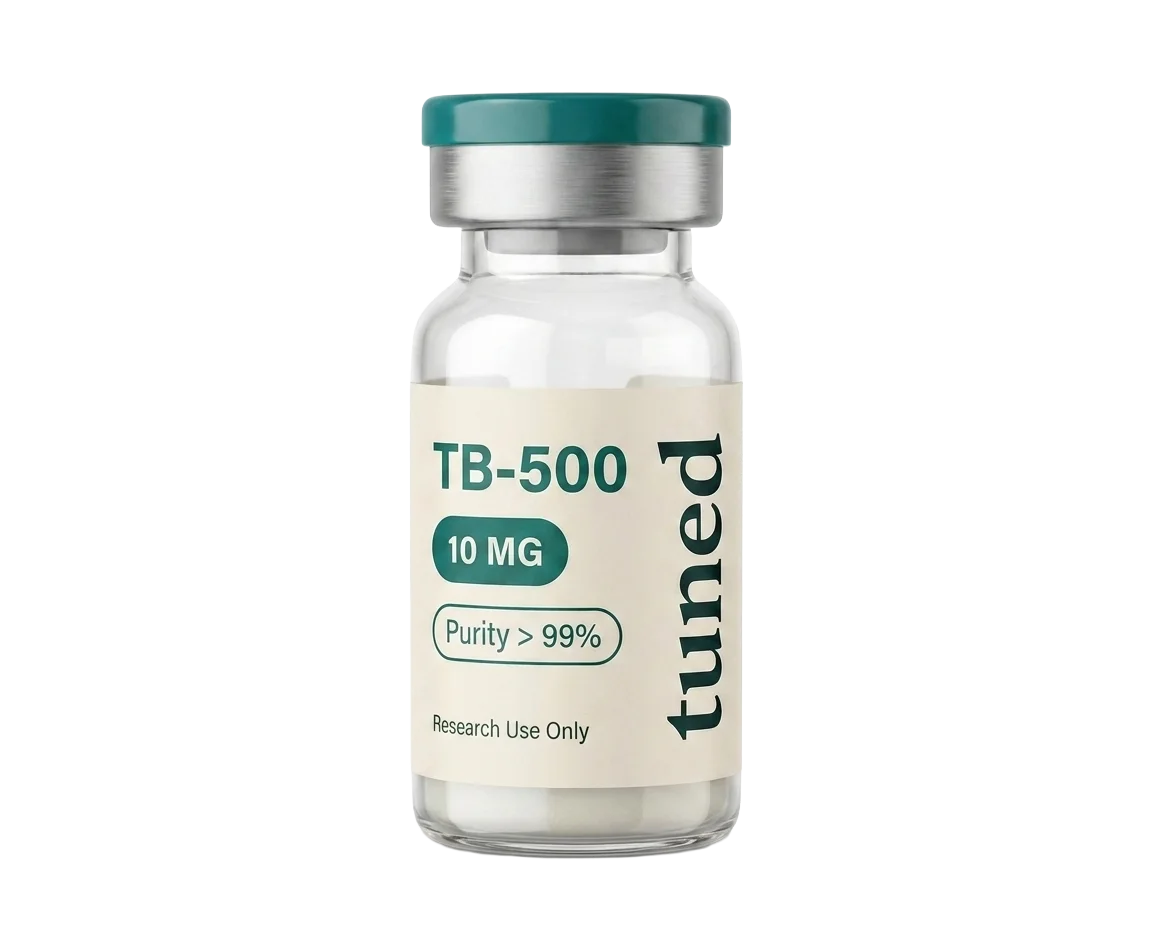
tuned TB-500
For laboratory research use only · available to researchers. Specifications, pricing & Certificate of Analysis on the product page.
What does TB-500 do?
The research theme — drawn from thymosin β-4 — is repair and recovery. Tβ4 and its actin-binding region influence how cells move and rebuild, and that's the basis for TB-500's recovery framing.[3] The actions described in the literature are:
- Cell migration. Tβ4 helps endothelial and skin cells migrate — a key step in closing and rebuilding a wound.[2]
- Angiogenesis. The actin-binding motif promotes new blood-vessel growth, bringing supply to healing tissue.[4]
- Wound healing. In animal wound models, Tβ4 sped up reepithelialization and collagen organisation.[3]
- Anti-inflammatory effects. Tβ4 reduces inflammatory signalling in some animal models.
What TB-500 is used for in research
Those properties are why TB-500 is explored for systemic recovery — tendon, ligament and muscle injury, and general tissue repair — and why it's so often paired with BPC-157.[3] The honest qualifier: this is mechanism and animal data on the full protein, with the fragment's human effects unproven.
How does TB-500 work?
The mechanism comes back to one molecule: actin. Inside every cell is a scaffolding of actin filaments that the cell constantly assembles and disassembles to change shape and move. Thymosin β-4 is the body's main actin-sequestering peptide — it binds free actin building blocks and regulates how that scaffolding is built.[2]
The actin-binding motif (LKKTET)
The part of thymosin β-4 that does this is a short motif, LKKTET — and that motif is exactly what TB-500 reproduces.[1] Research showed this actin-binding region is also what drives Tβ4's blood-vessel-growth activity,[4] which is the link between "regulates actin" and "supports repair": by helping cells reorganise and migrate, and by encouraging new vessels, the peptide creates the conditions tissue needs to rebuild.
TB-500 fragment vs the full peptide
Because TB-500 is only the motif and not the whole protein, it's reasonable to expect some shared activity — but not to assume identical effects. A fragment can be cleared faster, distribute differently, or lack interactions the full protein has. That's why the mechanism is best described as "plausible, by analogy to thymosin β-4," not proven for the fragment.
TB-500 benefits
The reported TB-500 benefits centre on recovery — faster soft-tissue, tendon and muscle repair, better flexibility, and (from thymosin β-4 research) even hair growth.[3][6] These follow from the cell-migration and angiogenesis mechanism, and they're the reason it's popular with athletes despite the WADA ban. As everywhere on this topic, the evidence is thymosin-β-4 and animal data, not human trials of the fragment, so the benefits are research-framed rather than proven.
Full TB-500 benefits guide — recovery, injury & hair growth →
TB-500 and BPC-157
TB-500 and BPC-157 are frequently paired in recovery marketing because their proposed mechanisms are presented as complementary.[3] This pairing is a community and marketing convention with no controlled trial of the combination. The blend guide examines that evidence gap.
Is TB-500 FDA approved & WADA banned?
Two clear answers. FDA: TB-500 is not FDA-approved and has no human clinical program — it's a research chemical (full thymosin β-4 has had clinical trials, but that's a different molecule). WADA: TB-500 is explicitly banned — it's named on the World Anti-Doping Agency Prohibited List under growth factors (class S2), prohibited at all times for tested athletes.[1] Human safety data is limited; reported effects are mild (injection-site reactions, transient lethargy), with a mechanism-based caution around active cancer given the angiogenesis effect.
How to choose TB-500
For a research peptide with no GMP supply chain, material quality is the dominant variable — endotoxin and impurities are the realistic risks, not the molecule. A batch-specific Certificate of Analysis (UPLC purity, identity, endotoxin) matters more than any community convention; absence of a recent, lot-matched CoA is itself a risk signal.
Common questions
What is TB-500?
Is TB-500 the same as thymosin beta-4?
What does TB-500 do?
Is TB-500 banned by WADA?
Is there human evidence for TB-500?
TB-500 blend, research evidence, benefits & more
This page is the overview. For the specifics, these guides go deeper:
Related research peptide guides
References
- Esposito S, Deventer K, Goeman J, et al. Synthesis and characterization of the N-terminal acetylated 17-23 fragment of thymosin beta 4 identified in TB-500, a product suspected to possess doping potential. Drug Testing and Analysis, 2012;4(9):733–738. PMID 22962027. (Confirms TB-500 = Ac-LKKTETQ fragment.)
- Safer D, Elzinga M, Nachmias VT. Thymosin beta 4 and Fx, an actin-sequestering peptide, are indistinguishable. Journal of Biological Chemistry, 1991;266(7):4029–4032. PMID 1999398.
- Malinda KM, Sidhu GS, Mani H, et al. Thymosin beta4 accelerates wound healing. Journal of Investigative Dermatology, 1999;113(3):364–368. PMID 10469335. (Tβ4, rat wound model.)
- Philp D, Huff T, Gho YS, Hannappel E, Kleinman HK. The actin binding site on thymosin beta4 promotes angiogenesis. FASEB Journal, 2003;17(14):2103–2105. PMID 14500546.
- Bock-Marquette I, Saxena A, White MD, et al. Thymosin beta4 activates integrin-linked kinase and promotes cardiac cell migration, survival and cardiac repair. Nature, 2004;432(7016):466–472. PMID 15565145. (Full Tβ4.)
- Philp D, Nguyen M, Scheremeta B, et al. Thymosin beta4 increases hair growth by activation of hair follicle stem cells. FASEB Journal, 2004;18(2):385–387. PMID 14657002. (Tβ4, animal.)
Sources [2–6] are on full thymosin β-4 (mostly animal/preclinical), not the TB-500 fragment; [1] confirms TB-500's identity as the Ac-LKKTETQ fragment. There is no human randomized trial of the TB-500 fragment. Community study protocol and the BPC-157 stack are unverified conventions. TB-500 is not FDA-approved and is WADA-prohibited (S2); verify current WADA/FDA status as both update. Not medical advice.
For research use only. Not for human consumption. This page summarises published research for educational purposes. It is not medical advice and is not intended to diagnose, treat, cure, or prevent any disease.