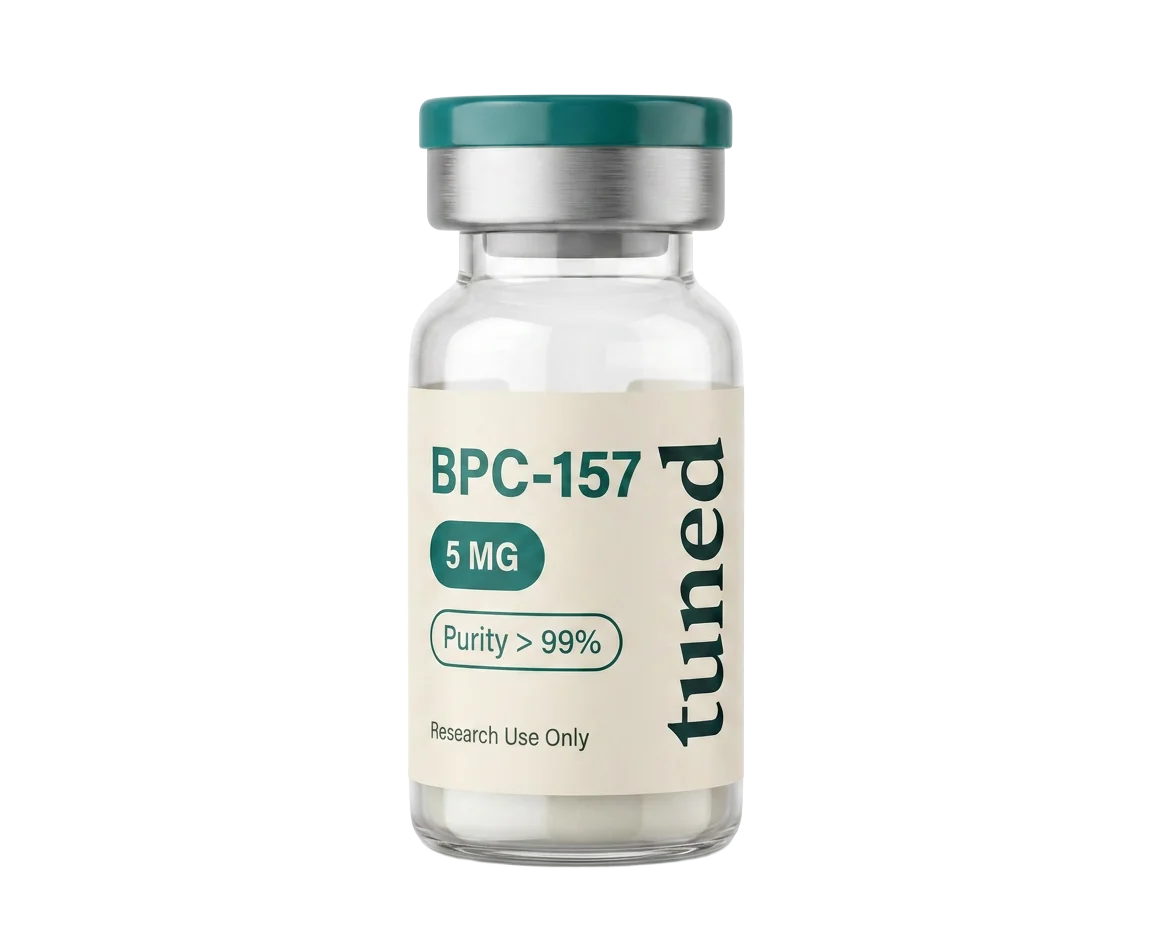
BPC-157 and TB-500
BPC-157 and TB-500 are commonly marketed together as a recovery “blend.” The rationale is that their proposed mechanisms are complementary.[2] The pairing remains a community and marketing convention: there is no controlled human trial of the combination, neither peptide is FDA-approved, and TB-500 is WADA-banned.
What is the BPC-157 and TB-500 blend?
The BPC-157 and TB-500 blend is a commercially marketed pairing built around two proposed recovery mechanisms.[1]
They're paired because their research stories point in complementary directions. BPC-157 is a gastric peptide studied for localised tissue and gut repair;[3] TB-500 is the actin-binding fragment of thymosin β-4, framed as supporting more systemic, whole-body recovery through cell migration and blood-vessel growth.[2] Combining them is meant to cover both the local and the systemic side of repair.
BPC-157 and TB-500 benefits
The benefits attributed to the BPC-157 and TB-500 blend are recovery-focused: faster soft-tissue, tendon and muscle repair, reduced inflammation, and better resilience to injury.[4][2] The appeal of the stack is the idea of two mechanisms working together — BPC-157's local repair plus TB-500's systemic, migration-and-angiogenesis support.
Why the BPC-157 and TB-500 stack is used
Researchers and athletes reach for the combination on the logic that recovery isn't one process — it's local healing and systemic tissue turnover — so a peptide for each is meant to be more complete than either alone. That logic is reasonable, but it's important to separate it from evidence: BPC-157's data is largely animal,[3] TB-500's is thymosin-β-4 animal work,[2] and the combination has never been tested in a controlled trial. The synergy is plausible and popular, not proven.
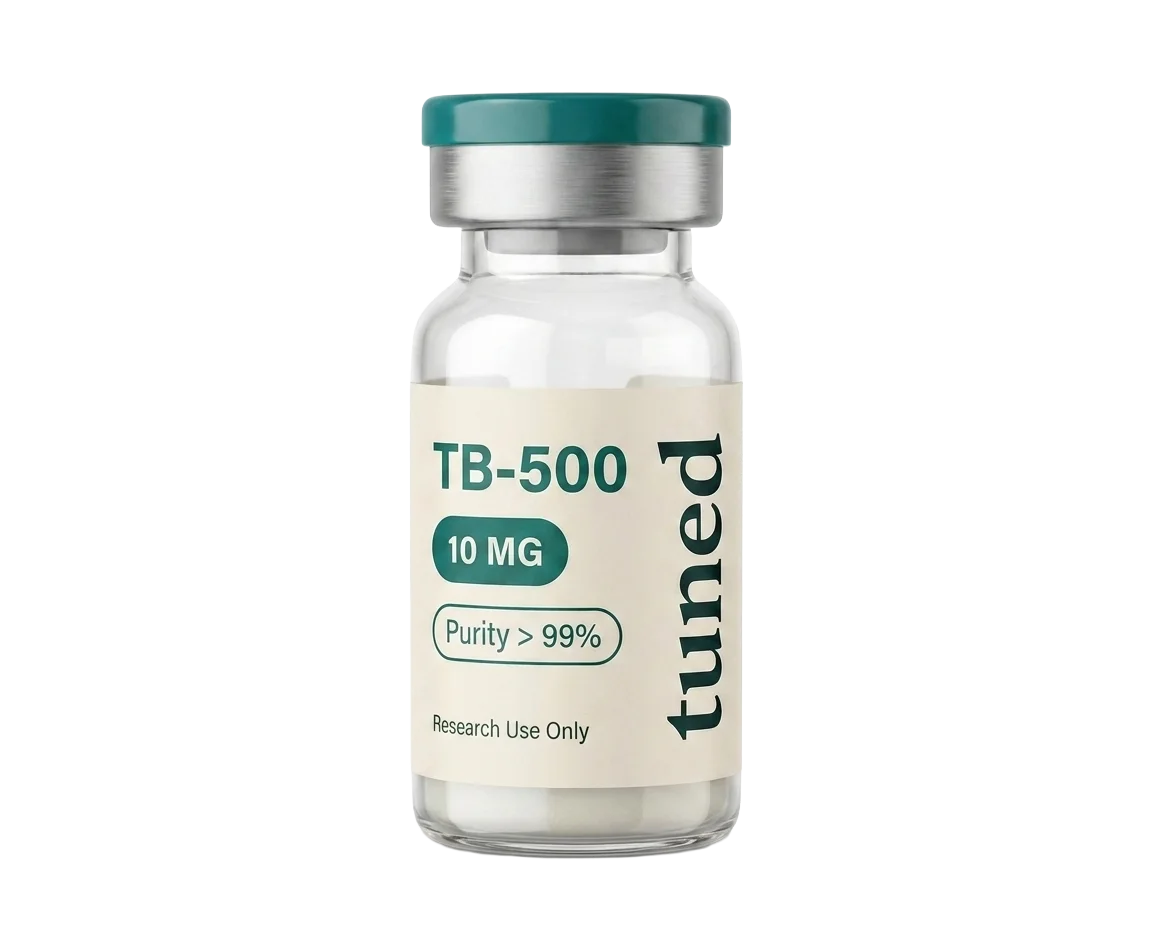
tuned TB-500
For laboratory research use only · available to researchers. Specifications, pricing & Certificate of Analysis on the product page.
BPC-157 + TB-500 blend research evidence
No controlled trial has evaluated the BPC-157 and TB-500 combination or established it as a treatment.[1] Blend claims are vendor and community conventions rather than clinical evidence.
Evidence for the combined formulation
Commercial blend compositions are marketing choices rather than evidence-based formulas. No controlled trial has established an optimal combined formulation or validated the blend as a treatment.
Is the BPC-157 and TB-500 stack worth it?
"Is it worth it?" depends on what you mean. As a research question it's a reasonable pairing — two complementary repair mechanisms, both with supportive (if preclinical) rationale.[2][3] As a proven recovery treatment, no: there's no human trial of either peptide's efficacy, none of the combination, and both are sold for research use only.
BPC-157 and TB-500: the honest verdict
The honest verdict is that the stack is popular and mechanistically coherent but evidentially unproven — and carries real caveats: TB-500 is WADA-banned for athletes, neither peptide is FDA-approved, and material quality (endotoxin, purity) is the dominant real-world risk for both. For a head-to-head of the two on their own, see the BPC-157 vs TB-500 comparison.
Common questions
What is the BPC-157 and TB-500 blend?
What are the benefits of the BPC-157 and TB-500 stack?
Is the BPC-157 and TB-500 stack worth it?
References
- Esposito S, Deventer K, Goeman J, et al. Synthesis and characterization of the N-terminal acetylated 17-23 fragment of thymosin beta 4 identified in TB-500, a product suspected to possess doping potential. Drug Testing and Analysis, 2012;4(9):733–738. PMID 22962027.
- Malinda KM, Sidhu GS, Mani H, et al. Thymosin beta4 accelerates wound healing. Journal of Investigative Dermatology, 1999;113(3):364–368. PMID 10469335. (Tβ4, rat wound model.)
- Sikiric P, Seiwerth S, Rucman R, et al. Stable gastric pentadecapeptide BPC 157: novel therapy in gastrointestinal tract. Current Pharmaceutical Design, 2011;17(16):1612–1632. PMID 21548867.
- Gwyer D, Wragg NM, Wilson SL. Gastric pentadecapeptide body protection compound BPC 157 and its role in accelerating musculoskeletal soft tissue healing. Cell and Tissue Research, 2019;377(2):153–159. PMID 30915550.
TB-500 is the Tβ4 fragment [1]; cited recovery mechanisms are thymosin β-4 (animal) [2] and BPC-157 (largely animal) [3,4]. There is no controlled trial of either peptide efficacy or of the BPC-157 + TB-500 combination — the stack is a community/marketing convention. Neither is FDA-approved; TB-500 is WADA-banned. Not medical advice.
For research use only. Not for human consumption. This page summarises published research for educational purposes. It is not medical advice and is not intended to diagnose, treat, cure, or prevent any disease.