TB-500 side effects
Human safety data for the TB-500 fragment is limited to absent — no controlled trials exist.[1] Reported effects are anecdotal and mild (injection-site reactions, transient lethargy or head-rush). The notable mechanism-based caution is around active cancer, since the same angiogenesis that aids repair could in theory feed a tumour.[2] The biggest real-world risk is material quality (no GMP supply), and TB-500 is not FDA-approved and is WADA-banned.
What are the side effects of TB-500?
Reported TB-500 side effects are mild and anecdotal — there's no controlled human safety data on the fragment to draw firm conclusions from.[1]
Because the TB-500 fragment has never been through human trials, the "side effects" discussed come from user reports and veterinary use rather than documented data:
| Reported effect | Context |
|---|---|
| Injection-site reactions | Redness or soreness — common to any subcutaneous injection |
| Transient lethargy / head-rush | Anecdotal and not characterised in controlled research |
| Serious toxicity | None documented — but that reflects absence of trials, not proven safety |
Injection-site & reported effects
The most consistently mentioned effect is local — soreness at the injection site, common to any subcutaneous peptide. The systemic reports (a brief tired or light-headed feeling) are anecdotal and poorly characterised. The honest framing: "few reported side effects" mostly reflects the absence of a reporting channel and of trials, not established safety.
There's a subtle trap in how this gets discussed. Because TB-500 has no FDA-approved product, there's no formal adverse-event reporting system feeding it — so a clean-looking safety record is partly an artefact of nobody collecting the data. Athlete-doping channels, compounding pharmacies and equine vets each see slices of use that never aggregate anywhere. Read "well tolerated" claims with that in mind: they describe the quiet, not a verified all-clear.[1]
Is TB-500 safe?
In the limited information available, TB-500 hasn't shown serious toxicity — but "limited information" is the operative phrase, and there are two specific reasons for caution beyond the lack of trials.[1]
The cancer caution (angiogenesis)
The first is mechanism-based. Part of how thymosin β-4 and its fragment aid repair is by promoting angiogenesis — new blood-vessel growth.[2] Tumours also depend on new blood vessels, so a pro-angiogenic compound is something to be cautious about in the presence of an active cancer. This is a theoretical, mechanism-based concern, not evidence that TB-500 causes cancer — but it's a real reason the angiogenic mechanism cuts both ways. The same logic applies, more faintly, to anyone with a history of cancer rather than active disease — not a documented harm, but a sensible place for caution given that the entire benefit case rests on promoting cell migration and new vessels.[2] Pregnancy is another prudent avoid, simply because there's no data and the mechanism touches developmental processes.
TB-500 purity & material quality
The second is supply. TB-500 has no GMP (pharmaceutical-grade) supply chain, so endotoxin, impurities and incorrect potency are the realistic hazards — arguably more than the molecule itself. A batch-specific Certificate of Analysis (UPLC purity, identity, endotoxin) addresses this more directly than any community rule. This isn't a hypothetical: peptide research chemicals have been found contaminated with bacterial endotoxin, and an endotoxin reaction (fever, malaise) can look like a "side effect of the peptide" when it's really a side effect of the manufacturing. Verified material removes that confound.
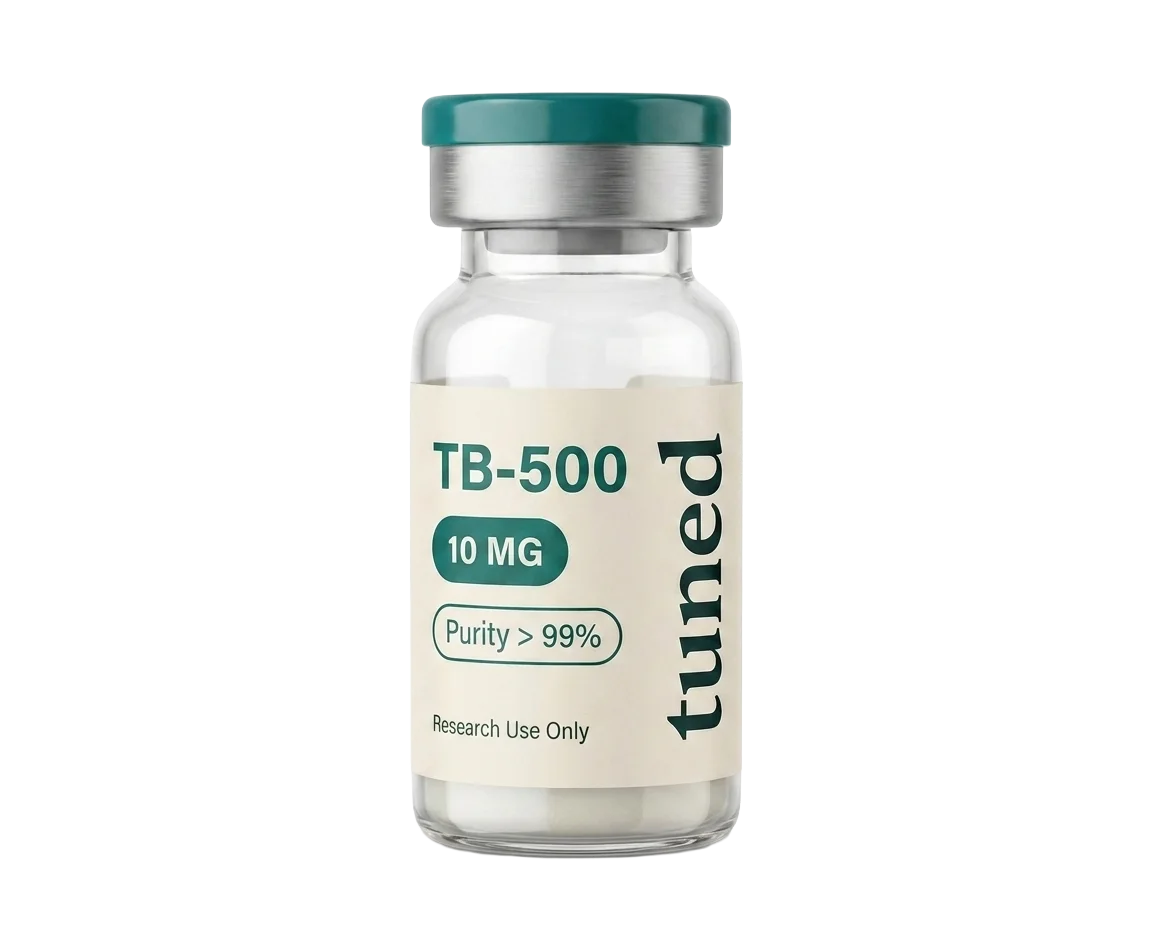
tuned TB-500
For laboratory research use only · available to researchers. Specifications, pricing & Certificate of Analysis on the product page.
Is TB-500 FDA approved & WADA banned?
Two clear regulatory answers. FDA: TB-500 is not FDA-approved and has no human clinical program — it's handled as a research chemical. (Full thymosin β-4 has had clinical trials in narrow indications, but that's a different molecule.)[1] WADA: TB-500 is explicitly named and banned on the World Anti-Doping Agency Prohibited List, under growth factors (class S2), prohibited at all times for tested athletes.
WADA status & testing
The WADA listing is not a grey area — "thymosin-β-4 and its derivatives, e.g. TB-500" appear by name, and it's detectable in anti-doping testing (the fragment was characterised partly in a doping-control context).[3] For any tested athlete, TB-500 is a sanctionable substance at all times, in and out of competition, and peptide growth factors like this can be detectable for an extended window after use — so "I stopped before the test" is not a safe assumption. These regulatory facts are exactly why tuned sells it strictly for research use only.
WADA and FDA classifications update over time; verify the current status before relying on it. This page is educational and not medical advice.
Common questions
What are the side effects of TB-500?
Is TB-500 safe?
Does TB-500 cause cancer?
Is TB-500 FDA approved?
Is TB-500 banned by WADA?
References
- Esposito S, Deventer K, Goeman J, et al. Synthesis and characterization of the N-terminal acetylated 17-23 fragment of thymosin beta 4 identified in TB-500, a product suspected to possess doping potential. Drug Testing and Analysis, 2012;4(9):733–738. PMID 22962027.
- Philp D, Huff T, Gho YS, Hannappel E, Kleinman HK. The actin binding site on thymosin beta4 promotes angiogenesis. FASEB Journal, 2003;17(14):2103–2105. PMID 14500546.
- Malinda KM, Sidhu GS, Mani H, et al. Thymosin beta4 accelerates wound healing. Journal of Investigative Dermatology, 1999;113(3):364–368. PMID 10469335. (Tβ4, rat wound model.)
No controlled human safety data exists for the TB-500 fragment [1]. The angiogenesis-based cancer caution derives from the Tβ4 actin-motif angiogenesis mechanism [2,3]. Reported effects are anecdotal/veterinary, not trial data. TB-500 is not FDA-approved and is WADA-banned (S2); verify current status. Not medical advice.
For research use only. Not for human consumption. This page summarises published research for educational purposes. It is not medical advice and is not intended to diagnose, treat, cure, or prevent any disease.