TB-500 benefits
The reported TB-500 benefits centre on recovery: faster soft-tissue, tendon and muscle repair, better flexibility, and — from thymosin β-4 research — hair growth.[1][3] These follow from a real mechanism (cell migration and new blood-vessel growth),[4][2] but the crucial caveat is that the evidence is on full thymosin β-4 in animals, not the TB-500 fragment in humans — there are no human trials of the fragment. So these are research-framed possibilities, not proven outcomes.
What are the benefits of TB-500?
The benefits of TB-500 that show up in research all trace to thymosin β-4's effect on cell movement and tissue repair — so they cluster around recovery.[1]
TB-500 reproduces the actin-binding part of thymosin β-4, and from that the literature describes a set of related, research-reported benefits (all from Tβ4 studies):
| Reported benefit | Basis in the research | Evidence |
|---|---|---|
| Soft-tissue recovery | Cell migration & wound healing | Tβ4, animal[1] |
| Angiogenesis (blood supply) | Actin-binding motif drives vessel growth | Tβ4, preclinical[2] |
| Endothelial cell migration | Directional migration of vessel-lining cells | Tβ4, in vitro[4] |
| Hair growth | Hair-follicle stem-cell activation | Tβ4, animal[3] |
The cell-migration & angiogenesis mechanism
Every benefit comes back to the same mechanism: by regulating actin, thymosin β-4 helps cells migrate into damaged areas and promotes new blood vessels to supply them.[4][2] That's the engine behind the recovery and repair framing — and the reason the benefits cluster so tightly around healing tissue.
TB-500 for recovery & injury
TB-500 for recovery is the most-searched benefit, and it follows directly from the mechanism. In animal wound models, thymosin β-4 sped up reepithelialization and improved collagen organisation and angiogenesis[1] — exactly the processes that matter for tendon, ligament and muscle repair.
TB-500 for tendon & muscle
The soft-tissue framing — tendon, ligament, muscle — is why TB-500 is popular in athletic recovery, and why it's so often stacked with BPC-157. The honest limit: this rests on thymosin-β-4 animal data plus anecdotal and veterinary (equine) use, with no human trial of the TB-500 fragment for any injury. It's a mechanism-led research interest, not a proven recovery aid.
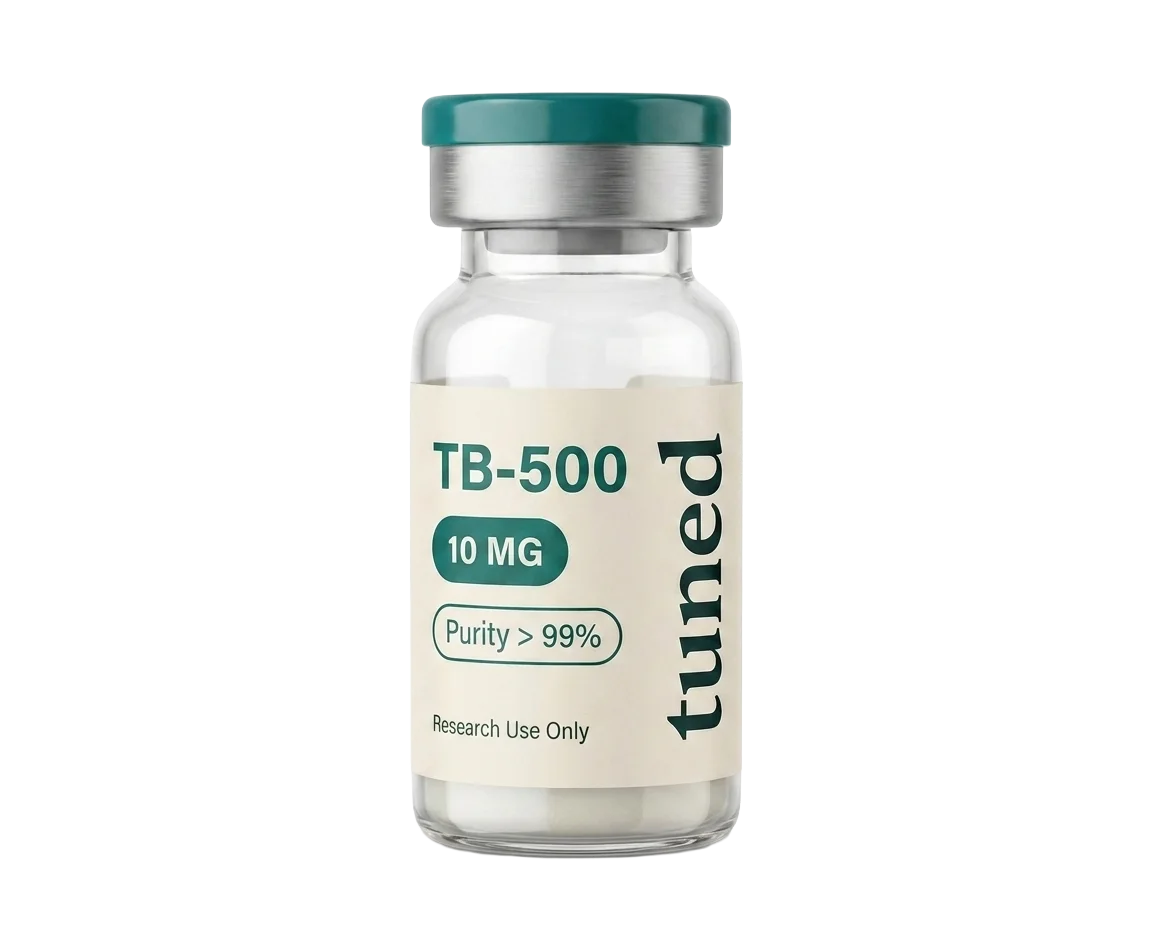
tuned TB-500
For laboratory research use only · available to researchers. Specifications, pricing & Certificate of Analysis on the product page.
TB-500 for hair growth
TB-500 for hair growth is a real research thread — but, like everything here, it comes from thymosin β-4, not the fragment. In a 2004 study from Hynda Kleinman's group, thymosin β-4 increased hair growth in rodents by activating hair-follicle stem cells and promoting the migration of the cells that build a new follicle.[3]
What the hair-growth research shows
That finding is genuine and mechanistically interesting, but two caveats matter: it's an animal study, and it used full thymosin β-4. "TB-500 hair growth" claims extrapolate from it on the assumption that the actin-binding fragment shares the effect — plausible, but unproven in humans. Treat hair growth as a thymosin-β-4 research finding, not a demonstrated TB-500 benefit.
What the evidence actually shows
Stepping back, the evidence picture is unusually important for TB-500 because of the fragment-versus-protein gap. The thymosin β-4 body of work is real: actin sequestration, endothelial migration, angiogenesis, wound healing, hair growth, even early human clinical trials in narrow indications.[2][4]
Tβ4 evidence vs the TB-500 fragment
But the TB-500 fragment itself has essentially no direct human evidence — no randomized trials, no FDA-approved product, only off-label and veterinary use.[5] Its case rests entirely on retaining the actin-binding motif and on extrapolation from thymosin β-4. So the most accurate summary of TB-500 benefits is: a strong mechanistic rationale borrowed from a related molecule, not proven outcomes for the fragment in people. That distinction isn't pedantry — it's the difference between "a related protein does this in mice" and "this product does this in you," and most TB-500 marketing quietly collapses the two.
None of this is a treatment claim. TB-500 is not an approved drug; benefits here are research findings about thymosin β-4 and its fragment, not promises of a clinical outcome.
Common questions
What are the benefits of TB-500?
Does TB-500 help recovery and injury?
Does TB-500 grow hair?
Is there human evidence for TB-500 benefits?
How strong is the evidence for TB-500?
References
- Malinda KM, Sidhu GS, Mani H, et al. Thymosin beta4 accelerates wound healing. Journal of Investigative Dermatology, 1999;113(3):364–368. PMID 10469335. (Tβ4, rat wound model.)
- Philp D, Huff T, Gho YS, Hannappel E, Kleinman HK. The actin binding site on thymosin beta4 promotes angiogenesis. FASEB Journal, 2003;17(14):2103–2105. PMID 14500546.
- Philp D, Nguyen M, Scheremeta B, et al. Thymosin beta4 increases hair growth by activation of hair follicle stem cells. FASEB Journal, 2004;18(2):385–387. PMID 14657002. (Tβ4, animal.)
- Malinda KM, Goldstein AL, Kleinman HK. Thymosin beta 4 stimulates directional migration of human umbilical vein endothelial cells. FASEB Journal, 1997;11(6):474–481. PMID 9194528.
- Esposito S, Deventer K, Goeman J, et al. Synthesis and characterization of the N-terminal acetylated 17-23 fragment of thymosin beta 4 identified in TB-500, a product suspected to possess doping potential. Drug Testing and Analysis, 2012;4(9):733–738. PMID 22962027.
Cited benefits are from full thymosin β-4: wound healing [1], angiogenesis [2], hair growth [3], endothelial migration [4] — mostly animal/preclinical. [5] confirms TB-500 is the Tβ4 fragment. There is no human trial of the TB-500 fragment. TB-500 is not FDA-approved and is WADA-banned. Benefits are research findings, not treatment claims. Not medical advice.
For research use only. Not for human consumption. This page summarises published research for educational purposes. It is not medical advice and is not intended to diagnose, treat, cure, or prevent any disease.