What is oxytocin?
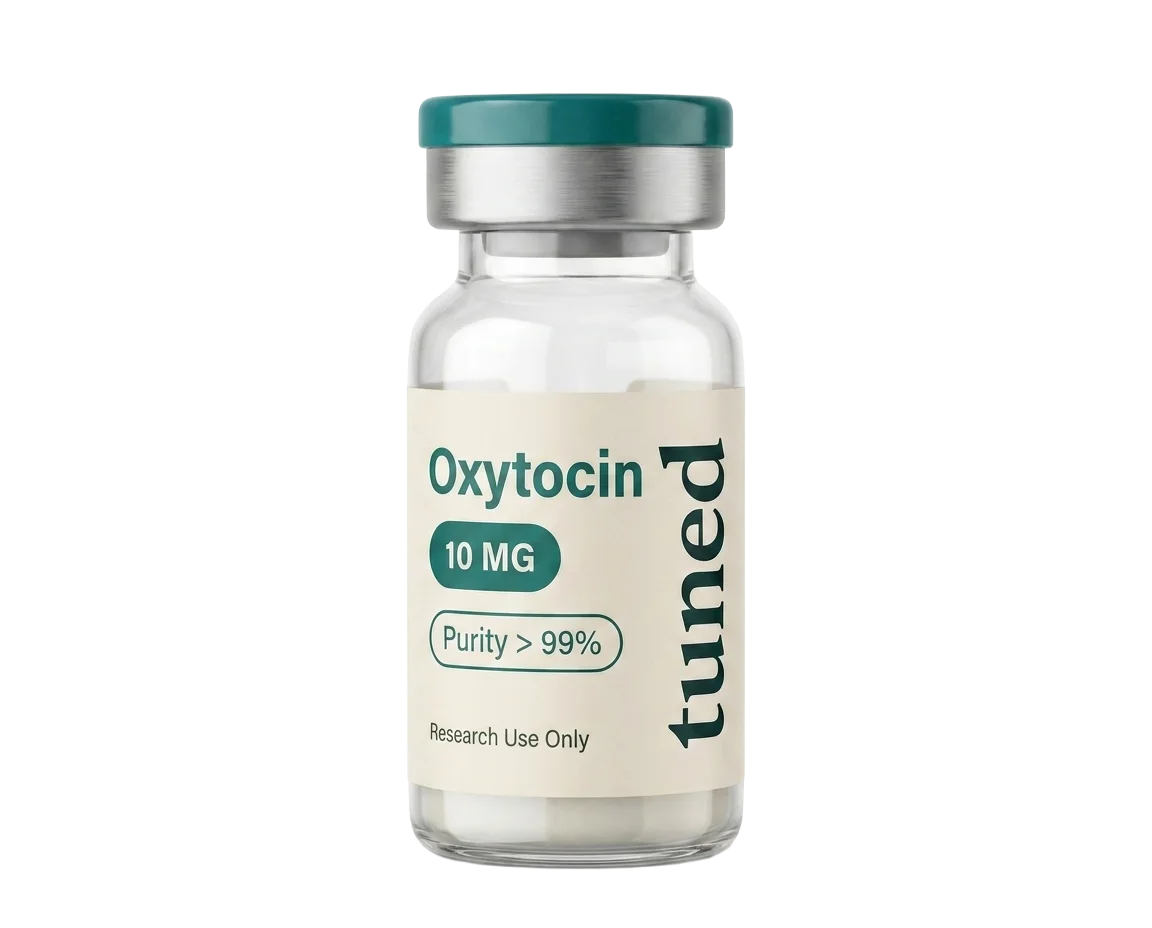
Oxytocin is a natural neuropeptide and hormone — nine amino acids — that the body makes in the hypothalamus; it's central to childbirth, lactation, social bonding and the sexual response.[5] As a research compound it's studied mostly intranasally for social cognition, trust and anxiety — an area where early findings were striking but later replication has been mixed and debated.[1][2] Note the regulatory line: oxytocin is FDA-approved only as an injectable obstetric drug (e.g. Pitocin); the research compound is not that product and is not approved for social, mood or sexual use.
What is oxytocin, exactly?
Oxytocin is a small endogenous peptide (a nonapeptide — nine amino acids) produced in the hypothalamus and released by the pituitary. It acts as both a hormone in the body and a neuromodulator in the brain.[5]
Physiologically it's best known for triggering uterine contractions in labour and milk let-down in breastfeeding, the roles for which the injectable drug form is actually approved. In the brain it's tied to social behaviours — bonding, attachment and stress buffering — which is the basis of its popular "love hormone" nickname and most of the research interest in it as a compound.[4]
Oxytocin peptide and oxytocin acetate
"Oxytocin peptide" and "oxytocin acetate" refer to the synthetic peptide form (the acetate salt is used for stability); it's the same molecule the body makes. As a research material it's supplied as a lyophilized powder and studied in injectable and intranasal forms. Throughout, the important distinction is that the research compound is not the approved obstetric drug.
What does oxytocin do, and how does it work?
Oxytocin binds its own receptor (OXTR) on cells in the brain and body. Peripherally that drives uterine and mammary smooth-muscle contraction; centrally it modulates circuits involved in social salience, bonding and the stress response.[4]
The social-bonding and stress mechanism
The research story is that oxytocin tunes how the brain weights social information and dampens stress reactivity — for example, oxytocin combined with social support reduced cortisol and subjective stress in a controlled psychosocial-stress study.[4] From that single mechanism flow the popular themes of trust, empathy and calm. The honest qualifier, developed below, is that translating "modulates social circuits" into reliable real-world effects has proven much harder than the early headlines suggested.[2][3]
Oxytocin benefits
The oxytocin benefits people search for cluster around social and emotional themes — and this is a compound where the state of the evidence matters more than the list:
- Trust & social bonding — a landmark 2005 study reported intranasal oxytocin increased trust in an economic game.[1]
- Stress buffering — oxytocin with social support lowered cortisol and stress responses.[4]
- Anxiety interest — intranasal oxytocin continues to be studied for anxiety and stress-related disorders.[6]
- Social cognition — explored in autism and related conditions, with inconsistent results.[3]
Why the oxytocin evidence is genuinely mixed
Here is the honesty this topic demands. The famous "trust" finding and many early intranasal results have faced serious replication and methodology concerns — critical reviews have questioned how reliably intranasal oxytocin reaches the brain and whether the headline social effects hold up.[2][3] So oxytocin's "benefits" are best read as an active, unsettled research area, not established effects: the mechanism is real, some signals (like stress buffering) are reasonably supported, but the popular "love hormone" claims run well ahead of robust, replicated human evidence.
It's worth being concrete about why the picture is so mixed. Many early intranasal studies were small, used single doses, and measured effects that proved hard to reproduce when larger or pre-registered studies were run; the result is a literature where headline findings and null results sit side by side.[2][3] That doesn't make oxytocin uninteresting — it remains one of the most actively studied neuropeptides in social neuroscience — but it does mean the responsible way to read any specific "oxytocin does X" claim is as a hypothesis under test, weighed against the replication record, rather than as a settled effect a product can deliver.
Oxytocin forms: nasal spray, cream and troches
Oxytocin is encountered in several formats. The intranasal (nasal spray) form is by far the most studied, because it's the route used in nearly all the social-cognition and anxiety research.[1] Oxytocin cream (topical) and troches (dissolving lozenges) also circulate, marketed for skin or convenience.
What the forms can and can't claim
The research base sits almost entirely with the intranasal route; topical cream and troche forms have little controlled evidence behind them for the social or sexual claims attached to them, and absorption by those routes for a peptide is uncertain. The dedicated oxytocin nasal spray guide covers the intranasal research in depth. This page describes the forms and the research — it does not provide preparation or administration instructions.
Oxytocin side effects
In the intranasal research, oxytocin has generally been well tolerated short-term, with mild, transient effects (headache, nasal irritation, fatigue) reported across studies.[6] Long-term and repeated-use safety for the social/mood applications is far less characterised, and effects on social-emotional processing are not uniformly positive — context appears to matter.
Oxytocin withdrawal and what's unknown
Questions like "oxytocin withdrawal" reflect interest in what happens after repeated use; there is no well-characterised oxytocin withdrawal syndrome in the research literature, but neither is there robust long-term data, so this is an area of uncertainty rather than reassurance. As with any research peptide, material quality — a batch-specific Certificate of Analysis — is the most controllable real-world risk.
Is oxytocin FDA approved?
Precisely: oxytocin is FDA-approved as an injectable obstetric medicine (e.g. Pitocin/Syntocinon) for inducing labour and controlling postpartum bleeding — used in hospitals under supervision. It is not approved for social bonding, anxiety, libido or any of the wellness uses it's marketed for, and the research-chemical "oxytocin" is not the approved obstetric product.
Common questions
What is oxytocin?
What does oxytocin do?
Do oxytocin's social benefits hold up?
Is oxytocin a nasal spray, cream or injection?
Is oxytocin FDA approved?
Oxytocin guides
This page is the overview. These guides go deeper on the most-searched angles:
References
- Kosfeld M, Heinrichs M, Zak PJ, et al. Oxytocin increases trust in humans. Nature, 2005;435(7042):673–676. PMID 15931222. (Landmark intranasal trust finding.)
- Nave G, Camerer C, McCullough M. Does Oxytocin Increase Trust in Humans? A Critical Review of Research. Perspect Psychol Sci, 2015;10(6):772–789. PMID 26581735. (Replication & methodology concerns.)
- Evans SL, Dal Monte O, Noble P, et al. Intranasal oxytocin effects on social cognition: a critique. Brain Res, 2014;1580:69–77. PMID 24239931. (Critical appraisal incl. brain-delivery question.)
- Heinrichs M, Baumgartner T, Kirschbaum C, et al. Social support and oxytocin interact to suppress cortisol and subjective responses to psychosocial stress. Biol Psychiatry, 2003;54(12):1389–1398. PMID 14675803. (Stress buffering.)
- Carmichael MS, Humbert R, Dixen J, et al. Plasma oxytocin increases in the human sexual response. J Clin Endocrinol Metab, 1987;64(1):27–31. PMID 3782434. (Endogenous role in sexual response.)
- Moshfeghinia R, Sanaei E, et al. Exploring the efficacy of intranasal oxytocin for anxiety and stress-related disorders. BMC Pharmacol Toxicol, 2025. PMID 41074229. (Anxiety/stress evidence synthesis.)
Oxytocin is an endogenous nonapeptide (OXTR) central to bonding, stress and the sexual response [4][5]; intranasal research reported effects on trust [1] and stress buffering [4] and continues for anxiety [6], but replication and brain-delivery concerns make the social findings genuinely mixed [2][3]. It is FDA-approved only as an injectable obstetric drug (Pitocin); the research compound is not that product and is not approved for social, mood or sexual use. No research dose is provided here. Community "before and after," research evidence and wellness claims are unverified. Not medical advice.
For research use only. Not for human consumption. This page summarises published research for educational purposes. It is not medical advice and is not intended to diagnose, treat, cure, or prevent any disease.