Oxytocin in men: what the research shows
The "oxytocin for men" interest — including "do guys use oxytocin" — centres on bonding and the sexual response. What's documented: plasma oxytocin rises during the human sexual response in men and women.[1] What's much less settled: whether giving oxytocin reliably improves male desire, performance or bonding — the evidence is limited and mixed.[2] This page describes the research, not a recommendation to use the research-chemical oxytocin, which is not an approved product for any such use.
Oxytocin in men
Searches like "oxytocin for men" and "do guys use oxytocin" reflect interest in two overlapping themes — pair-bonding and the sexual response — both of which oxytocin participates in physiologically in men, not only women.[1]
Oxytocin is often framed as a female-associated hormone because of its roles in childbirth and lactation, but it is present and active in men too, released during physical intimacy and implicated in the same social-bonding and stress circuits.[4] That shared biology is why the male interest exists.
Oxytocin and male desire
The popular "oxytocin and libido" framing in men rests mostly on the endogenous role described below plus anecdote, rather than on robust trials showing that administering oxytocin reliably raises male desire. The endocrinology of male sexual arousal is complex and multi-hormonal, and oxytocin is one contributor rather than a master switch.[3]
Oxytocin and the male sexual response
The clearest documented link is physiological: plasma oxytocin increases during the human sexual response, rising around arousal and orgasm in both sexes.[1] This is a real, measured endocrine event — the basis for oxytocin's connection to intimacy and post-coital bonding.
What administration studies do and don't show
Moving from "oxytocin rises naturally" to "giving oxytocin improves the male sexual response" is where the evidence thins. The endocrinology reviews treat oxytocin as one of several signals in arousal,[3] and controlled work on administered oxytocin for sexual outcomes is limited — one study even examined men's responses in the context of a female partner's intranasal oxytocin use, underscoring how exploratory this area still is.[5] So the honest position: the endogenous role is documented; reliable benefit from taking oxytocin is not established, and oxytocin is not approved for sexual use.
This gap between "the body uses it" and "supplementing it helps" is a recurring trap with endogenous signalling molecules. The fact that oxytocin rises naturally at a meaningful moment doesn't establish that adding more, from outside, improves the experience — the system is regulated, context-dependent, and (as the broader oxytocin literature shows) often resistant to crude push from administered peptide.[3][4] The male sexual-function research on administered oxytocin is small and exploratory, so confident "oxytocin for men" performance or desire claims are not supported by the kind of controlled evidence that would justify them.
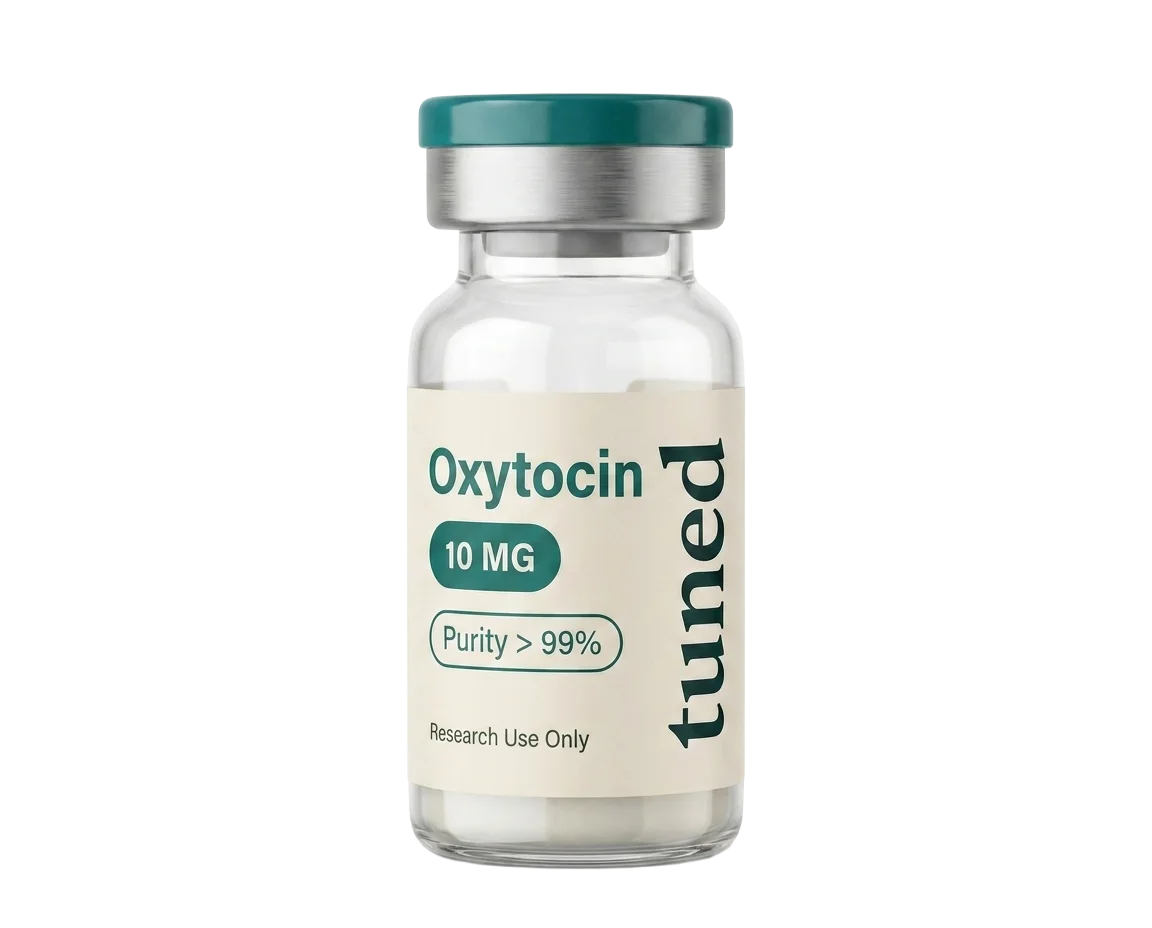
tuned Oxytocin
For laboratory research use only · available to researchers. Specifications, pricing & Certificate of Analysis on the product page.
Oxytocin with tadalafil and PT-141
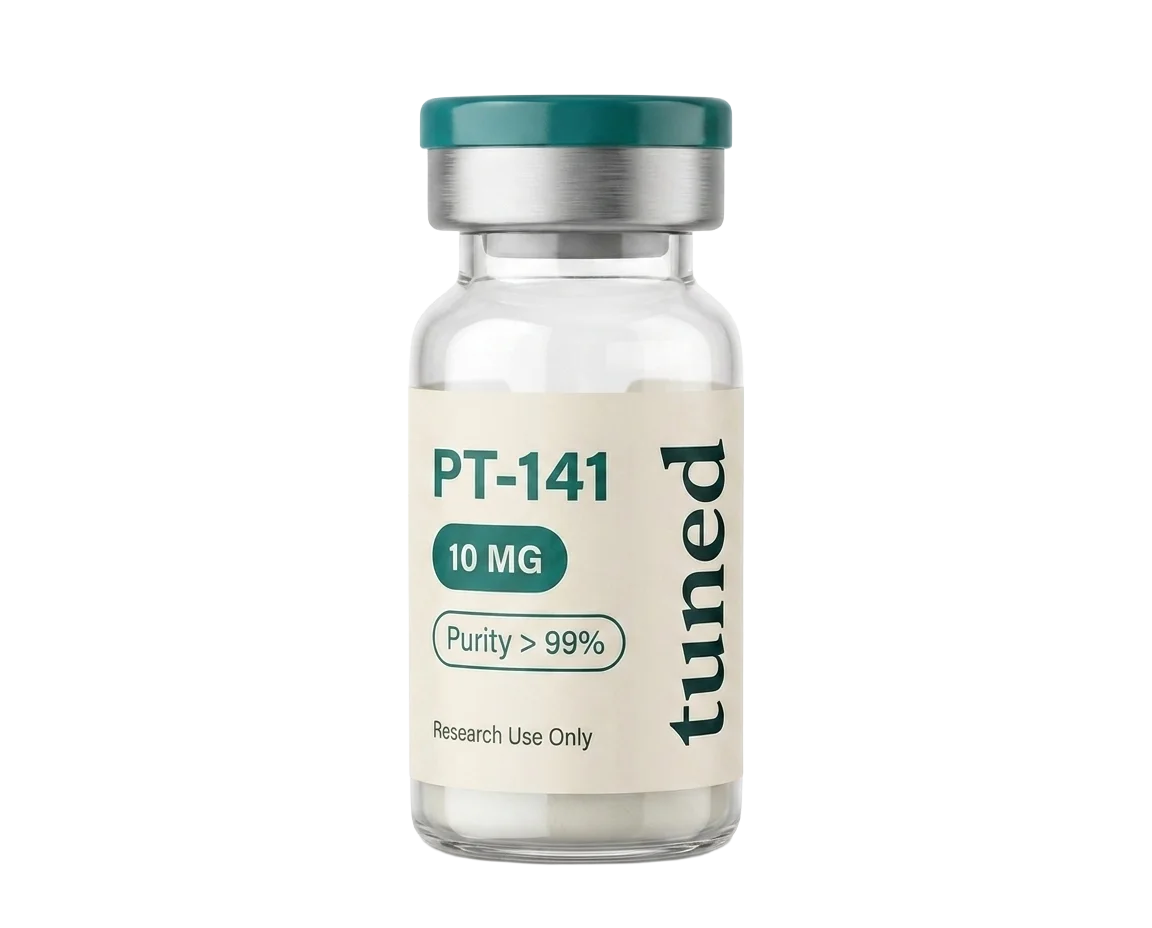
A recurring set of searches pairs oxytocin with erectile-dysfunction or libido compounds — "oxytocin and tadalafil," "tadalafil oxytocin PT-141." The rationale people cite is hitting different parts of the sexual response: tadalafil (a PDE5 inhibitor) on the vascular side, PT-141 (a melanocortin agonist) on central desire, and oxytocin on bonding/arousal.
What's actually known about these combinations
The honest answer is very little in controlled form: there is no robust trial evidence validating oxytocin-plus-tadalafil or oxytocin-plus-PT-141 combinations, and they are community/clinic theories rather than established protocols. We don't provide study protocol or combination instructions. For the melanocortin compound, see the PT-141 guide, which covers its own randomized-trial record. Each of these is a separate compound with its own status, and oxytocin itself is not approved for sexual use.
Common questions
Do men use oxytocin, and does it work for them?
What does oxytocin do in the male sexual response?
Can oxytocin be combined with tadalafil or PT-141?
Is oxytocin a libido booster for men?
Is oxytocin approved for men's sexual or bonding use?
References
- Carmichael MS, Humbert R, Dixen J, et al. Plasma oxytocin increases in the human sexual response. J Clin Endocrinol Metab, 1987;64(1):27–31. PMID 3782434. (Endogenous oxytocin rise during sexual response, both sexes.)
- Salonia A, Nappi RE, Pontillo M, et al. Menstrual cycle-related changes in plasma oxytocin are relevant to normal sexual function in healthy women. Horm Behav, 2005;47(2):164–169. PMID 15664019. (Oxytocin and normal sexual function.)
- Bancroft J. The endocrinology of sexual arousal. J Endocrinol, 2005;186(3):411–427. PMID 16135662. (Multi-hormonal context of arousal.)
- Heinrichs M, Baumgartner T, Kirschbaum C, et al. Social support and oxytocin interact to suppress cortisol and subjective responses to psychosocial stress. Biol Psychiatry, 2003;54(12):1389–1398. PMID 14675803. (Bonding/stress mechanism.)
- Muin DA, Sheikh Rezaei S, Tremmel-Scheinost M, et al. Men's sexual response to female partner's intranasal oxytocin administration for hypoactive sexual desire disorder. Fertil Steril, 2017;107(3):781–787. PMID 28189292. (Exploratory administration study.)
Oxytocin participates in the male sexual response — plasma oxytocin rises during the human sexual response [1] within a multi-hormonal arousal system [3], and oxytocin is tied to bonding/stress in both sexes [4]. Evidence that administering oxytocin reliably improves male desire, performance or bonding is limited and exploratory [5]; combinations with tadalafil/PT-141 are unvalidated. Oxytocin is FDA-approved only as an injectable obstetric drug — not for sexual, libido or bonding use — and the research-chemical is not the approved product. No study protocol provided. Not medical advice.
For research use only. Not for human consumption. This page summarises published research for educational purposes. It is not medical advice and is not intended to diagnose, treat, cure, or prevent any disease.