NAD+ side effects
NAD+ side effects are mostly tied to the IV route and infusion speed: nausea, flushing, light-headedness and a sense of chest or abdominal tightness when an NAD+ drip runs too fast — reactions that ease when it's slowed.[1] A controlled slow infusion reported no adverse events,[1] and NAD+ precursors were well tolerated in trials,[2] so these look like rate effects, not toxicity. NAD+ is not an FDA-approved drug, and long-term safety isn't established in large trials.
What are the side effects of NAD+?
Reported NAD+ side effects are mostly mild and linked to how it's given — especially the speed of an IV infusion — rather than to the molecule being toxic.[1]
NAD+ is something the body already makes and uses constantly, and its precursors were well tolerated in human trials.[2] The effects that come up are mainly route-related:
| Reported effect | Context |
|---|---|
| Nausea, flushing, light-headedness | During fast IV infusion; eases when slowed |
| Chest / abdominal tightness or pressure | Infusion-rate sensation; not documented at slow rates[1] |
| Injection-site reactions | Redness or soreness with subcutaneous shots — common to any injection |
| Serious toxicity | None documented at studied amounts[1] |
Why infusion speed drives the effects
The pattern researchers describe is consistent: the faster NAD+ goes in, the more likely the nausea-and-tightness reaction; slow it down and the reactions fade. That's why clinics run NAD+ drips over hours, and why the controlled slow-infusion pilot logged no adverse events.[1]
It's worth separating two things people lump together. The acute reactions above are about infusion speed and are transient. They're different from any question of long-term safety, which is a separate matter entirely — and one where the honest answer is that repeated IV or injected NAD+ simply hasn't been studied in large, long-term human trials. The reassuring tolerability seen in precursor studies[2] doesn't automatically transfer to high-dose IV NAD+, so the absence of serious reported toxicity should be read as limited evidence, not a clean bill of health.
NAD+ IV & injection side effects
By route, the picture splits. IV NAD+ side effects are the rate-dependent reactions above — the trade-off clinics manage by slowing the drip. NAD+ injections (shots) add the ordinary injection-site effects of any subcutaneous shot — transient redness or soreness — while delivering a smaller amount than an IV.
The risk that often matters most
For any research compound given by injection, a major real-world variable is material quality — contamination, endotoxin or wrong potency in lower-grade product. Third-party testing and a batch Certificate of Analysis address this more directly than any community rule, which is why they matter for NAD+ as much as for any peptide.
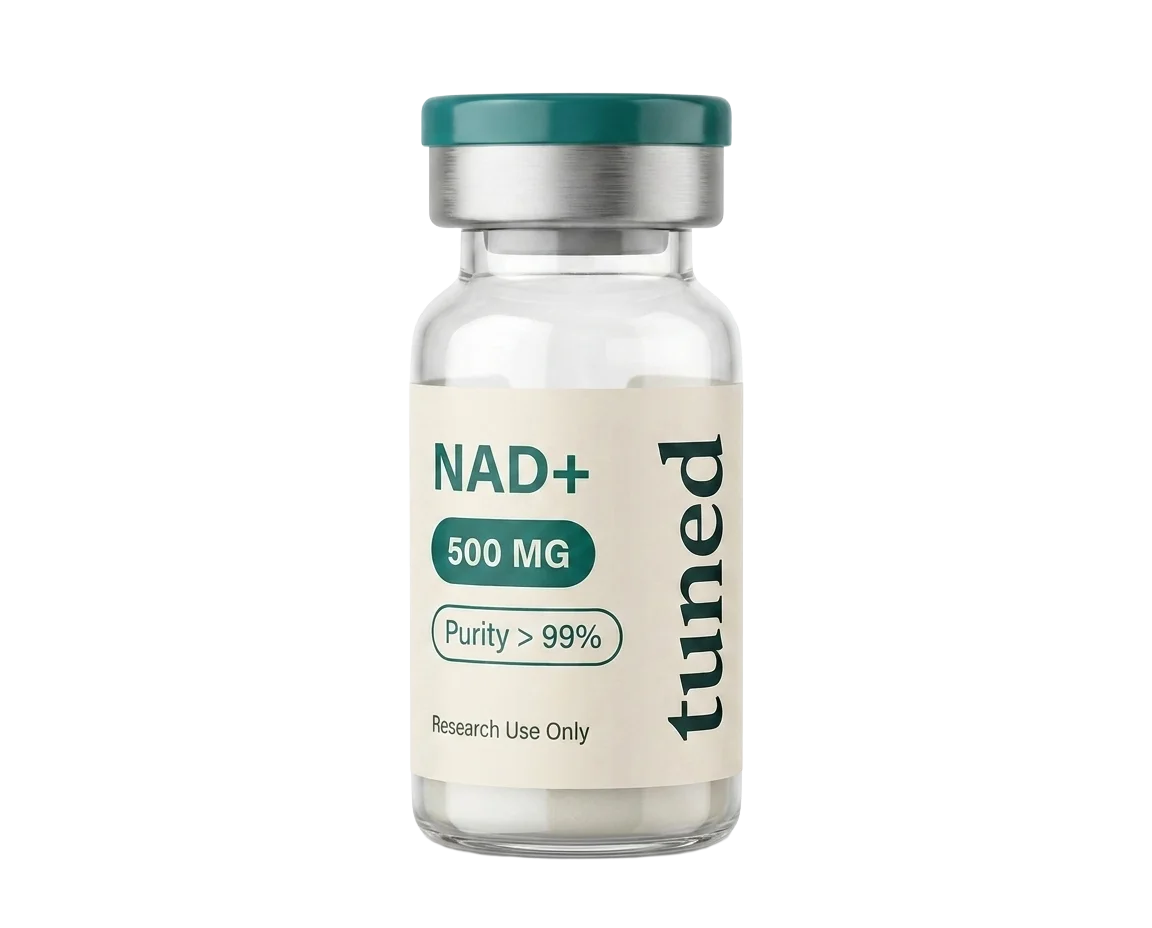
tuned NAD+
For laboratory research use only · available to researchers. Specifications, pricing & Certificate of Analysis on the product page.
Are NAD+ injections safe?
In the available research, NAD+ looks low-risk: precursors were well tolerated in trials,[2] and a controlled slow IV infusion produced no adverse events.[1] But "low-risk in the studies that exist" is not the same as proven long-term safety — IV and injected NAD+ haven't been tested in large controlled trials, and NAD+ is not FDA-approved.
What can't be claimed
So "are NAD+ injections safe?" can't be answered with an unqualified yes. The reassuring signals are real, but limited; the realistic risks are infusion-rate reactions (manageable by slowing) and material quality (manageable with a CoA). Treat confident safety guarantees as unverified.
How long do NAD+ side effects last?
Published reports associate some adverse effects with infusion rate, but the available evidence is too limited to establish a general safety profile or provide management guidance for research material.
The honest framing for "how long do NAD+ side effects last" is therefore: the documented effects are the brief, rate-related ones, which resolve quickly. Anything beyond that — lingering or delayed effects — isn't characterised in the literature, which is a gap in the evidence rather than a reassurance. The practical lever researchers point to is prevention over duration: a slower infusion avoids most of the reaction in the first place, and verified material avoids the contamination risks that a low-grade product could add.
This is educational, not medical advice. NAD+ is not an approved drug; tuned supplies it for research use only.
Common questions
What are the side effects of NAD+?
Are NAD+ injections safe?
Is NAD+ FDA approved?
References
- Grant R, Berg J, Mestayer R, et al. A pilot study investigating changes in the human plasma and urine NAD+ metabolome during a 6 hour intravenous infusion of NAD+. Frontiers in Aging Neuroscience, 2019;11:257. PMID 31572171.
- Martens CR, Denman BA, Mazzo MR, et al. Chronic nicotinamide riboside supplementation is well-tolerated and elevates NAD+ in healthy middle-aged and older adults. Nature Communications, 2018;9(1):1286. PMID 29599478.
- Verdin E. NAD+ in aging, metabolism, and neurodegeneration. Science, 2015;350(6265):1208–1213. PMID 26785480.
Side-effect statements reflect the available research: a controlled slow IV infusion reported no adverse events [1], and precursors were well tolerated [2]. Infusion-rate reactions are real but community/clinic-described and not from a controlled trial at fast rates. IV/injected NAD+ is not tested in large trials and NAD+ is not FDA-approved. Not medical advice.
For research use only. Not for human consumption. This page summarises published research for educational purposes. It is not medical advice and is not intended to diagnose, treat, cure, or prevent any disease.