What is NAD+?
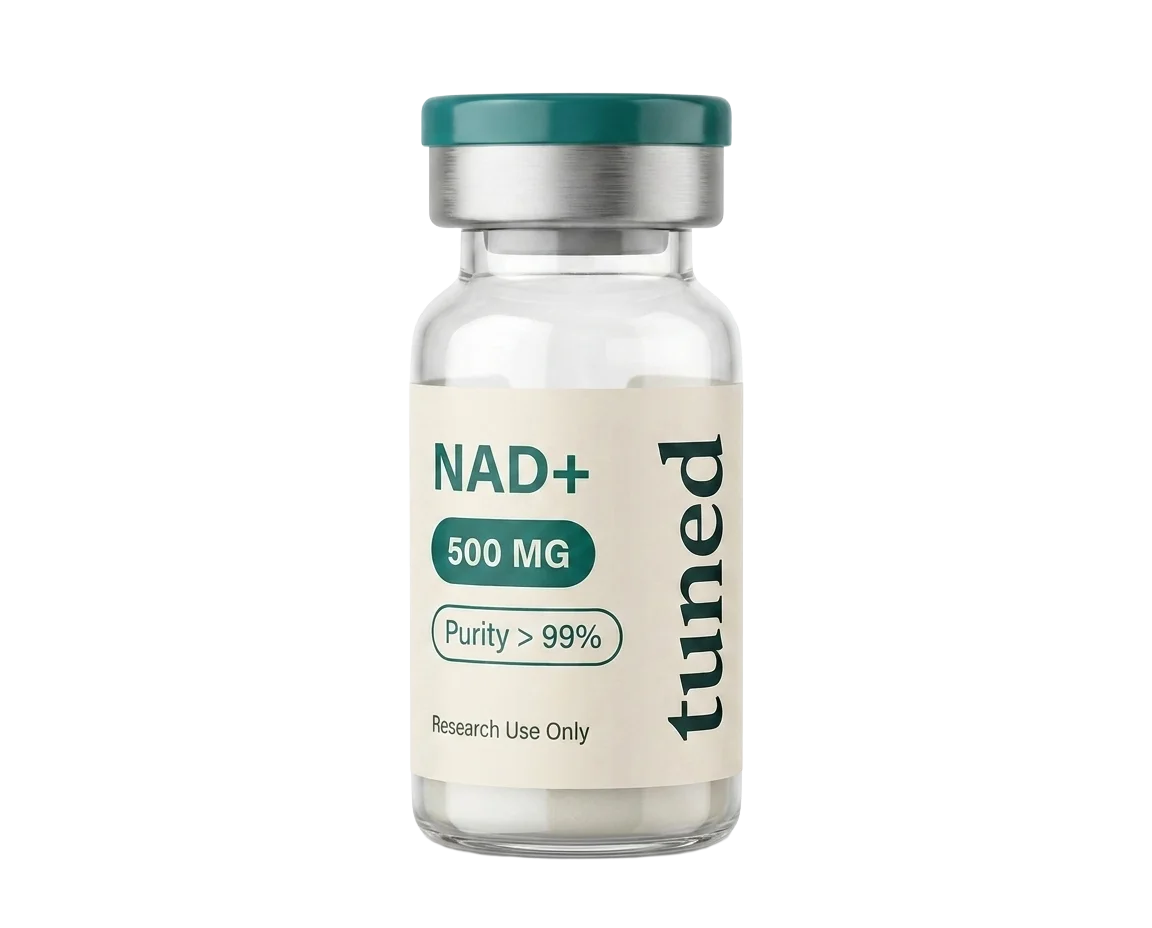
NAD+ (nicotinamide adenine dinucleotide) is a coenzyme found in every living cell. It does two big jobs: it carries the electrons that turn food into cellular energy, and it fuels "longevity" enzymes called sirtuins.[1] NAD+ levels fall as we age,[3] which is why it's central to aging research. It is not a peptide — it's a dinucleotide — and it's studied as IV drips, injections and supplements (mostly its precursors, NMN and NR).
What is NAD+, exactly?
NAD+ stands for nicotinamide adenine dinucleotide. It's a coenzyme — a small helper molecule — present in every cell of the body, where it's essential for turning nutrients into usable energy.[1][2]
Chemically it's a dinucleotide: two nucleotides (one built around nicotinamide, the other around adenine) joined through their phosphate groups. That structure matters for one of the most common misconceptions about it, which we'll address next.
NAD+ exists in two interconverting forms — NAD+ (the "empty," oxidized form) and NADH (the "loaded," reduced form that's carrying electrons). The pair shuttles electrons during metabolism, which is the chemical basis of how cells make energy. Levels of NAD+ are highest when we're young and decline with age,[3] a finding that put NAD+ at the centre of longevity science.
Is NAD+ a peptide?
No — NAD+ is not a peptide. It's a dinucleotide coenzyme, built from nucleotides, not from amino acids.[1]
The distinction is worth keeping straight because it explains a lot about how NAD+ behaves: as a coenzyme it works with the body's enzymes rather than acting like a signalling peptide, and its precursors (NMN, NR) are themselves nucleotide-based, not peptides either.
What does NAD+ do?
NAD+ has two distinct roles, and both are central to how cells function. The first is metabolic; the second is regulatory.
- It carries energy. In the reactions that break down food (glycolysis, the TCA cycle, oxidative phosphorylation), NAD+ accepts electrons to become NADH, then hands them off to make ATP — the cell's energy currency.[2]
- It fuels sirtuins and PARPs. NAD+ is the required fuel for sirtuins (including SIRT1), enzymes tied to cellular repair and aging, and for PARPs involved in DNA repair.[1]
- It's consumed by CD38. An enzyme called CD38 uses up NAD+, and its activity rises with age — one reason NAD+ levels fall over time.[4]
What NAD+ does for energy & aging
Those roles are why NAD+ is framed around energy and aging: the energy link is direct (no NAD+, no efficient ATP production), and the aging link runs through the sirtuins it fuels and the age-related decline in its levels.[3] Most of the excitement is mechanistic and preclinical, with the strongest human evidence coming from its precursors rather than NAD+ given directly — a distinction we keep throughout this guide.
tuned NAD+
For laboratory research use only · available to researchers. Specifications, pricing & Certificate of Analysis on the product page.
How does NAD+ work?
NAD+ works as a go-between. On the energy side, it cycles continuously between its two forms: it picks up electrons (becoming NADH) from the breakdown of food, carries them to the mitochondria, and releases them to drive ATP production — then returns to NAD+ to do it again.[2] This cycle runs millions of times a second across the body.
The sirtuin and CD38 angle
On the regulatory side, NAD+ is spent rather than recycled. Sirtuins like SIRT1 consume NAD+ each time they act on a target, which is how the cell's energy status (reflected in NAD+ levels) gets linked to repair and longevity pathways.[1] Working against that, the enzyme CD38 also consumes NAD+, and because CD38 activity climbs with age, it drains the very pool the sirtuins depend on.[4] A 2016 study from Eduardo Chini's group identified CD38 as a key driver of this age-related NAD+ decline.[4]
Why raising NAD+ is the goal
Put those together and the research logic is simple: NAD+ falls with age while demand for it stays high, so the field is focused on restoring it. The catch is delivery — which is why precursors, IV drips, injections and other formats all exist, each trying to get NAD+ levels back up by a different route.
NAD+ vs NADH
NAD+ and NADH aren't different substances — they're the same coenzyme in two states. NAD+ is the oxidized form (ready to accept electrons); NADH is the reduced form (carrying electrons it has picked up).[2] The cell constantly converts one into the other, and the ratio between them is a readout of its metabolic state.
| NAD+ | NADH | |
|---|---|---|
| Form | Oxidized ("empty") | Reduced ("loaded") |
| Role | Accepts electrons | Carries electrons to make ATP |
| Fuels sirtuins? | Yes — the active cosubstrate | No |
When people talk about "boosting NAD+," they usually mean raising the total pool and keeping enough in the NAD+ form to fuel sirtuins — not converting it to NADH.
NAD+ benefits
The reported NAD+ benefits centre on energy and aging: better mitochondrial energy production, support for the sirtuin repair pathways, and interest in healthy aging and recovery.[1][3] It's important to be precise about the evidence, though — the strongest human results come from NAD+ precursors (NR and NMN), which have been shown in controlled trials to raise NAD+ levels and are generally well tolerated.[5][6] Direct NAD+ benefits via IV or injection are mostly supported by mechanism and small studies, not large trials.
Full NAD+ benefits guide — energy, aging & what the evidence shows →
NAD+ side effects
NAD+ precursors were generally well tolerated in the cited human trials.[6] Separate clinical literature has reported formulation- and infusion-rate-related adverse effects, but those findings do not establish a general safety profile or provide management guidance for research material.[1]
Full NAD+ side effects guide — IV, injections & how long they last →
NAD+ forms and is NAD+ FDA approved?
NAD+ is researched in several forms: IV drips and injections (the compound given directly), oral precursors (NR and NMN, which the body converts to NAD+), and unproven formats like patches and nasal sprays. On approval: NAD+ itself is not an FDA-approved drug — IV NAD+ is offered through compounding pharmacies and wellness clinics, not as an approved medicine. Among precursors, NR is sold as a dietary supplement, and NMN's status shifted in 2025 to again being lawful in U.S. supplements.
NAD+ and resveratrol
NAD+ is often discussed alongside resveratrol because resveratrol is studied as a sirtuin activator — so the logic is that NAD+ supplies the fuel while resveratrol nudges the enzymes that use it. The pairing is popular in longevity circles, but it's a mechanistic rationale and community practice, not a combination proven in large human trials. See the NAD+ vs NMN guide for how the precursors compare.
Common questions
Is NAD+ a peptide?
What does NAD+ do?
What's the difference between NAD+ and NADH?
Does NAD+ decline with age?
Is NAD+ FDA approved?
NAD+ research evidence & more
This page is the overview. For the specifics, these guides go deeper:
Related research peptide guides
References
- Verdin E. NAD+ in aging, metabolism, and neurodegeneration. Science, 2015;350(6265):1208–1213. PMID 26785480.
- Cantó C, Menzies KJ, Auwerx J. NAD+ metabolism and the control of energy homeostasis: a balancing act between mitochondria and the nucleus. Cell Metabolism, 2015;22(1):31–53. PMID 26118927.
- Massudi H, Grant R, Braidy N, et al. Age-associated changes in oxidative stress and NAD+ metabolism in human tissue. PLoS One, 2012;7(7):e42357. PMID 22848760.
- Camacho-Pereira J, Tarragó MG, Chini CCS, et al. CD38 dictates age-related NAD decline and mitochondrial dysfunction through an SIRT3-dependent mechanism. Cell Metabolism, 2016;23(6):1127–1139. PMID 27304511.
- Trammell SAJ, Schmidt MS, Weidemann BJ, et al. Nicotinamide riboside is uniquely and orally bioavailable in mice and humans. Nature Communications, 2016;7:12948. PMID 27721479.
- Martens CR, Denman BA, Mazzo MR, et al. Chronic nicotinamide riboside supplementation is well-tolerated and elevates NAD+ in healthy middle-aged and older adults. Nature Communications, 2018;9(1):1286. PMID 29599478.
Sources are peer-reviewed. The strongest human evidence for raising NAD+ is from precursors (NR/NMN) [5–6]; direct NAD+ IV/injection evidence is limited and largely uncontrolled. NAD+ declines with age [3]. NAD+ is a coenzyme, not a peptide. Regulatory status (esp. NMN) is evolving; verify current FDA position. Not medical advice.
For research use only. Not for human consumption. This page summarises published research for educational purposes. It is not medical advice and is not intended to diagnose, treat, cure, or prevent any disease.