NAD+ benefits
The reported NAD+ benefits centre on energy and aging: NAD+ powers the reactions that turn food into cellular energy, and it fuels the sirtuin enzymes tied to repair and longevity.[1][2] Because NAD+ falls with age,[3] raising it is the central research goal. The most reliable human evidence comes from NAD+ precursors (NR and NMN), which raised NAD+ and were well tolerated in controlled trials;[4][5] direct NAD+ benefits are supported mainly by mechanism. These are research findings, not treatment claims.
What are the benefits of NAD+?
The benefits of NAD+ that show up in research follow from its two jobs — making cellular energy and fuelling the sirtuin repair enzymes — so they cluster around energy, metabolism and healthy aging.[1]
NAD+ is a coenzyme every cell depends on, and its level is a kind of readout of cellular health that declines with age.[3] From that, the literature describes a set of related, research-reported benefits:
| Reported benefit | Basis in the research | Evidence |
|---|---|---|
| Cellular energy | NAD+/NADH carries electrons to make ATP | Established biochemistry[2] |
| Healthy aging / repair | Fuels sirtuins (SIRT1); NAD+ declines with age | Mechanistic + human tissue[1][3] |
| Raised NAD+ levels | Precursors NR/NMN raise NAD+ in trials | Human RCTs (precursors)[4][5] |
| Metabolic support | NMN improved muscle insulin sensitivity | Human RCT (NMN)[5] |
The energy & sirtuin mechanism behind the benefits
Every benefit traces to the same place: NAD+ is both the electron carrier that lets mitochondria produce ATP and the fuel sirtuins burn to do repair work.[1][2] Restore NAD+ and, in principle, you support both — which is the unifying logic behind the energy and longevity interest.
NAD+ for energy & cellular health
NAD+ for energy is the most direct benefit, because the link is literal biochemistry rather than a downstream effect. Without enough NAD+, cells cannot efficiently convert nutrients into ATP, so the "energy" framing reflects NAD+'s core role as the electron shuttle of metabolism.[2]
Why energy is the headline benefit
This is also where the honest line sits. That NAD+ is required for energy production is settled; that supplementing NAD+ makes a healthy person feel more energetic is not the same claim, and it isn't established by large trials. The clearest human evidence is that precursors raise NAD+ levels[4] — a measurable biochemical change — rather than a proven boost in subjective energy.
The "cellular health" framing works the same way. NAD+ is consumed by repair enzymes (sirtuins and PARPs) and by CD38, and the balance between making and spending it reflects how a cell is coping with stress and age.[1] Keeping that pool topped up is the rationale behind the cellular-health benefit — a coherent idea grounded in real biochemistry, but one whose payoff in healthy people is still being studied rather than demonstrated.
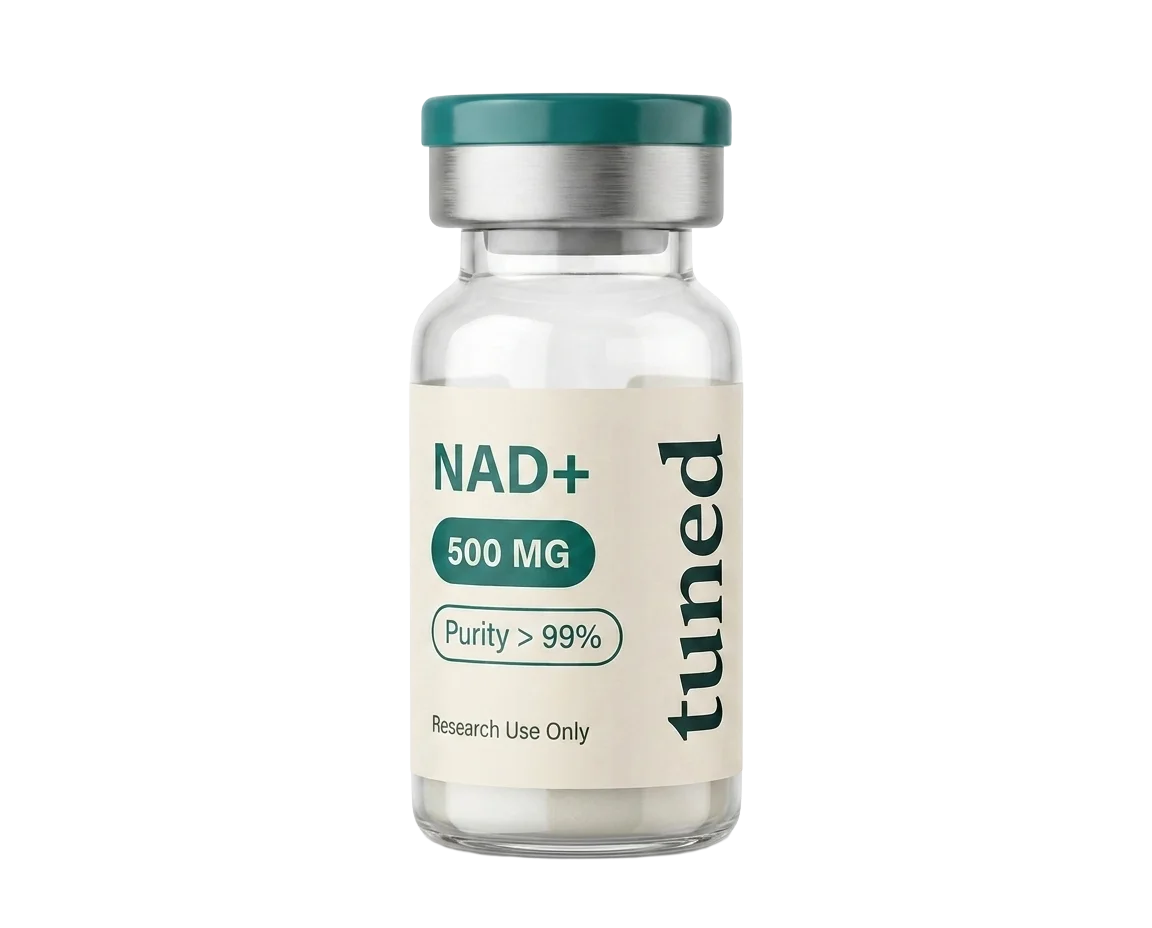
tuned NAD+
For laboratory research use only · available to researchers. Specifications, pricing & Certificate of Analysis on the product page.
NAD+ for aging & longevity
NAD+ for aging is the benefit driving most of the research interest, and it rests on a documented fact: NAD+ levels decline with age in human tissue.[3] Because NAD+ fuels the sirtuins involved in cellular repair, the hypothesis is that restoring NAD+ supports healthier aging.[1]
What the longevity evidence shows
In humans, the strongest results are from precursors: chronic nicotinamide riboside raised NAD+ and was well tolerated in middle-aged and older adults,[4] and NMN improved muscle insulin sensitivity in a randomized trial.[5] These are meaningful biochemical and metabolic outcomes — but "raises NAD+ and improves a metabolic marker" is not the same as "extends lifespan," which remains unproven in people. The longevity case is promising and mechanistically grounded, not settled.
NAD+ benefits for men
"NAD+ benefits for men" is a common search, but there's nothing male-specific in NAD+'s biology — it's a universal coenzyme, and its energy and aging roles apply to everyone.[1] The framing reflects NAD+'s popularity in men's longevity and performance communities rather than a different effect by sex. The same honest caveats apply: energy and aging benefits are mechanism-led, with the firm human evidence on precursors raising NAD+.[4]
None of this is a treatment claim. NAD+ is not an approved drug; benefits described here are research findings about a coenzyme, not promises of a clinical outcome.
Common questions
What are the benefits of NAD+?
Does NAD+ give you more energy?
Is NAD+ good for aging and longevity?
Are NAD+ benefits different for men?
How strong is the evidence for NAD+ benefits?
References
- Verdin E. NAD+ in aging, metabolism, and neurodegeneration. Science, 2015;350(6265):1208–1213. PMID 26785480.
- Cantó C, Menzies KJ, Auwerx J. NAD+ metabolism and the control of energy homeostasis. Cell Metabolism, 2015;22(1):31–53. PMID 26118927.
- Massudi H, Grant R, Braidy N, et al. Age-associated changes in oxidative stress and NAD+ metabolism in human tissue. PLoS One, 2012;7(7):e42357. PMID 22848760.
- Martens CR, Denman BA, Mazzo MR, et al. Chronic nicotinamide riboside supplementation is well-tolerated and elevates NAD+ in healthy middle-aged and older adults. Nature Communications, 2018;9(1):1286. PMID 29599478.
- Yoshino M, Yoshino J, Kayser BD, et al. Nicotinamide mononucleotide increases muscle insulin sensitivity in prediabetic women. Science, 2021;372(6547):1224–1229. PMID 33888596.
NAD+ benefits are grounded in established biochemistry [1,2] and the documented age-related decline [3]. The firmest human evidence is from precursors NR/NMN raising NAD+ and improving a metabolic marker [4,5]; direct NAD+ injection/IV outcomes are not established in large trials. NAD+ is a coenzyme, not an approved drug. Benefits are research findings, not treatment claims. Not medical advice.
For research use only. Not for human consumption. This page summarises published research for educational purposes. It is not medical advice and is not intended to diagnose, treat, cure, or prevent any disease.