NAD+ vs NMN
NAD+ and NMN aren't rivals so much as different points on the same path: NMN (nicotinamide mononucleotide) is a precursor the body converts into NAD+, the active coenzyme.[2] The precursor chain runs NR → NMN → NAD+. In humans, oral precursors (NR and NMN) have controlled-trial evidence for raising NAD+,[1][3] whereas direct NAD+ is given by IV/injection. NADH is just NAD+'s reduced form, and NAC is an unrelated compound often confused with it.
NAD+ vs NMN — what's the difference?
The core difference: NMN is a precursor and NAD+ is the destination. The body takes NMN and converts it into NAD+, the coenzyme that actually does the work.[2]
It helps to see the whole chain. Vitamin B3 forms (niacin, nicotinamide) and NR (nicotinamide riboside) feed into NMN, which is then converted into NAD+.[2] Controlled human trials reported that certain NR and NMN products raised measured NAD+ levels.[1][3] Those formulation-specific findings do not establish guidance for the research material sold on this site.
This is why "NAD+ vs NMN" is slightly the wrong question. They're not competing products doing the same job differently — they're a precursor and its product, so the practical comparison is really about route and evidence: NMN is the oral, trial-backed way to raise NAD+, while direct NAD+ is the inject-it approach with thinner human data. Choosing between them is choosing how you want to raise the same NAD+ pool, not picking between two different effects.
| NAD+ | NMN | |
|---|---|---|
| What it is | The active coenzyme | A precursor to NAD+ |
| Position | Destination | One step before NAD+ |
| Typical route | IV / injection | Oral (capsule/powder) |
| Human evidence for raising NAD+ | Limited (IV pilot) | Controlled trials[3] |
NAD+ vs NADH
NAD+ vs NADH is a different kind of comparison — not two molecules, but one coenzyme in two states. NAD+ is the oxidized form that accepts electrons; NADH is the reduced form carrying them.[4] They interconvert constantly during energy metabolism. NMN and NR are precursors that build the NAD+ pool; NADH is simply that pool's electron-loaded state. So "NAD+ vs NADH" is about redox state, while "NAD+ vs NMN" is about precursor vs product.
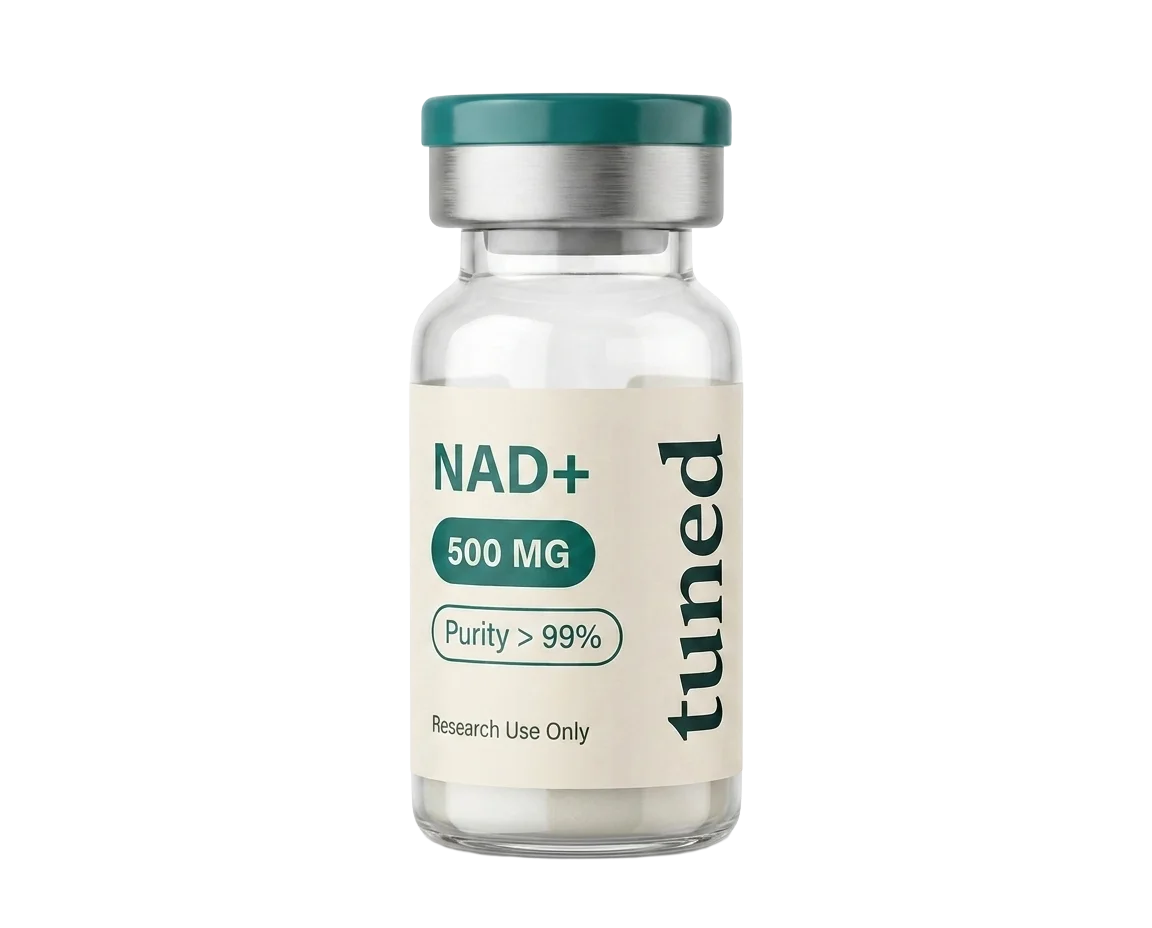
tuned NAD+
For laboratory research use only · available to researchers. Specifications, pricing & Certificate of Analysis on the product page.
NAD+ vs NR (nicotinamide riboside)
NR (nicotinamide riboside) is the other major NAD+ precursor, sitting one step before NMN in the chain.[2] Like NMN, it's an oral molecule the body converts to NAD+ — and NR has some of the clearest human pharmacokinetic data: a controlled study showed oral NR is uniquely well absorbed and raises the blood NAD+ metabolome.[1] In practice, NR and NMN are the two precursors with real human trials behind them; the choice between them is an active research debate rather than a settled answer.
A note on NAC vs NAD
One common mix-up: NAC (N-acetylcysteine) is not a NAD+ compound at all. It's an unrelated amino-acid derivative used as a glutathione precursor, and "NAC vs NAD" usually reflects a spelling confusion rather than a real comparison. If you're comparing ways to raise NAD+, the relevant molecules are NMN and NR, not NAC.
Between NR and NMN themselves, the practical question is which the body uses more efficiently, and that's genuinely unsettled. NR has the older and more extensive human pharmacokinetic record,[1] while NMN has its own growing set of trials;[3] both reliably raise NAD+, and head-to-head human comparisons are scarce. For research purposes the useful point is that both are legitimate, evidence-backed precursors — the choice is a matter of ongoing study, not a clear winner.
Has combined NMN and NAD+ been studied?
People often ask whether NMN and NAD+ can be combined, the logic being "supply the precursor and the product at once." Because both ultimately raise the same NAD+ pool, there's no obvious chemical conflict — but there's also no controlled trial of the combination, so any added benefit from stacking them is unproven, and the sensible research framing is one variable at a time.[3] Stacking also makes results harder to interpret: if two inputs feed the same pool, you can't tell which one moved it, so a combination tells you less, not more, about what's actually working.
tuned supplies research-grade NAD+ for laboratory research. NMN and NR are precursors with their own regulatory status (NR is a supplement; NMN became lawful again in U.S. supplements in 2025). This page is educational, not medical advice.
Common questions
What is the difference between NAD+ and NMN?
What is the difference between NAD+ and NADH?
NAD+ vs NR — which is better?
Is NAC the same as NAD?
References
- Trammell SAJ, Schmidt MS, Weidemann BJ, et al. Nicotinamide riboside is uniquely and orally bioavailable in mice and humans. Nature Communications, 2016;7:12948. PMID 27721479.
- Cantó C, Menzies KJ, Auwerx J. NAD+ metabolism and the control of energy homeostasis. Cell Metabolism, 2015;22(1):31–53. PMID 26118927.
- Yoshino M, Yoshino J, Kayser BD, et al. Nicotinamide mononucleotide increases muscle insulin sensitivity in prediabetic women. Science, 2021;372(6547):1224–1229. PMID 33888596.
- Verdin E. NAD+ in aging, metabolism, and neurodegeneration. Science, 2015;350(6265):1208–1213. PMID 26785480.
Precursor chain and identities are from peer-reviewed sources [1,2,4]. Human evidence for raising NAD+ via precursors: NR pharmacokinetics [1] and an NMN RCT [3]. NADH is the reduced form of NAD+. NAC is unrelated. Regulatory status (esp. NMN) is evolving; verify current FDA position. Not medical advice.
For research use only. Not for human consumption. This page summarises published research for educational purposes. It is not medical advice and is not intended to diagnose, treat, cure, or prevent any disease.