What is MOTS-C?
MOTS-C is a tiny 16-amino-acid peptide — and an unusual one, because it's encoded inside your mitochondria, not the main genome. In research it's studied as a metabolic regulator and "exercise mimetic": it activates the cell's energy sensor AMPK, improves insulin sensitivity in animals, and rises naturally with exercise.[1][3] Levels fall with age. It is not FDA-approved, and it's banned in sport by WADA.
What is MOTS-C, exactly?
MOTS-C stands for "Mitochondrial ORF of the 12S rRNA type-c." It's a short, 16-amino-acid peptide that the body makes itself — and it belongs to a special class called mitochondrial-derived peptides.[1]
What makes it remarkable is where it comes from. Most of the body's proteins are encoded by DNA in the cell nucleus; MOTS-C is encoded by a small stretch of DNA inside the mitochondria — the cell's energy factories — specifically within the 12S rRNA gene.[1] It was discovered in 2015 by Changhan Lee and Pinchas Cohen's group at USC.
That mitochondrial origin is the whole story: MOTS-C acts as a signal from the energy factories to the rest of the cell, coordinating metabolism. It is studied for insulin sensitivity, exercise biology and aging.
Is MOTS-C a peptide?
Yes — MOTS-C is a peptide. Specifically, it's a mitochondrial-derived peptide (MDP): a short chain of 16 amino acids encoded within mitochondrial DNA.[1]
So "MOTS-C peptide" is accurate. What's unusual isn't whether it's a peptide but where its instructions live — inside the mitochondria rather than the nucleus. That places it in a small, relatively newly recognised family of signalling peptides that come from the mitochondrial genome, of which MOTS-C is the best-studied member.
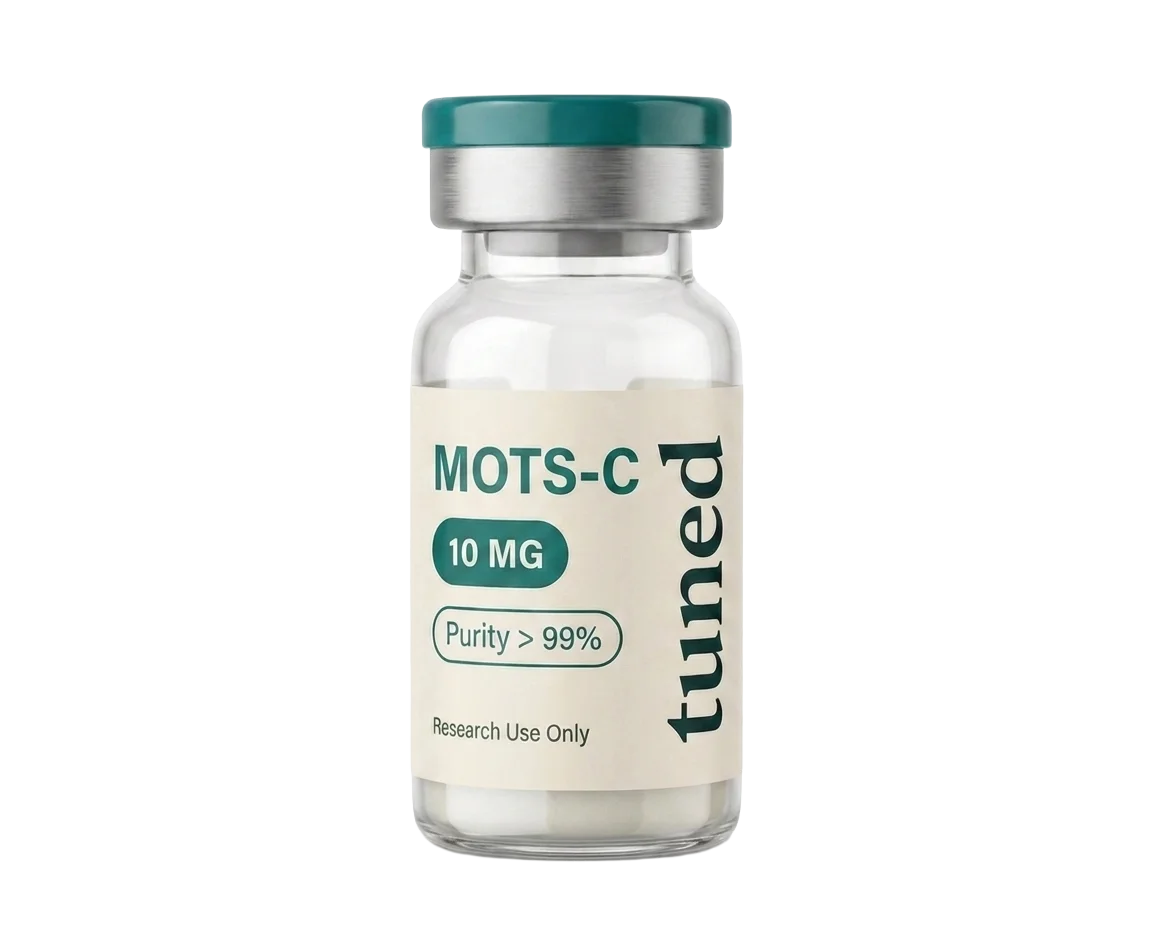
tuned MOTS-C
For laboratory research use only · available to researchers. Specifications, pricing & Certificate of Analysis on the product page.
What does MOTS-C do?
The clearest theme across MOTS-C research is metabolic regulation — it helps cells handle fuel efficiently, much as exercise does. The actions described in the literature are:
- Activates AMPK. MOTS-C switches on AMP-activated protein kinase, the cell's master energy sensor that promotes fuel-burning over fuel-storing.[1]
- Improves insulin sensitivity. In animal studies it reduced insulin resistance and protected against diet-induced obesity.[1]
- Acts as an "exercise mimetic." It's induced by exercise and, given to mice, improved physical performance — including in aged animals.[3]
- Responds to stress. Under metabolic stress it moves into the nucleus to switch on protective, stress-adaptive genes.[2]
MOTS-C, exercise & the "exercise mimetic" idea
The "exercise mimetic" framing comes from a real finding: exercise raises MOTS-C in human muscle and blood, and supplying it to mice reproduced some exercise-like benefits.[3] The honest qualifier — explained throughout — is that the administered-peptide efficacy is mouse data, while the human evidence is exercise-response (it rises when you train), not a trial of injecting it.
How does MOTS-C work?
MOTS-C works by acting as a metabolic stress signal, and its mechanism has two well-described parts: an energy-sensing pathway and a gene-regulating one.
The AMPK energy pathway
The headline mechanism is AMPK activation. MOTS-C interferes with the folate one-carbon cycle and the purine-building pathway downstream of it, which causes a metabolite (AICAR) to accumulate — and AICAR is a natural switch for AMPK.[1] Once AMPK is on, the cell shifts toward burning glucose and fat for energy and improves how it responds to insulin — the metabolic core of MOTS-C's effects.
Nuclear translocation under stress
The second mechanism is more surprising for a mitochondrial peptide: under metabolic stress (like low glucose), MOTS-C moves into the cell nucleus and helps switch on a set of protective, antioxidant and stress-adaptive genes, working with a master regulator called NRF2.[2] So MOTS-C is both an immediate energy-pathway activator and a longer-term stress-response coordinator — which is why it's tied to resilience and aging, since its levels decline as we get older.[3]
The two mechanisms also explain why MOTS-C reads as an 'exercise mimetic' rather than a stimulant: exercise stresses the mitochondria, raises AMPK and triggers the same stress-adaptive programs, and MOTS-C sits at the centre of that loop. It isn't forcing the body into a new state so much as nudging it toward the one training already produces — which is the appeal, and also why the honest evidence question is whether supplying it from outside reproduces what your own mitochondria do.
MOTS-C benefits
The reported MOTS-C benefits follow from its metabolism-and-energy biology: better energy and metabolic health, improved insulin sensitivity, exercise-like effects, and interest in healthy aging.[1][3] The evidence is strongest as mechanism plus animal studies, with the human side being exercise-response rather than trials of the injected peptide. As with everything here, these are research findings, not proven outcomes — and any "weight loss" angle is metabolic research, not a treatment.
Full MOTS-C benefits guide — energy, metabolism & exercise →
MOTS-C side effects
Human safety data for the native peptide is limited; reported effects are mild and anecdotal (injection-site reactions). The most-searched safety topic is "MOTS-C and cancer" — and the honest answer is that the research there is preclinical and mechanistic (animal and cell studies of metabolism), not evidence that MOTS-C treats or causes cancer.[4] MOTS-C is also banned by WADA for athletes.
Full MOTS-C side effects guide — the cancer question & WADA status →
Is MOTS-C FDA approved?
No — MOTS-C is not FDA-approved and is handled as a research chemical; there's no approved product and no completed trial of the native peptide. One important nuance: a company developed an engineered analog of MOTS-C, called CB4211, which reached an early-stage (Phase 1) human trial for fatty liver disease — but that's a different, modified molecule, the data is only preliminary topline, and it was never approved.[1] So human-trial claims you see for "MOTS-C" generally trace to that analog, not the peptide itself. For athletes, MOTS-C is explicitly named on the WADA Prohibited List as an AMPK activator, banned at all times.
How to choose MOTS-C
For a research peptide with no GMP supply chain, material quality is the dominant variable — endotoxin and impurities, not the molecule, are the realistic risks. A batch-specific Certificate of Analysis (UPLC purity, identity, endotoxin) does more for safety than any community convention; absence of a recent, lot-matched CoA is itself a risk signal.
Common questions
What is MOTS-C?
What does MOTS-C do?
Is there human evidence for MOTS-C?
Is MOTS-C banned by WADA?
Is MOTS-C FDA approved?
MOTS-C research evidence, benefits & more
This page is the overview. For the specifics, these guides go deeper:
Related research peptide guides
References
- Lee C, Zeng J, Drew BG, et al. The mitochondrial-derived peptide MOTS-c promotes metabolic homeostasis and reduces obesity and insulin resistance. Cell Metabolism, 2015;21(3):443–454. PMID 25738459. (Discovery; 16-aa; folate cycle → AMPK.)
- Kim KH, Son JM, Benayoun BA, Lee C. The mitochondrial-encoded peptide MOTS-c translocates to the nucleus to regulate nuclear gene expression in response to metabolic stress. Cell Metabolism, 2018;28(3):516–524. PMID 29983246.
- Reynolds JC, Lai RW, Woodhead JST, et al. MOTS-c is an exercise-induced mitochondrial-encoded regulator of age-dependent physical decline and muscle homeostasis. Nature Communications, 2021;12(1):470. PMID 33473109.
- Yang L, Li M, Liu Y, et al. MOTS-c is an effective target for treating cancer-induced bone pain through the induction of AMPK-mediated mitochondrial biogenesis. Acta Biochimica et Biophysica Sinica, 2024;56(9):1323–1339. PMID 38716540. (Mouse model — not a human cancer treatment.)
MOTS-C is a 16-aa mitochondrial-derived peptide that activates AMPK and improves insulin sensitivity [1], translocates to the nucleus under stress [2], and is exercise-induced and declines with age [3]. Administered-peptide efficacy is animal data; human data is exercise-response — no human RCT of the native peptide. The only human program (CB4211) was an engineered analog, Phase 1, not approved. "MOTS-C and cancer" research is preclinical/mechanistic [4], not a treatment. Not FDA-approved; WADA-prohibited (verify current list). Not medical advice.
For research use only. Not for human consumption. This page summarises published research for educational purposes. It is not medical advice and is not intended to diagnose, treat, cure, or prevent any disease.