MOTS-C side effects
Human safety data for the native MOTS-C peptide is limited — no completed trial of it exists.[1] Reported effects are mild and anecdotal (injection-site reactions). The most-searched safety topic is "MOTS-C and cancer," and the honest answer is that the research there is preclinical and mechanistic (animal and cell studies of metabolism)[2] — not evidence that MOTS-C treats or causes cancer. MOTS-C is not FDA-approved and is WADA-banned as an AMPK activator.
What are the side effects of MOTS-C?
Reported MOTS-C side effects are mild and anecdotal — there's no completed human trial of the native peptide to draw firm safety conclusions from.[1]
Because the native MOTS-C peptide hasn't been through a finished human trial, the "side effects" discussed come from user reports rather than documented data. The closest formal safety signal comes from an engineered analog (CB4211), where mild injection-site reactions were the notable issue:
| Reported effect | Context |
|---|---|
| Injection-site reactions | Redness or soreness — the most consistently noted effect; also seen with the CB4211 analog |
| Mild, transient effects | Anecdotal; not characterised in controlled studies of the native peptide |
| Serious toxicity | None documented — but that reflects absence of trials, not proven safety |
Injection-site & reported effects
The most consistently mentioned effect is local — soreness at the injection site, common to any subcutaneous peptide. The honest framing: "few reported side effects" mostly reflects the absence of a reporting channel and of completed trials of the native peptide, not established safety.
There's a useful detail in the one place MOTS-C-related biology was watched closely in humans: the CB4211 analog trial was actually paused over persistent (though mild) injection-site reactions before resuming under an amended protocol.[1] That's the kind of signal that only shows up under formal monitoring — and its absence for vendor MOTS-C isn't reassurance so much as a reminder that nobody is systematically collecting the data.
MOTS-C and cancer
"MOTS-C and cancer" is a common search, and the honest answer is that the research is preclinical and mechanistic — MOTS-C is not an approved or evidence-based cancer treatment, and there's no evidence it causes cancer.[2]
What actually exists is laboratory and animal work on MOTS-C's metabolic mechanism in cancer-related contexts. For example, a 2024 mouse study explored MOTS-C for cancer-induced bone pain via its AMPK and mitochondrial-biogenesis effects.[2] That's mechanism research in a disease model — a long way from "MOTS-C treats cancer," which no human study supports.
How to read the cancer research honestly
Two things can both be true: MOTS-C is a metabolic peptide that researchers study in many disease contexts (including some cancer-related models), and it is not a cancer therapy. Because cancer and metabolism are deeply linked, a metabolic peptide will naturally show up in cancer-biology papers — but appearing in mechanistic research is not the same as being a treatment, and none of this is medical advice.
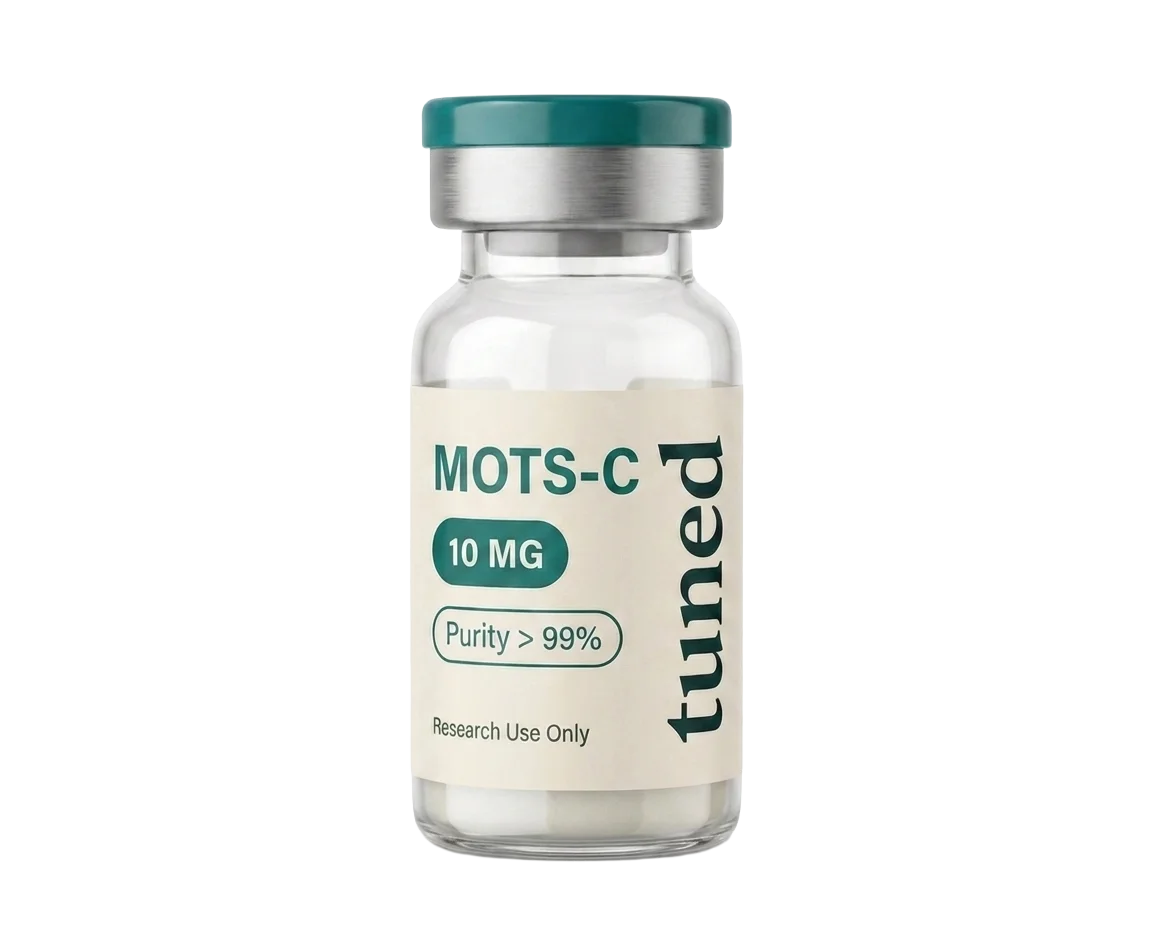
tuned MOTS-C
For laboratory research use only · available to researchers. Specifications, pricing & Certificate of Analysis on the product page.
Is MOTS-C safe, FDA approved & WADA banned?
Three clear answers. On safety: the native peptide has limited human data — no completed trial — so long-term safety isn't established; the realistic risk is material quality.[1] On FDA: MOTS-C is not FDA-approved and is a research chemical; the only human program was an engineered analog (CB4211), Phase 1, not approved. On WADA: MOTS-C is explicitly banned.
MOTS-C WADA status
MOTS-C is named on the WADA Prohibited List as an AMPK activator — the same metabolic-modulator class as AICAR — and is prohibited at all times, in and out of competition.[3] For any tested athlete, MOTS-C is a sanctionable substance; treat it as high-risk. (WADA updates the list annually, so verify the current edition.)
The material-quality risk
As with any research peptide without a GMP supply chain, the most realistic hazard isn't the molecule — it's what's in the vial. Endotoxin, impurities and incorrect potency are the genuine risks, and an endotoxin reaction can masquerade as a "side effect of the peptide." A batch-specific Certificate of Analysis (UPLC purity, identity, endotoxin) addresses this more directly than any community rule — and for a peptide with no GMP route to market, that document is effectively the only safety control available to a researcher.
FDA and WADA classifications update over time; verify current status before relying on it. This page is educational and not medical advice.
Common questions
What are the side effects of MOTS-C?
Does MOTS-C cause or treat cancer?
Is MOTS-C safe?
Is MOTS-C FDA approved?
Is MOTS-C banned by WADA?
References
- Lee C, Zeng J, Drew BG, et al. The mitochondrial-derived peptide MOTS-c promotes metabolic homeostasis and reduces obesity and insulin resistance. Cell Metabolism, 2015;21(3):443–454. PMID 25738459.
- Yang L, Li M, Liu Y, et al. MOTS-c is an effective target for treating cancer-induced bone pain through the induction of AMPK-mediated mitochondrial biogenesis. Acta Biochimica et Biophysica Sinica, 2024;56(9):1323–1339. PMID 38716540. (Mouse model.)
- Reynolds JC, Lai RW, Woodhead JST, et al. MOTS-c is an exercise-induced mitochondrial-encoded regulator of age-dependent physical decline and muscle homeostasis. Nature Communications, 2021;12(1):470. PMID 33473109.
No completed human trial of native MOTS-C exists [1]; reported effects are anecdotal. The "cancer" research is preclinical/mechanistic — e.g., a mouse cancer-pain model [2] — not a human treatment, and there is no evidence MOTS-C causes cancer. MOTS-C is not FDA-approved (the only human program, CB4211, was an engineered analog, not approved) and is WADA-banned as an AMPK activator [3]; verify current WADA/FDA status. Not medical advice.
For research use only. Not for human consumption. This page summarises published research for educational purposes. It is not medical advice and is not intended to diagnose, treat, cure, or prevent any disease.