MOTS-C benefits
The reported MOTS-C benefits centre on metabolism and energy: it activates the cell's energy sensor AMPK, improves insulin sensitivity in animals, acts as an "exercise mimetic," and is tied to healthy aging.[1][2] The honest framing is consistent throughout — the administered-peptide efficacy is animal data, and the human side is exercise-response (MOTS-C rises when you train), not trials of injecting it. These are research findings, not proven outcomes, and any weight angle is metabolic research, not a weight-loss claim.
What are the benefits of MOTS-C?
The benefits of MOTS-C that show up in research all trace to one thing — it helps cells handle fuel efficiently, much as exercise does.[1]
MOTS-C is a mitochondrial-derived peptide that signals metabolic state, and from that the literature describes a set of related, research-reported benefits:
| Reported benefit | Basis in the research | Evidence |
|---|---|---|
| Energy & metabolism | Activates AMPK; shifts cells toward burning fuel | Animal/cell[1] |
| Insulin sensitivity | Reduced insulin resistance in animal studies | Animal[1] |
| Exercise-like effects | Exercise-induced; improved performance given to mice | Mouse + human exercise-response[2] |
| Healthy aging | Declines with age; aided physical capacity in aged mice | Animal[2] |
The AMPK energy mechanism
Every benefit comes back to AMPK — the cell's master energy sensor. By activating AMPK, MOTS-C pushes cells toward burning glucose and fat rather than storing them, and toward responding better to insulin.[1] That single lever explains why the benefits cluster around energy, metabolic health and exercise.
MOTS-C for energy & metabolism
MOTS-C for energy is the most-searched benefit, and it's the most direct. The peptide's whole role is metabolic: by switching on AMPK it improves how efficiently cells produce and use energy, which is the biological basis for the "more energy" framing.[1]
MOTS-C and insulin sensitivity
The metabolism story is anchored by the discovery study: in animals, MOTS-C improved insulin sensitivity and protected against diet-induced obesity and metabolic dysfunction.[1] That's a genuine, mechanistically grounded finding — but it's animal data. The honest line is that MOTS-C is required for healthy energy metabolism and improves it in mice; whether injecting it boosts energy in healthy people is the part still unproven, since there's no human trial of the native peptide.
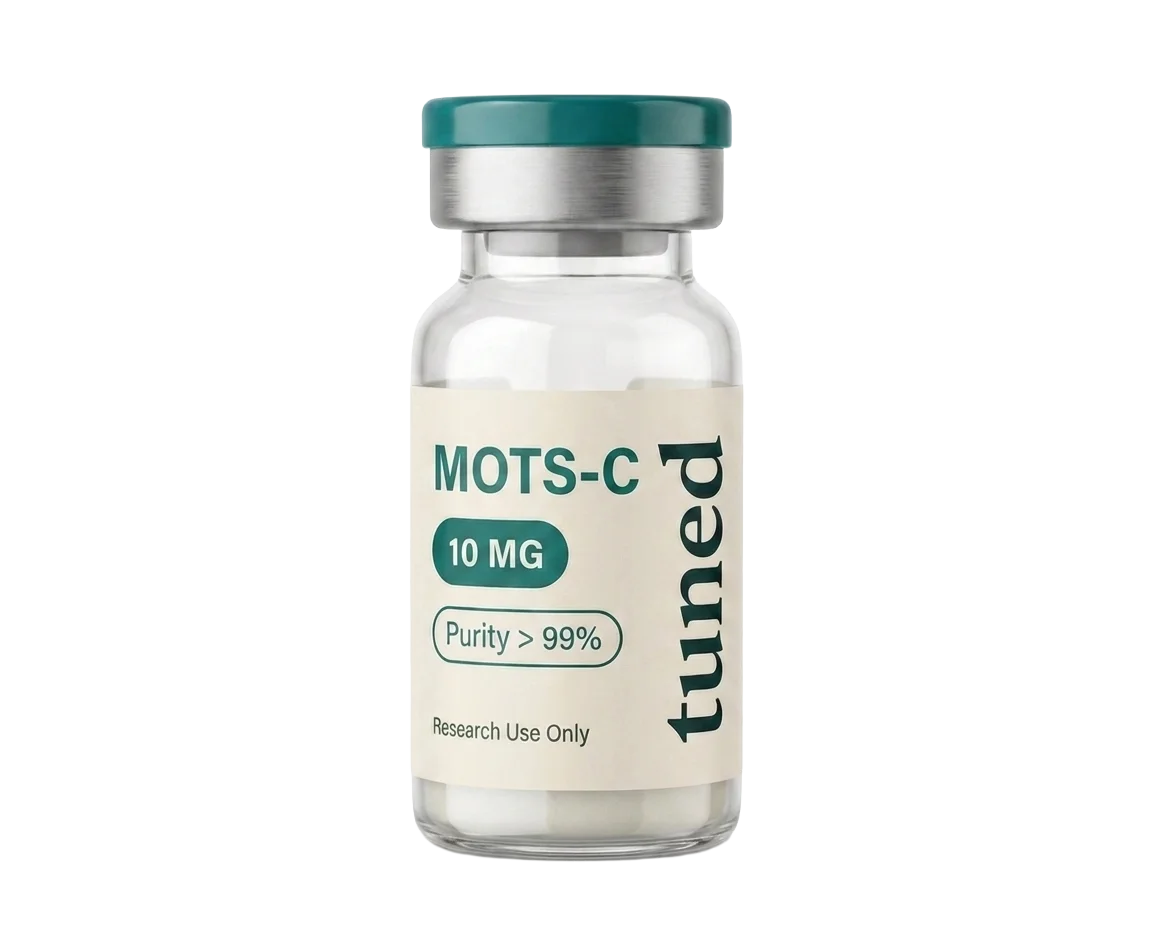
tuned MOTS-C
For laboratory research use only · available to researchers. Specifications, pricing & Certificate of Analysis on the product page.
MOTS-C for metabolic health & weight
Because MOTS-C improves insulin sensitivity and protected against diet-induced obesity in animals,[1] it's searched for "metabolic health" and weight — but this is exactly where precision matters. The animal data is about metabolic regulation, not a demonstrated weight-loss treatment in people.
Why "MOTS-C for weight loss" needs care
The honest position: there is no human trial of the native MOTS-C peptide for weight or metabolic disease. The closest human work was on an engineered analog (CB4211) in an early-stage trial for fatty liver, which reported preliminary biomarker signals and a weight trend — but that's a different, modified molecule that was never approved, and it shouldn't be read as evidence for vendor MOTS-C. So MOTS-C's weight/metabolic interest is a research direction grounded in animal metabolism, not a weight-loss aid — and we describe it as such, never as a treatment.
MOTS-C, exercise & aging
MOTS-C's "exercise mimetic" and aging benefits are the most distinctive, and they come from a 2021 study: exercise raises MOTS-C in human muscle and blood, and giving it to mice improved physical performance — including in aged animals, where MOTS-C levels are naturally lower.[2]
What the exercise-and-aging research shows
This is a real and elegant finding, but read it carefully on two fronts. First, the human part is observational — MOTS-C goes up when you exercise; it isn't a trial of injecting it to get fitter. Second, the performance and healthspan benefits from administering MOTS-C are mouse data. So the accurate summary is that MOTS-C is a genuine exercise-induced, age-declining metabolic regulator, and supplying it helps aged mice — a strong rationale for the longevity interest, not a proven human anti-aging effect.
None of this is a treatment claim. MOTS-C is not an approved drug; benefits here are research findings about a mitochondrial peptide, not promises of a clinical outcome.
Common questions
What are the benefits of MOTS-C?
Does MOTS-C give you more energy?
Is MOTS-C good for weight loss?
Is MOTS-C an exercise mimetic?
How strong is the evidence for MOTS-C benefits?
References
- Lee C, Zeng J, Drew BG, et al. The mitochondrial-derived peptide MOTS-c promotes metabolic homeostasis and reduces obesity and insulin resistance. Cell Metabolism, 2015;21(3):443–454. PMID 25738459.
- Reynolds JC, Lai RW, Woodhead JST, et al. MOTS-c is an exercise-induced mitochondrial-encoded regulator of age-dependent physical decline and muscle homeostasis. Nature Communications, 2021;12(1):470. PMID 33473109.
- Kim KH, Son JM, Benayoun BA, Lee C. The mitochondrial-encoded peptide MOTS-c translocates to the nucleus to regulate nuclear gene expression in response to metabolic stress. Cell Metabolism, 2018;28(3):516–524. PMID 29983246.
MOTS-C activates AMPK and improves insulin sensitivity in animals [1]; it is exercise-induced, declines with age, and aided aged mice [2]; it regulates stress-adaptive genes [3]. Administered-peptide efficacy is animal data; human data is exercise-response. No human trial of native MOTS-C exists (the only human program, CB4211, was an engineered analog, not approved). Weight/metabolic interest is research, not a treatment claim. MOTS-C is not FDA-approved and is WADA-banned. Not medical advice.
For research use only. Not for human consumption. This page summarises published research for educational purposes. It is not medical advice and is not intended to diagnose, treat, cure, or prevent any disease.