Selank side effects
In the available research — largely Russian clinical studies — Selank side effects are reported as mild, with minor nasal irritation the most common, and notably without the sedation of benzodiazepines.[1] On the big question — withdrawal — no dependence or withdrawal syndrome has been reported for Selank, unlike benzodiazepines,[1] but that reflects limited (mostly Russian) data, not proof of absence. Selank is approved in Russia but is not FDA-approved.
What are the side effects of Selank?
Reported Selank side effects are generally mild and tied to the nasal route, with no serious toxicity documented in the available research.[1]
Across the (mostly Russian) clinical literature, Selank is described as well-tolerated. Because it's given as nasal drops or spray, the effects that come up are usually local rather than systemic:
| Reported effect | Context |
|---|---|
| Nasal / local irritation | Mild stinging or dryness from the intranasal solution — the most commonly noted effect |
| Mild, transient effects | Occasional reports of slight headache; not well-characterised |
| Sedation | Notably absent — unlike benzodiazepines, Selank is non-sedating in the studies[1] |
| Serious toxicity | None documented in the available studies at studied amounts |
Nasal & local effects
The most likely effect is mild irritation where the solution meets the nasal lining. Using measured drops and not overusing it are the usual ways this is minimised; it's a feature of the route, not evidence the molecule is toxic.
Does Selank cause withdrawal or dependence?
No withdrawal or dependence syndrome has been reported for Selank — a key contrast with benzodiazepines — but the honest framing is "none documented," not "proven impossible".[1]
This is the question that brings most people to "Selank withdrawal," and it deserves a precise answer. The appeal of Selank as a research anxiolytic is exactly that, unlike benzodiazepines (which cause tolerance, dependence and a real withdrawal syndrome), Selank's Russian studies report anxiety relief without sedation, dependence or withdrawal.[1] It isn't a controlled substance, and its peptide mechanism is different from the GABA-receptor flooding that drives benzodiazepine dependence.
Selank vs benzodiazepine withdrawal
The crucial caveat: "no reported withdrawal" comes from small, mostly Russian studies, not large long-term Western trials — so it's an absence of reported evidence, not proof of absence. The accurate statement is that Selank shows no documented dependence or withdrawal, and is mechanistically unlike benzodiazepines, but long-term human data is limited. Treat confident "zero withdrawal, guaranteed" claims as overstated.
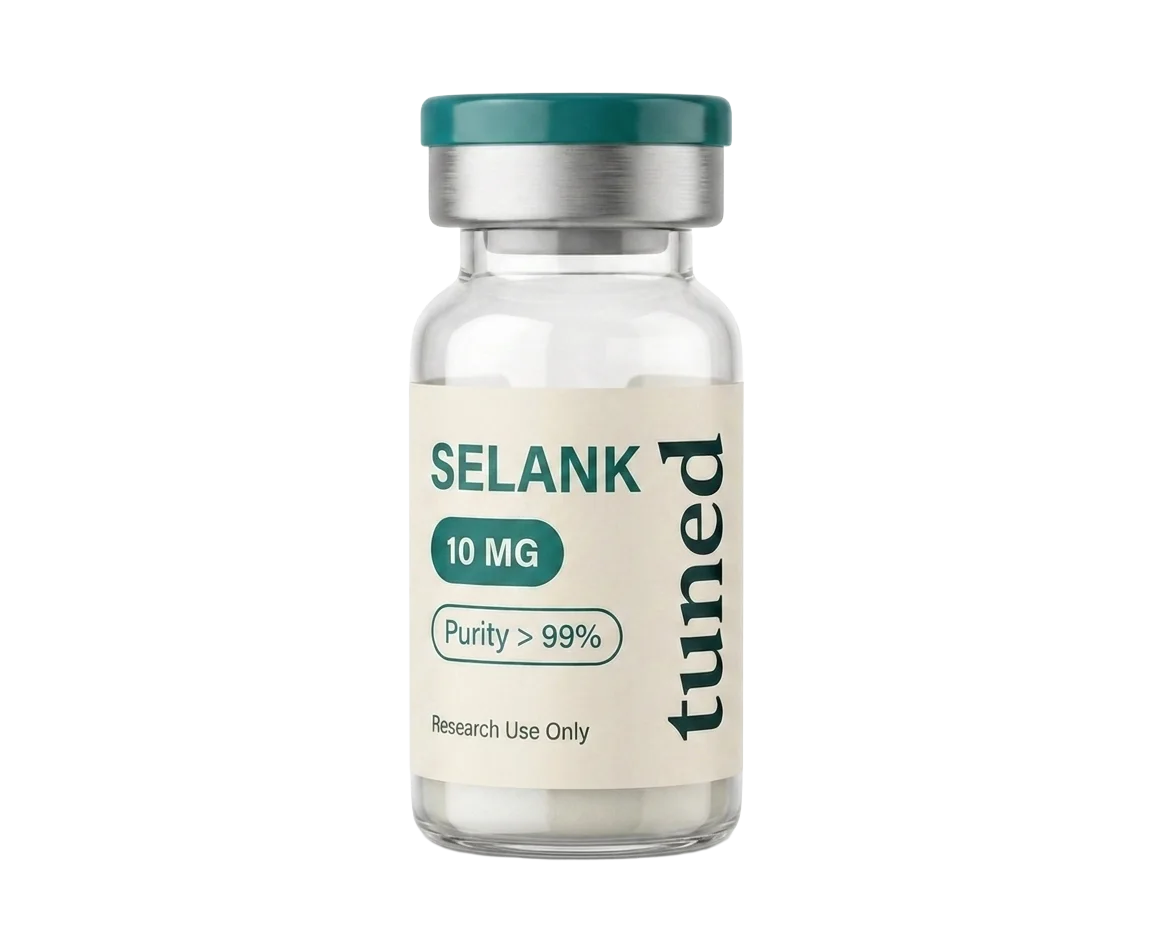
tuned Selank
For laboratory research use only · available to researchers. Specifications, pricing & Certificate of Analysis on the product page.
Is Selank safe & FDA approved?
Two parts. On safety: in the available research Selank looks low-risk — mild, mostly local side effects, no documented serious toxicity, and no sedation or dependence[1] — but that rests on mostly small Russian studies, not large controlled Western trials, so long-term safety isn't established. On approval: Selank is not FDA-approved in the US.
Russia, FDA & WADA status
Selank is approved and used as an anti-anxiety medicine in Russia (for generalised anxiety and neurasthenia),[1] but that approval doesn't carry to the US or EU, where it's handled as a research chemical. For tested athletes, Selank isn't individually named on the WADA Prohibited List, but as a non-approved substance it could fall under the catch-all S0 category — so athletes should verify against the current list rather than assume. These uncertainties are why tuned sells it strictly for research use only.
Selank purity & material quality
As with any research peptide, the most realistic risk isn't the molecule — it's what's in the vial. Contamination, endotoxin or wrong potency in lower-grade product are the genuine hazards, and a batch-specific Certificate of Analysis addresses them more directly than any community rule.
It's worth separating two ideas people blur together here. Selank's reported clean profile — non-sedating, no dependence[1] — is about the molecule's pharmacology; the material-quality risk is about manufacturing. A research peptide can have a benign mechanism and still cause a reaction if the vial carries endotoxin from a low-grade source. That's why "is Selank safe?" really has two answers: the molecule looks low-risk in the studies, and the product is only as safe as its verification.
Common questions
What are the side effects of Selank?
Does Selank cause withdrawal?
Is Selank addictive like benzodiazepines?
Is Selank safe?
Is Selank FDA approved?
References
- Zozulya AA, Neznamov GG, Siuniakov TS, et al. Efficacy and possible mechanisms of action of a new peptide anxiolytic selank in the therapy of generalized anxiety disorders and neurasthenia. Zhurnal Nevrologii i Psikhiatrii imeni S.S. Korsakova, 2008;108(4):38–48. PMID 18454096. (Russian clinical; vs the benzodiazepine medazepam.)
- Kost NV, Sokolov OYu, Gabaeva MV, et al. Semax and selank inhibit the enkephalin-degrading enzymes from human serum. Russian Journal of Bioorganic Chemistry, 2001;27(3):180–183. PMID 11443939.
- Kolomin T, Shadrina M, Andreeva L, et al. Expression of inflammation-related genes in mouse spleen under tuftsin analog Selank. Regulatory Peptides, 2011;170(1–3):18–23. PMID 21609736.
Safety and the no-dependence/withdrawal framing reflect the cited research, which is mostly small Russian clinical work [1] plus preclinical studies [2,3], with no large controlled Western safety trials. "No reported withdrawal" is an absence of reported evidence, not proof of absence. Selank is approved in Russia but not by the FDA; WADA status should be reconfirmed. Not medical advice.
For research use only. Not for human consumption. This page summarises published research for educational purposes. It is not medical advice and is not intended to diagnose, treat, cure, or prevent any disease.