What is Selank?
Selank is a synthetic peptide developed in Russia, based on a natural immune molecule called tuftsin. In research it's studied as an anxiolytic (anti-anxiety) and nootropic — and notably as a non-benzodiazepine one, with anxiety effects comparable to a benzodiazepine in Russian trials but without the reported sedation or dependence.[2] It's given as a nasal spray. It's approved as a medicine in Russia but is not FDA-approved.
What is Selank, exactly?
Selank is a synthetic heptapeptide — a chain of seven amino acids — developed in Russia and studied mainly for anxiety and stress.[1]
It comes from the same Russian peptide-research tradition as Semax, out of the Institute of Molecular Genetics led by Nikolai Myasoedov. Its design is based on tuftsin, a small natural peptide that's part of the immune system — which is why Selank carries both calming and immune-related effects in the research.
Because it's a stable peptide that reaches the brain, it's given intranasally (as a spray or drops) rather than swallowed. In Russia it's an approved anti-anxiety medicine; elsewhere it's used in research and nootropic settings. The headline reason it's interesting is the next point — its relationship to tuftsin.
What is Selank made of?
Selank is made of seven amino acids — Thr-Lys-Pro-Arg-Pro-Gly-Pro — built from the natural immune peptide tuftsin.[1]
Tuftsin itself is just the first four of those amino acids (Thr-Lys-Pro-Arg). Selank adds a short Pro-Gly-Pro tail on the end — the same stabilising trick used in Semax — which protects the peptide from being broken down too quickly by the body's enzymes.[1] So yes, Selank is a peptide; specifically, it's a stabilised tuftsin analog.
That tuftsin origin is the key to understanding it: tuftsin is an immune-signalling peptide, so Selank inherits both a calming, brain-directed action and a milder immune-modulating one — a combination that shapes its whole research profile.
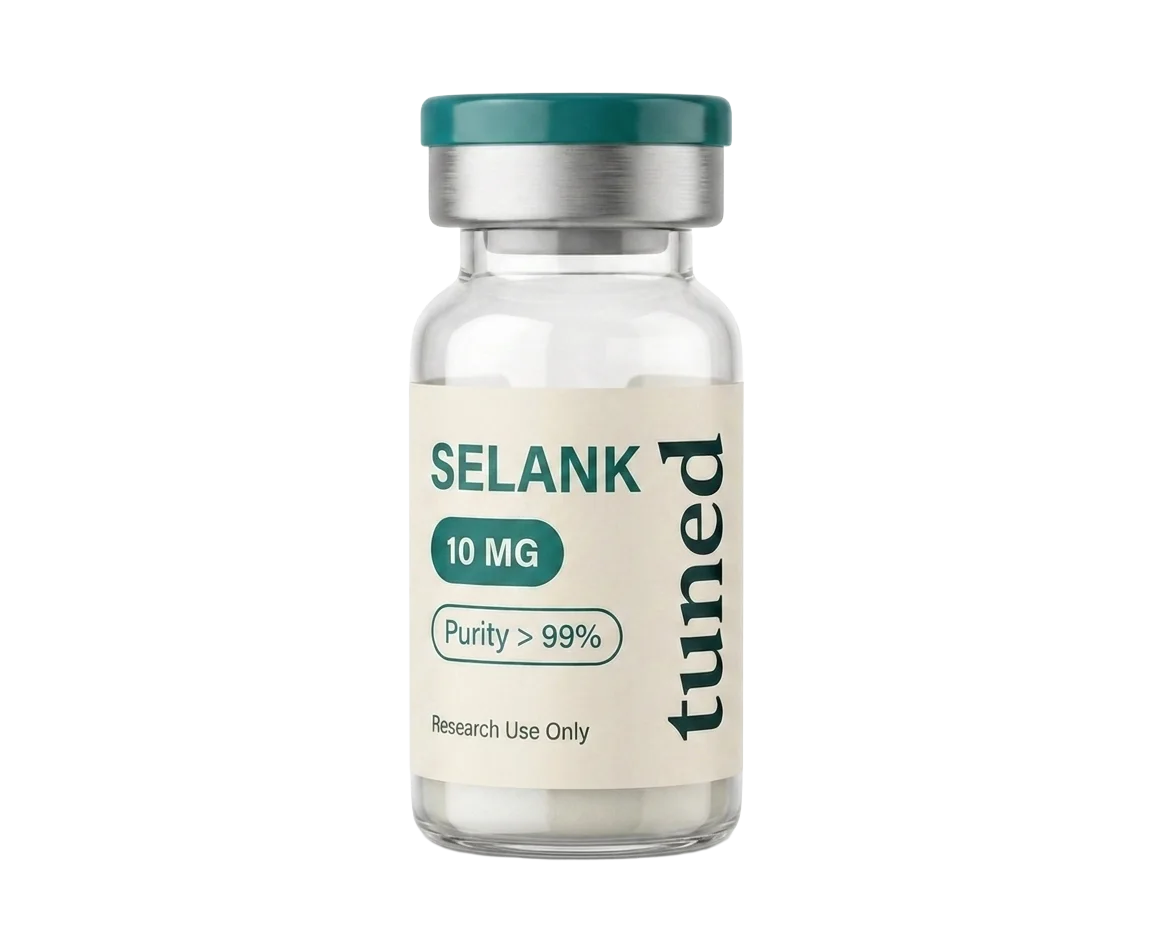
tuned Selank
For laboratory research use only · available to researchers. Specifications, pricing & Certificate of Analysis on the product page.
What does Selank do?
The clearest theme in Selank research is calming anxiety without sedating. Unlike a stimulant or a sedative, it's described as taking the edge off stress while leaving focus intact — and the studies add a nootropic and a mild immune dimension. Researchers describe a few overlapping actions:
- Anxiolytic. Reduces anxiety in animal models and in Russian clinical studies, comparably to a benzodiazepine but without sedation.[2]
- Affects serotonin and BDNF. Influences the serotonin system and raises the growth factor BDNF, both tied to mood and resilience.[4][6]
- Immune-modulating. From its tuftsin origin, it shifts the expression of inflammation-related genes.[5]
- Prolongs natural peptides. Slows the breakdown of the body's own enkephalins.[1]
What Selank is used for
Those actions line up with how Selank is used: in Russia as an anti-anxiety medicine for generalised anxiety and neurasthenia,[2] and in the wider research and nootropic community for calm, focus and stress resilience. As with Semax, the human evidence is largely Russian and the rest preclinical.
How does Selank work?
Selank works by tuning several of the brain's calming and signalling systems rather than switching one on. The research points to a few mechanisms, and it's worth being precise about each.
Serotonin, GABA & BDNF
On the calming side, Selank influences the serotonin system — in one model it prevented stress-driven changes in brain serotonin[4] — and it raises BDNF, a growth factor linked to mood and learning, when given intranasally.[6] Its relationship with GABA (the brain's main calming neurotransmitter) is more nuanced than marketing suggests: a cell study found Selank didn't act on GABA machinery on its own, but it modulated GABA's effects.[3] So "Selank works through GABA" is an oversimplification — it influences the GABA system rather than directly driving it.
The tuftsin & immune angle
Because it's built from tuftsin, Selank also has an immune-modulating action: a study found a single dose shifted the expression of dozens of inflammation-related genes in immune tissue.[5] Alongside that, both Selank and Semax slow the enzymes that break down the body's own enkephalins, prolonging their signalling.[1] Together these explain why Selank is framed as a calm-and-resilience peptide with an immune side, not a simple sedative.
Selank benefits
The reported Selank benefits follow from its biology: reduced anxiety and stress, steadier focus and mood, and mild immune support.[2][5] The strongest signal is anti-anxiety — in a Russian trial it matched a benzodiazepine for generalised anxiety while adding a mild anti-fatigue effect.[2] As with all of Selank, the human evidence is mostly Russian and preclinical, so these are research findings rather than guaranteed effects.
Full Selank peptide benefits guide — anxiety, focus & immune →
Selank and Semax
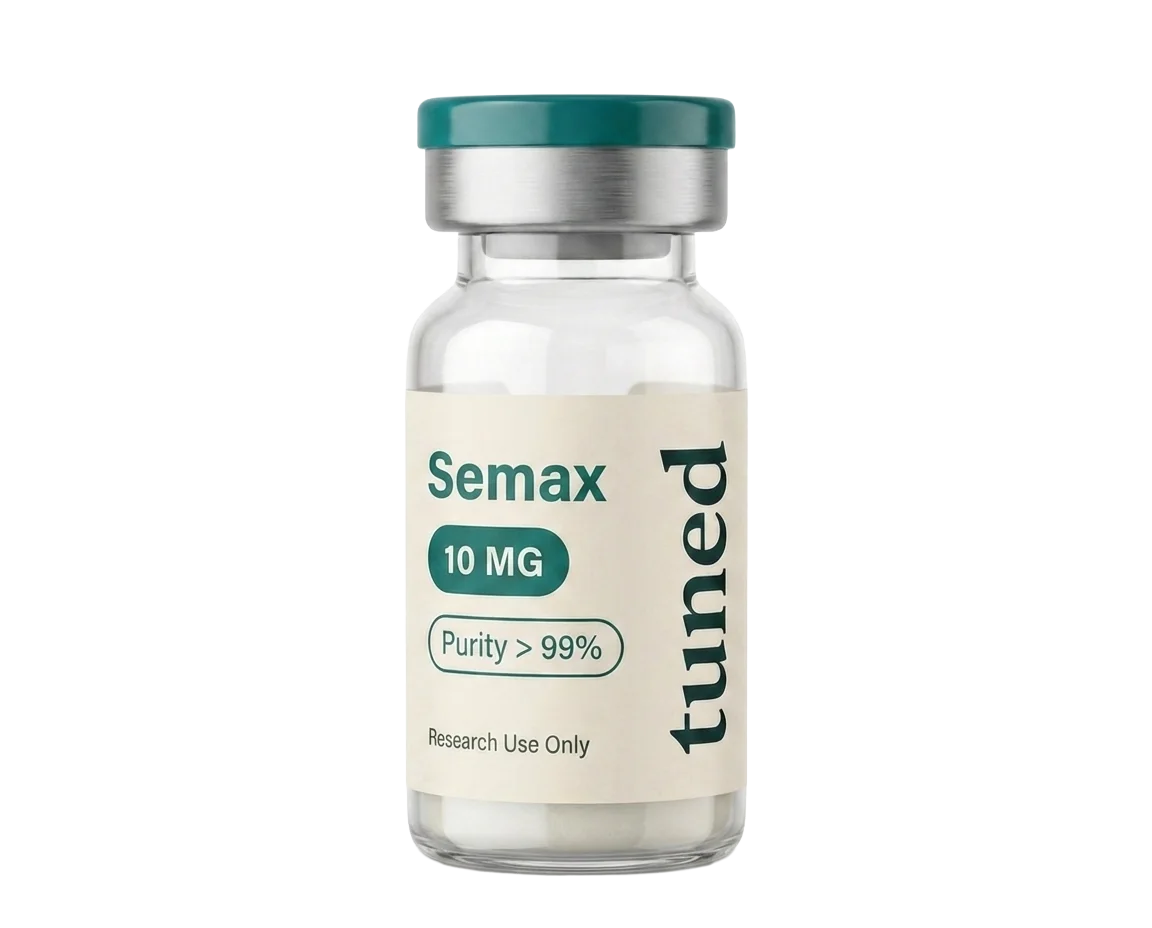
Selank and Semax are the two best-known Russian nootropic peptides, and they're frequently discussed together and stacked. They're complementary: Selank is the tuftsin-derived calm peptide (anxiolytic), while Semax is the ACTH-derived drive peptide (nootropic and neuroprotective) — so they're paired for "calm focus."[1] The stack is a community convention, not a trial-validated combination.
N-Acetyl Selank Amidate
You'll also see N-Acetyl Selank Amidate, a modified version with chemical caps added (acetyl and amide) intended to make it more stable. The rationale is standard peptide chemistry, but there's no published research on this specific analog — its claims rely on parent-Selank data, so treat "more potent" marketing as unverified. See the full Semax vs Selank comparison for how the two differ.
Is Selank safe & FDA approved?
In the available research — largely Russian clinical studies — Selank is reported as well-tolerated, with mild nasal irritation the most common issue, and notably without the sedation or dependence of benzodiazepines.[2] But that record comes without large Western trials, and Selank is not FDA-approved (it's an approved medicine in Russia for anxiety). For athletes, it isn't individually named by WADA but, as a non-approved substance, would fall under the catch-all S0 category — verify the current list.
How to choose Selank
For a research peptide, the biggest real-world variable is what's actually in the vial. A batch-specific Certificate of Analysis — UPLC purity, mass-spec identity, endotoxin screening — does more for safety than any community convention. If a supplier can't show a recent, lot-matched CoA, treat that absence as a risk signal.
Common questions
What is Selank used for?
What is Selank made of?
How does Selank work?
Is Selank the same as Semax?
Is Selank FDA approved?
Selank nasal spray, research evidence & more
This page is the overview. For the specifics, these guides go deeper:
Related research peptide guides
References
- Kost NV, Sokolov OYu, Gabaeva MV, et al. Semax and selank inhibit the enkephalin-degrading enzymes from human serum. Russian Journal of Bioorganic Chemistry, 2001;27(3):180–183. PMID 11443939.
- Zozulya AA, Neznamov GG, Siuniakov TS, et al. Efficacy and possible mechanisms of action of a new peptide anxiolytic selank in the therapy of generalized anxiety disorders and neurasthenia. Zhurnal Nevrologii i Psikhiatrii imeni S.S. Korsakova, 2008;108(4):38–48. PMID 18454096. (Russian clinical; vs the benzodiazepine medazepam.)
- Filatova E, Kasian A, Kolomin T, et al. GABA, Selank, and Olanzapine affect the expression of genes involved in GABAergic neurotransmission in IMR-32 cells. Frontiers in Pharmacology, 2017;8:89. PMID 28293190.
- Nadorova AV, Kolik LG, Klodt PM, et al. The relationship between the anxiolytic action of selank and the level of serotonin in brain structures during the modeling of alcohol abstinence. Neurochemical Journal, 2014;8(2):115–120. DOI 10.1134/S1819712414020081.
- Kolomin T, Shadrina M, Andreeva L, et al. Expression of inflammation-related genes in mouse spleen under tuftsin analog Selank. Regulatory Peptides, 2011;170(1–3):18–23. PMID 21609736.
- Inozemtseva LS, Karpenko EA, Dolotov OV, et al. Intranasal administration of the peptide Selank regulates BDNF expression in the rat hippocampus in vivo. Doklady Biological Sciences, 2008;421:241–243. DOI 10.1134/S0012496608040066.
Selank is a tuftsin-analog heptapeptide (Thr-Lys-Pro-Arg-Pro-Gly-Pro) [1]. Anxiolytic evidence is led by a small Russian clinical trial vs a benzodiazepine [2]; mechanism work is preclinical [3–6]. Sources [4] and [6] are Springer-translation journals (cited by DOI), not PubMed-indexed. Selank is approved in Russia but not by the FDA. "No dependence/withdrawal" reflects reported (mostly Russian) studies, not proof of absence. N-Acetyl Selank Amidate has no published research. Not medical advice.
For research use only. Not for human consumption. This page summarises published research for educational purposes. It is not medical advice and is not intended to diagnose, treat, cure, or prevent any disease.