What is Semax?
Semax is a synthetic seven-amino-acid peptide developed in Russia from a fragment of ACTH. It is studied for effects involving BDNF, NGF and neuroprotection, but it is not approved in the US or EU.
What is Semax, exactly?
Semax is a synthetic heptapeptide — a chain of seven amino acids, Met-Glu-His-Phe-Pro-Gly-Pro (MEHFPGP).[3]
Its design is clever: the first four residues copy a small active fragment of ACTH (adrenocorticotropic hormone) — the part linked to learning and attention, minus the hormone's stress-axis effects — and a short Pro-Gly-Pro tail is added on the end to stop the body's enzymes from breaking it down too quickly. That's why the literature usually calls Semax an analog of ACTH(4–10).[1]
It was developed in Russia in the 1980s–90s by a team at the Institute of Molecular Genetics led by Nikolai Myasoedov, whose group has published most of the work on it since.[1] This page summarizes the published findings without providing preparation, route-selection or administration guidance.
What does Semax do?
The clearest theme across Semax research is support for the brain — it behaves as a nootropic (cognition-supporting) and neuroprotective agent rather than a stimulant. It doesn't force activity the way caffeine does; instead it nudges the brain's own growth and signalling systems.
Researchers have described several overlapping actions:
- Raises BDNF and NGF — two growth factors that help neurons survive, connect and adapt.[1]
- Activates the brain's dopamine and serotonin systems, which are tied to focus, motivation and mood.[2]
- Slows the breakdown of the body's own enkephalins (natural signalling peptides), prolonging their effect.[3]
- Protects brain tissue under stress, with anti-inflammatory and vascular effects seen in models of reduced blood flow.[4]
What Semax does for focus & the brain
Those actions line up with why Semax is studied for focus and cognition: more BDNF and NGF support the machinery of learning, while the dopamine and serotonin effects map onto attention and motivation.[1][2] Much of this is preclinical (rodent) work plus Russian clinical studies, so it's a research story, not a settled human effect.
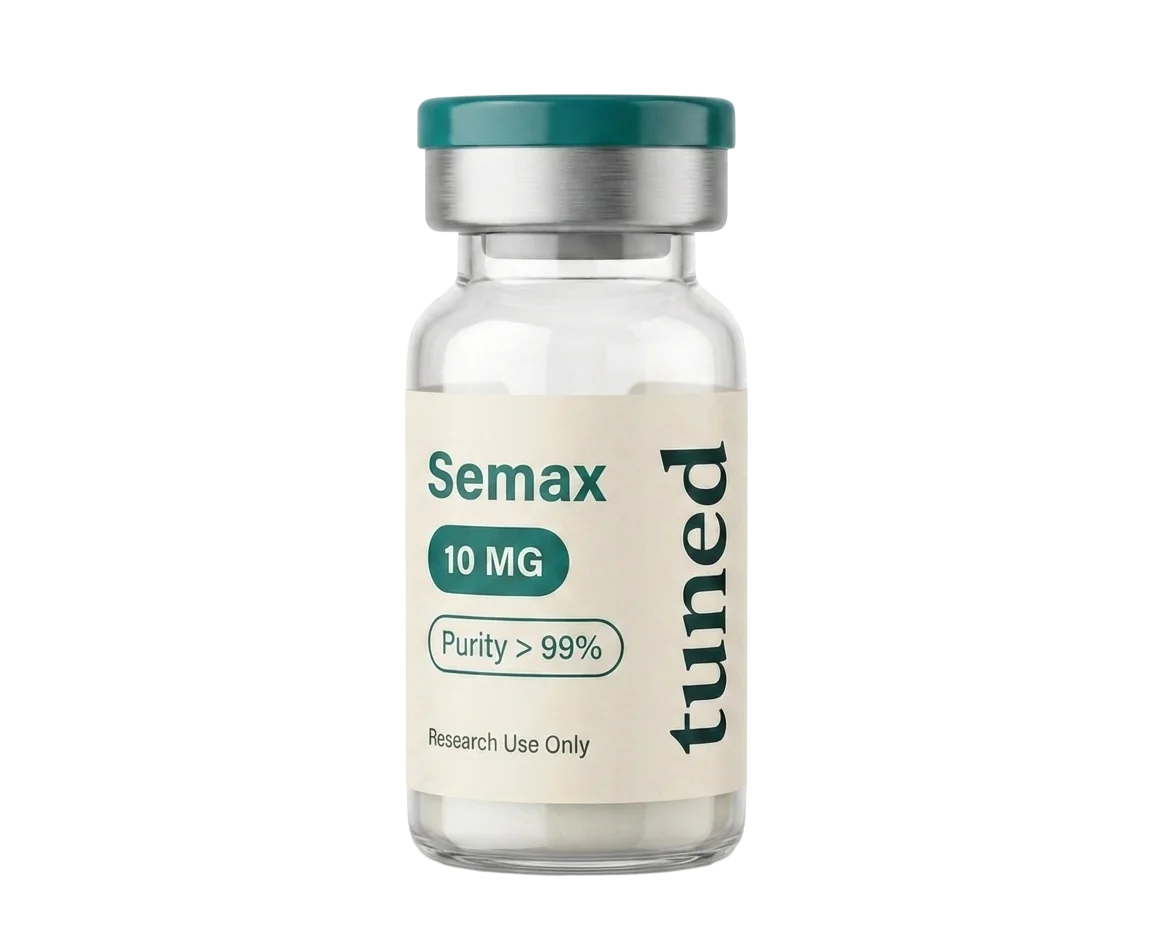
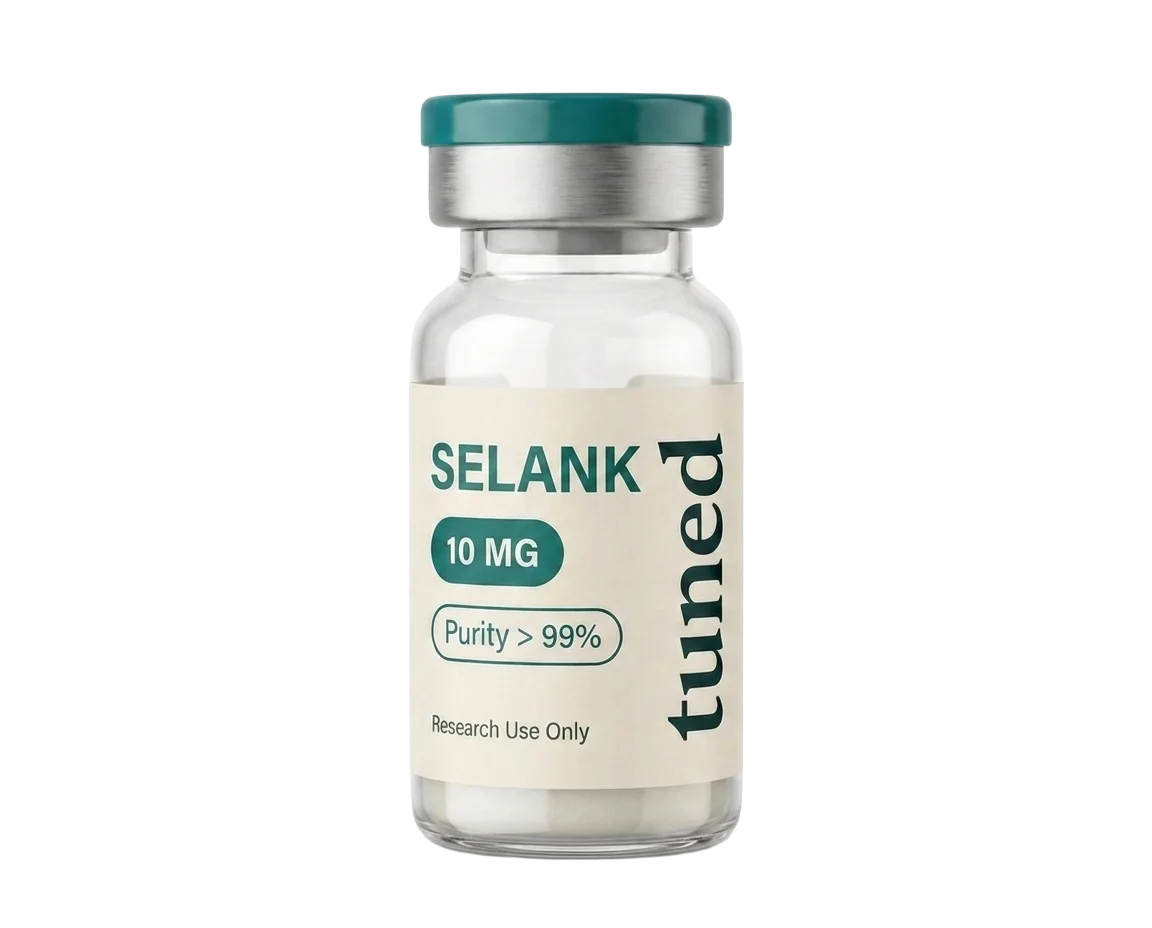
tuned Semax
For laboratory research use only · available to researchers. Specifications, pricing & Certificate of Analysis on the product page.
What is Semax used for?
Semax has an unusual split: it has real clinical use in one country and informal nootropic use elsewhere. In Russia, where it's an approved medicine, it has been studied and used for brain and nerve conditions; in the wider research and nootropic community it's explored for everyday cognition. The honest framing is that the clinical evidence is largely Russian and often small, and there are no large US/EU trials.
- Ischemic stroke & recovery. Its most-studied clinical use — Russian studies report benefits given during and after stroke.[5]
- Cognitive & attention support. The reason it's popular as a nootropic — focus, memory and mental stamina.[1]
- Mood & stress resilience. Tied to its dopamine/serotonin effects.[2]
- Optic-nerve & neuro conditions. Studied in Russia for optic-nerve disorders and other cerebrovascular problems.
What Semax peptide is used for, in plain terms
Put simply, Semax peptide is used as a brain-support compound — clinically in Russia for stroke and nerve conditions, and informally as a nootropic for focus and mood. Outside Russia it has no approved medical use, so all such use is research-framed.
How does Semax work?
Semax works less by switching one thing on and more by tuning several of the brain's own systems at once. The headline mechanism is its effect on growth factors; alongside that sit changes in neurotransmitters and in how long the body's natural peptides last.
The BDNF and NGF angle
The most-cited mechanism is that Semax increases expression of BDNF (brain-derived neurotrophic factor) and its receptor TrkB, along with NGF (nerve growth factor).[1] A 2006 study from Oleg Dolotov and colleagues in Myasoedov's group showed Semax regulating BDNF and TrkB in the rat hippocampus — a brain region central to learning and memory.[1] More BDNF and NGF means better conditions for neurons to survive, form connections and adapt, which is the biological basis for the cognitive and neuroprotective interest.
Neurotransmitters & neuroprotection
On top of the growth factors, Semax activates the brain's dopaminergic and serotonergic systems[2] and slows enzymes that degrade the body's own enkephalins, prolonging their signalling.[3] In models of reduced blood flow (ischemia), it shifts the expression of immune- and blood-vessel-related genes in a protective direction.[4] Together these explain why it's framed as neuroprotective rather than stimulant.
N-Acetyl Semax Amidate
N-Acetyl Semax Amidate — often shortened to NASA or written as N-acetyl semax amidate — is a modified version of Semax built for greater stability. Two chemical caps are added: an acetyl group on one end of the peptide and an amide group on the other.
Why the amidate form exists
Those two caps protect the peptide's ends from the enzymes that normally chew peptides up from each terminus, so the modified molecule is designed to resist breakdown for longer than plain Semax. In practice that's why "na semax" and the amidate form are discussed as more potent or longer-lasting in nootropic communities. It's worth being precise: the rationale (terminal protection slows enzymatic breakdown) is standard peptide chemistry, but specific half-life or potency multipliers circulating online are not from verified clinical data — treat those numbers as unverified.
Semax formulation research
The published Semax literature includes regulated Russian formulations studied under defined clinical protocols.[1] Those studies do not establish preparation, concentration, route-selection or administration guidance for research material.
Semax benefits
The reported Semax benefits follow from its biology: sharper focus and cognition, steadier mood and stress resilience, and neuroprotection during events like stroke.[1][5] In Russian clinical work the strongest signal is in stroke recovery; in the nootropic community the draw is everyday focus and mental stamina. As with the rest of Semax, the human evidence is mostly Russian and preclinical, so these are research findings rather than guaranteed effects.
Full Semax peptide benefits guide — focus, mood & neuroprotection →
Is Semax safe?
In the available research — largely Russian clinical studies — Semax is reported as well-tolerated, with the most common issue being mild nasal or local irritation.[5] But that record comes without large Western trials or long-term safety data, and Semax is not FDA-approved, so its safety profile outside Russian studies isn't established.
How to choose Semax
For a research peptide, the biggest real-world safety variable is what's actually in the vial. A batch-specific Certificate of Analysis — UPLC purity, mass-spec identity, endotoxin screening — does more for safety than any community convention. If a supplier can't show a recent, lot-matched CoA, treat that absence as a risk signal.
Full Semax side effects & dangers guide — including FDA status →
Common questions
What is Semax used for?
What does Semax do?
What is N-Acetyl Semax Amidate?
Is Semax FDA approved?
Semax research evidence & more
This page is the overview. For the specifics, these guides go deeper:
Related research peptide guides
References
- Dolotov OV, Karpenko EA, Inozemtseva LS, et al. Semax, an analog of ACTH(4-10) with cognitive effects, regulates BDNF and trkB expression in the rat hippocampus. Brain Research, 2006;1117(1):54–60. PMID 16996037.
- Eremin KO, Kudrin VS, Saransaari P, et al. Semax, an ACTH(4-10) analogue with nootropic properties, activates dopaminergic and serotoninergic brain systems in rodents. Neurochemical Research, 2005;30(12):1493–1500. PMID 16362768.
- Kost NV, Sokolov OYu, Gabaeva MV, et al. Semax and selank inhibit the enkephalin-degrading enzymes from human serum. Russian Journal of Bioorganic Chemistry, 2001;27(3):180–183. PMID 11443939.
- Medvedeva EV, Dmitrieva VG, Povarova OV, et al. The peptide semax affects the expression of genes related to the immune and vascular systems in rat brain focal ischemia: genome-wide transcriptional analysis. BMC Genomics, 2014;15:228. PMID 24661604.
- Gusev EI, Skvortsova VI, Myasoedov NF, et al. Effectiveness of semax in acute period of hemispheric ischemic stroke (a clinical and electrophysiological study). Zhurnal Nevrologii i Psikhiatrii imeni S.S. Korsakova, 1997;97(6):26–34. PMID 11517472.
Mechanistic sources [1–4] are preclinical (rodent/in vitro); clinical source [5] is a small Russian study. Semax is approved in Russia but not by the FDA/EMA. Molecular weight, exact nasal concentrations and any N-Acetyl Semax Amidate half-life figures circulating online are not verified here and are omitted as fact. Community nootropic study protocol is vendor-derived and unverified. Not medical advice.
For research use only. Not for human consumption. This page summarises published research for educational purposes. It is not medical advice and is not intended to diagnose, treat, cure, or prevent any disease.