Semax peptide benefits
The reported Semax peptide benefits all trace to one thing: it raises the brain's growth factors BDNF and NGF and tunes its dopamine and serotonin systems.[1][2] That maps onto three research themes — sharper focus and cognition, steadier mood and stress resilience, and neuroprotection (strongest in Russian stroke studies).[4] The evidence is mostly Russian clinical and preclinical, so these are research findings, not guaranteed effects.
What are the benefits of Semax?
The benefits of Semax that show up in research follow from its biology — it supports the brain's own growth and signalling systems rather than acting as a stimulant.[1]
Semax is a fragment of the hormone ACTH with a stabilising tail, and the consistent finding is that it lifts neurotrophic (nerve-growth) signalling.[1] From that single property, the literature describes a handful of related, research-reported benefits:
| Reported benefit | What the research shows | Evidence |
|---|---|---|
| Focus & cognition | Supports learning and attention via BDNF/NGF; nootropic effects in models | Preclinical[1] |
| Mood & stress | Activates dopamine and serotonin systems | Preclinical[2] |
| Neuroprotection | Protective effects in stroke and ischemia | Clinical (Russia) + preclinical[3][4] |
| Prolonged natural peptides | Slows breakdown of the body's own enkephalins | In vitro[5] |
The BDNF and NGF mechanism behind the benefits
Every one of those benefits comes back to the same mechanism: Semax increases expression of BDNF and its receptor TrkB, plus NGF.[1] These growth factors are what let neurons survive, form new connections and adapt — the cellular basis of learning, recovery and resilience. Understanding that one lever explains why Semax's benefits cluster so tightly around cognition, mood and brain protection.
Semax for focus & cognition
Semax for focus is the benefit most people are searching for, and it's well-grounded in the mechanism. By raising BDNF and NGF in the hippocampus — a brain region central to learning and memory — Semax supports the machinery of attention and recall.[1] A 2006 study from Oleg Dolotov and colleagues in Nikolai Myasoedov's group showed exactly this BDNF/TrkB regulation in the rat hippocampus.[1]
Why Semax is used as a nootropic
On top of the growth factors, Semax activates the brain's dopamine and serotonin systems,[2] which are tied to motivation and sustained attention. That combination — better conditions for neural adaptation plus a lift in focus-related neurotransmitters — is why Semax is used as a nootropic for mental stamina and concentration. The honest limit: most of this is rodent and Russian clinical work, so it describes research potential, not a proven cognitive boost in healthy people.
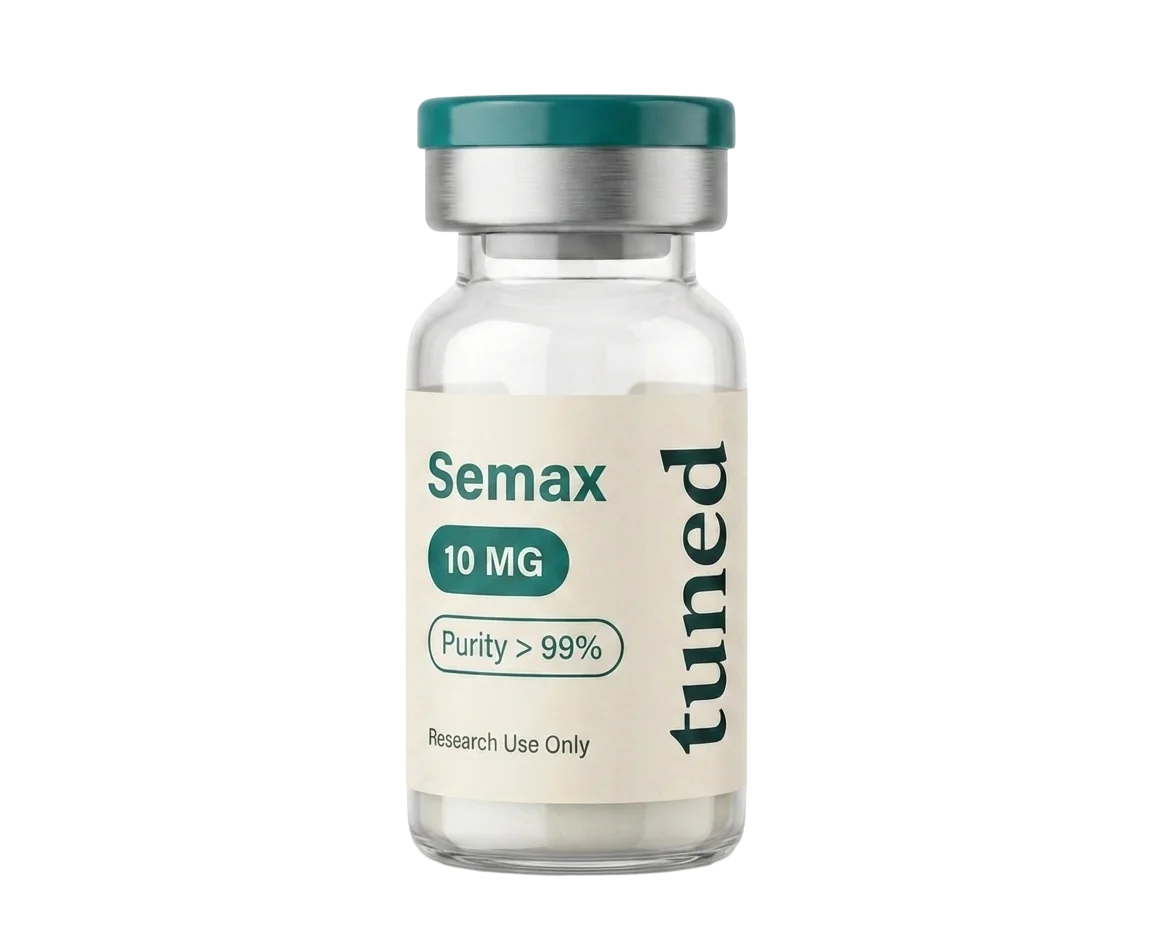
tuned Semax
For laboratory research use only · available to researchers. Specifications, pricing & Certificate of Analysis on the product page.
Semax for mood & anxiety
Semax for mood is the second-most-discussed benefit, and it follows from the same neurotransmitter effects. By activating the brain's dopamine and serotonin systems,[2] Semax is studied for steadier mood, motivation and resilience to stress — the systems those neurotransmitters govern.
Semax for stress resilience
There's a neat logic to it: Semax is derived from ACTH, the hormone at the centre of the stress response, but it's the fragment stripped of the hormonal stress-axis activity — so research interest is in the calming, adaptogenic side rather than a cortisol surge. Add the BDNF lift, which is repeatedly linked to mood regulation, and you have the rationale behind "Semax for anxiety." It's worth being precise, though: dedicated human anxiety trials are lacking, so mood benefits are a research direction, and community reports of calmer, more even mood are anecdotal, not clinical evidence.
Community note (unverified): in nootropic communities, users describe Semax as lifting motivation and smoothing stress. These are anecdotal reports, not trial findings, and we flag them as such.
Semax for neuroprotection & recovery
Semax for neuroprotection is its best-evidenced benefit, and it's where the human data is strongest. In Russia, Semax has been studied and used in ischemic stroke, where studies report better recovery when it's given during and after the event.[3]
What the stroke and ischemia research shows
The protection appears to work on two fronts. The growth factors (BDNF, NGF) support neuron survival and repair, while in models of reduced blood flow Semax shifts immune- and blood-vessel-related gene activity in a protective direction.[4] A Russian acute-stroke study reported clinical and electrophysiological benefit,[3] and later work tracked improvements in recovery alongside rising plasma BDNF. The honest caveat: these are largely small, Russian, often non-randomized studies — meaningful, but not the large Western randomized trials that would settle the question, and Semax is not approved outside Russia.
Common questions
What are the benefits of Semax?
Is Semax good for focus?
Does Semax help mood or anxiety?
Is Semax neuroprotective?
How strong is the evidence for Semax's benefits?
References
- Dolotov OV, Karpenko EA, Inozemtseva LS, et al. Semax, an analog of ACTH(4-10) with cognitive effects, regulates BDNF and trkB expression in the rat hippocampus. Brain Research, 2006;1117(1):54–60. PMID 16996037.
- Eremin KO, Kudrin VS, Saransaari P, et al. Semax, an ACTH(4-10) analogue with nootropic properties, activates dopaminergic and serotoninergic brain systems in rodents. Neurochemical Research, 2005;30(12):1493–1500. PMID 16362768.
- Gusev EI, Skvortsova VI, Myasoedov NF, et al. Effectiveness of semax in acute period of hemispheric ischemic stroke (a clinical and electrophysiological study). Zhurnal Nevrologii i Psikhiatrii imeni S.S. Korsakova, 1997;97(6):26–34. PMID 11517472.
- Medvedeva EV, Dmitrieva VG, Povarova OV, et al. The peptide semax affects the expression of genes related to the immune and vascular systems in rat brain focal ischemia: genome-wide transcriptional analysis. BMC Genomics, 2014;15:228. PMID 24661604.
- Kost NV, Sokolov OYu, Gabaeva MV, et al. Semax and selank inhibit the enkephalin-degrading enzymes from human serum. Russian Journal of Bioorganic Chemistry, 2001;27(3):180–183. PMID 11443939.
Mechanistic sources [1, 2, 4, 5] are preclinical/in vitro; clinical source [3] is a small Russian study. Semax is approved in Russia but not by the FDA/EMA, and large Western randomized trials are lacking. Community mood/focus reports are anecdotal and labelled unverified. Not medical advice; benefits are research findings, not treatment claims.
For research use only. Not for human consumption. This page summarises published research for educational purposes. It is not medical advice and is not intended to diagnose, treat, cure, or prevent any disease.