Semax side effects & dangers
In the available research — largely Russian clinical studies — Semax side effects are reported as mild, with the most common being minor nasal or local irritation from the intranasal route.[1] No serious toxicity is documented at studied amounts. But there are no large Western safety trials, the biggest real-world risk is material quality, and Semax is not FDA-approved (it's a medicine in Russia only).
What are the side effects of Semax?
Reported Semax side effects are generally mild and tied to the nasal route, and no serious toxicity has been documented in the available research at the amounts studied.[1]
Across the (mostly Russian) clinical literature, Semax is described as well-tolerated. Because it's given as nasal drops or spray, the effects that come up are usually local rather than systemic:
| Reported effect | Context |
|---|---|
| Nasal / local irritation | Mild stinging or dryness in the nose from the intranasal solution — the most commonly noted effect |
| Mild, transient effects | Occasional reports of slight headache or alertness changes; not well-characterised |
| Serious toxicity | None documented in the available studies at studied amounts[1] |
Nasal & local effects
The most likely effect is local irritation where the solution contacts the nasal lining — mild stinging or dryness. Giving it as measured drops and not overusing it are the usual ways this is minimised; it's a feature of the route, not evidence the molecule is toxic.
Are there systemic Semax side effects?
Systemic side effects aren't documented in the research, but that reflects the absence of large human trials as much as proven safety. One reassuring point with a mechanistic basis: Semax is the ACTH fragment without the hormone's stress-axis (cortisol) activity, so it isn't expected to drive the hormonal effects of ACTH itself — but long-term human data simply doesn't exist.
Is Semax dangerous?
"Is Semax dangerous?" is a fair question, and the honest answer is: there's no evidence of serious danger in the available research, but that research is limited. Decades of Russian clinical use and preclinical studies haven't surfaced serious toxicity at studied amounts,[1] which is reassuring — but it isn't the same as the large, long-term Western safety data that would let anyone call it definitively safe.
Where real risk actually sits
For a research peptide, the realistic danger usually isn't the molecule — it's what's in the vial. The clean profile comes from controlled, high-grade material; research-chemical supply doesn't always match that. Contamination, bacterial endotoxin, or wrong potency in lower-grade product are the genuine hazards, and they're exactly what proper testing screens for. A batch-specific Certificate of Analysis does more for safety than any community convention.
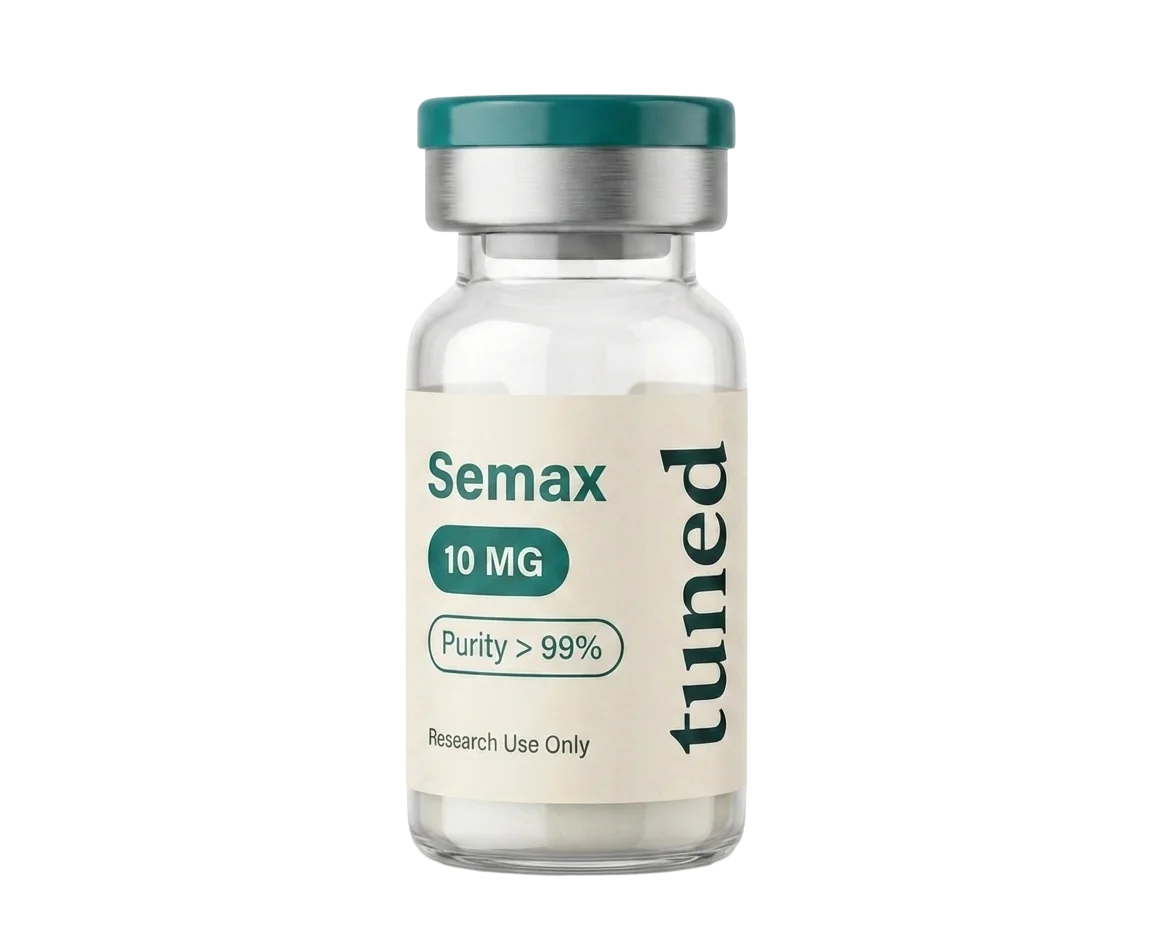
tuned Semax
For laboratory research use only · available to researchers. Specifications, pricing & Certificate of Analysis on the product page.
Is Semax safe & FDA approved?
Two parts to this. On safety: in the available research Semax looks low-risk — mild, mostly local side effects and no documented serious toxicity[1] — but that rests on mostly small Russian studies, not large controlled Western trials, so long-term safety in the general population isn't established. On approval: Semax is not FDA-approved and has no approved indication in the US or EU.
FDA, Russia & WADA status
Semax is approved and marketed as a medicine in Russia (for stroke and related neurological conditions), but that approval doesn't carry to the US or EU, where it has no approved use and is handled as a research chemical. For tested athletes, Semax is not a specifically named substance on the current WADA Prohibited List, but as an ACTH-derived peptide that influences growth factors it could fall under broader prohibited categories — so athletes should verify against the official list rather than assume, and treat its status as one to reconfirm. These uncertainties are why tuned sells it strictly for research use only.
Theoretical cautions with Semax
Because large human safety data is absent, the sensible cautions are precautionary rather than evidence-based. Semax acts on brain growth-factor and neurotransmitter signalling, which is something researchers would treat carefully where neurological or psychiatric conditions are already present, and its effects in pregnancy or alongside other compounds are simply unstudied.
- No Western study protocol standard — any amount used outside the Russian clinical context is a community convention, not a validated dose, which is itself a caution.
- Unstudied interactions — combinations (such as the Semax + Selank stack) are community practice, not trial-tested for safety.
- Material risk — as above, unverified product is the most realistic hazard; a Certificate of Analysis addresses it.
None of this is a list of documented harms — it's the honest gap between Semax's reassuring research profile and the large-scale human safety data that doesn't yet exist.
Common questions
What are the side effects of Semax?
Is Semax dangerous?
Is Semax safe?
Is Semax FDA approved?
What's the biggest risk with Semax?
References
- Gusev EI, Skvortsova VI, Myasoedov NF, et al. Effectiveness of semax in acute period of hemispheric ischemic stroke (a clinical and electrophysiological study). Zhurnal Nevrologii i Psikhiatrii imeni S.S. Korsakova, 1997;97(6):26–34. PMID 11517472.
- Medvedeva EV, Dmitrieva VG, Povarova OV, et al. The peptide semax affects the expression of genes related to the immune and vascular systems in rat brain focal ischemia: genome-wide transcriptional analysis. BMC Genomics, 2014;15:228. PMID 24661604.
Safety statements reflect the cited research, which is mostly small Russian clinical work [1] plus preclinical studies [2], with no large controlled Western safety trials. Reported mild tolerability should not be read as established long-term safety. Semax is approved in Russia but not by the FDA/EMA; WADA status should be reconfirmed against primary records as it can change. Community reports are anecdotal. Not medical advice.
For research use only. Not for human consumption. This page summarises published research for educational purposes. It is not medical advice and is not intended to diagnose, treat, cure, or prevent any disease.