GHK-Cu benefits & before and after
GHK-Cu's best-supported benefits are in skin and tissue repair — research shows it stimulates collagen and elastin, calms inflammation, and speeds wound healing.[1][3] Most solid human evidence is from topical creams; the dramatic injectable "before and after" photos online are anecdotal, not from controlled studies.
What are the benefits of GHK-Cu?
The benefits of GHK-Cu in research center on one theme: helping tissue — especially skin — rebuild and repair itself.
Across the published work, a handful of effects come up again and again, each tied to a specific action of the peptide:
| Benefit (in research) | What drives it | Evidence |
|---|---|---|
| Firmer, smoother skin | Stimulates collagen, elastin & glycosaminoglycans[1] | Topical human + cell studies |
| Faster wound healing | New blood-vessel growth, tissue remodeling[3] | Animal models |
| Antioxidant / anti-inflammatory | Lowers inflammatory signalling; mops up free radicals[2] | Cell studies |
| Hair support | Activity around hair follicles | Preliminary |
The reason a single small peptide touches so many of these is its breadth of signalling — gene-mapping work found GHK shifts the activity of thousands of human genes toward a repair-ready state.[2] The strongest, most reproducible benefits, though, are the skin and wound-repair ones.
GHK-Cu for skin
Skin is where GHK-Cu has the most support. In research it prompts fibroblasts — the cells that build the skin's scaffolding — to lay down fresh collagen and elastin, and it helps remodel sun-damaged tissue. That's why topical studies report firmer, denser, smoother skin over time,[1] and why it's a long-running cosmetic ingredient (copper tripeptide-1).
GHK-Cu for wound healing
Wound repair has the deepest biological evidence. By encouraging new blood-vessel growth and organising the rebuild of connective tissue, GHK-Cu accelerated healing in animal wound models — including a 2% gel that outperformed control on closure speed.[3]
GHK-Cu for hair
Hair is the most preliminary of the three. GHK-Cu is studied for supporting the hair follicle and the tissue around it, usually alongside other approaches rather than on its own — see the dedicated GHK-Cu for hair guide.
Is GHK-Cu good for anti-aging?
"Anti-aging" is the umbrella people put around all of this, and it's fair shorthand for the skin findings: natural GHK levels fall with age as repair slows, and topically restoring it is associated with firmer, better-structured skin.[2] It remains a research and cosmetic story, not an approved anti-aging treatment.
GHK-Cu before and after: what the research shows
Search "GHK-Cu before and after" and you'll find striking skin transformations — so it's worth separating what's measured from what's marketed.
What the research shows. Published cosmetic-formulation studies reported changes in skin density, thickness, firmness and photo-damage at defined assessment endpoints.[1][4] Animal wound models also reported accelerated healing with a study-specific gel formulation.[3]
What's anecdotal. The dramatic injectable before-and-after photos circulating on forums and vendor pages are not from controlled studies — there's no human trial of injected GHK-Cu — so treat them as unverified personal reports, not evidence.
What the evidence can support
The available findings are gradual and formulation-specific. They do not establish a consumer-use duration or expected timeline for research material.[4]
Does GHK-Cu help with acne?
GHK-Cu isn't an established acne treatment, and there's no clinical trial showing it clears acne. The reason people ask is its anti-inflammatory and skin-repair activity — calming inflammation and supporting healthy tissue turnover are relevant to post-acne repair in principle.[2]
So the honest answer: GHK-Cu may be of research interest for inflammatory, repair-related skin concerns, but "helps with acne" overstates what the evidence supports. It's studied for skin quality broadly, not as an acne therapy.
Where it comes up more often is acne scarring rather than active breakouts — the post-acne repair phase involves exactly the collagen remodeling GHK-Cu is known to influence.[1] Even there, though, the link is indirect: it's reasoning from GHK-Cu's repair biology, not from acne-specific trials.
Common questions
What are the benefits of GHK-Cu?
Are GHK-Cu before-and-after claims supported?
Does GHK-Cu help with acne?
How do I know the GHK-Cu is pure?
References
- Pickart L, Vasquez-Soltero JM, Margolina A. GHK Peptide as a Natural Modulator of Multiple Cellular Pathways in Skin Regeneration. BioMed Research International, 2015;2015:648108. PMID 26236730.
- Pickart L, Margolina A. Regenerative and Protective Actions of the GHK-Cu Peptide in the Light of the New Gene Data. International Journal of Molecular Sciences, 2018;19(7):1987. PMID 29986520.
- Canapp SO Jr, Farese JP, Schultz GS, et al. The effect of topical tripeptide-copper complex on healing of ischemic open wounds. Veterinary Surgery, 2003;32(6):515–523. PMID 14648529.
- Leyden J, et al. Skin care benefits of copper peptide containing facial and eye creams. Presented at the American Academy of Dermatology 60th Annual Meeting, 2002 (conference abstract).
Peer-reviewed and conference sources cited above; [4] is a conference abstract, not a full peer-reviewed paper. Injectable "before and after" claims are anecdotal and not from any cited source. Not medical advice.
For research use only. Not for human consumption. This page summarises published research for educational purposes. It is not medical advice and is not intended to diagnose, treat, cure, or prevent any disease.
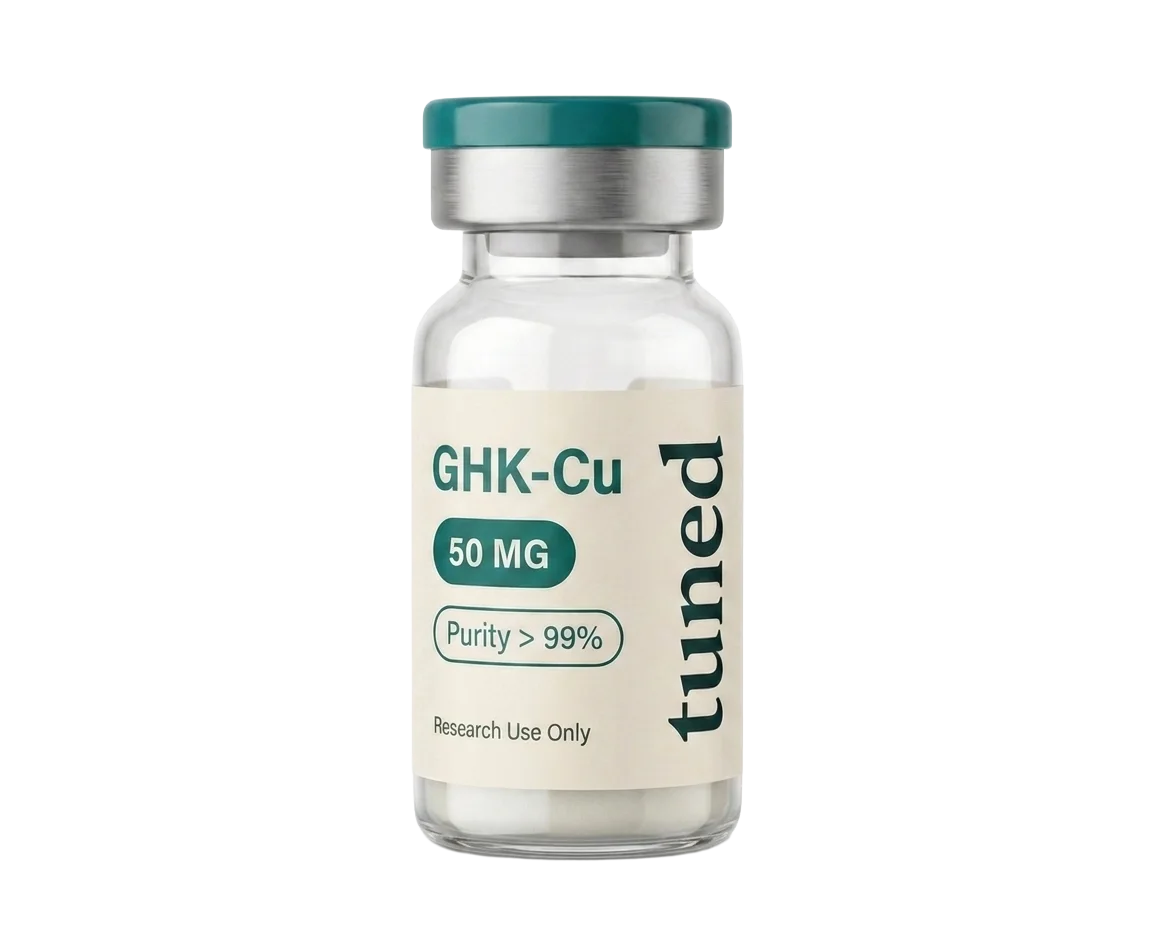
tuned GHK-Cu
For laboratory research use only · available to researchers. Specifications, pricing & Certificate of Analysis on the product page.