Topical GHK-Cu: cream, serum & skincare
Topical GHK-Cu — the copper peptide in creams and serums — is its most-studied and most-established form: it's a long-standing cosmetic ingredient (copper tripeptide-1) with topical human research behind it for firmer, smoother skin.[1][2] tuned supplies research-grade GHK-Cu (the raw lyophilized peptide), not a finished retail cream — this guide explains the topical landscape and how the two forms differ.
What is topical GHK-Cu?
Topical GHK-Cu refers to cosmetic formulations containing the copper-bound peptide.
In cosmetic ingredient lists it appears as copper tripeptide-1. Published research has examined collagen, elastin and tissue-remodelling markers in formulation-specific settings.[1]
Why topical is the most-studied form
Cosmetic formulations have the deepest human evidence for GHK-Cu, including studies that measured skin density and firmness.[2] Those findings concern the tested formulations and do not establish directions for research material.
GHK-Cu serum & cream
Serum and cream are two commercial formulation vehicles for the same copper-peptide ingredient. Their cosmetic properties do not establish a protocol for research material.
GHK-Cu serum
Commercial serums are lightweight formulation vehicles. Their composition and findings cannot be generalized to raw, lyophilized research material.
GHK-Cu cream
Commercial creams place the same ingredient in a moisturising base. Vehicle differences are formulation variables, not consumer selection guidance.
What formulation studies establish
Published cosmetic research is formulation-specific. It does not establish a concentration, preparation method or consumer-use protocol for the research material sold here.[2]
Topical vs injectable GHK-Cu
The honest version: topical is the evidence-backed form; injectable is the experimental one. Topical GHK-Cu has the human cosmetic research and the long safety track record; injectable GHK-Cu has neither a controlled human trial nor an established dose.
| Topical (cream/serum) | Injectable | |
|---|---|---|
| Evidence | Human cosmetic studies + decades of use[2] | No controlled human trials |
| Safety record | Long, largely uneventful | Not characterised in humans |
| Evidence context | Cosmetic-formulation studies | Preclinical and community claims |
| Status | Established cosmetic ingredient | Research use only, unverified |
What the comparison establishes
Human evidence concerns finished cosmetic formulations. Injectable claims lack controlled human trials. Neither evidence set provides preparation, administration or selection guidance for the research material sold here.
GHK-Cu for the face & skincare
Cosmetic-formulation studies have examined firmness, fine lines, tone and overall skin quality. Those findings are formulation-specific and do not establish guidance for the research material sold here.
What the formulation evidence does not establish
Published findings do not establish a consumer skincare routine, application frequency or combination schedule for the research material described on this site.
Common questions
What is topical GHK-Cu?
Does tuned sell a GHK-Cu cream?
References
- Pickart L, Vasquez-Soltero JM, Margolina A. GHK Peptide as a Natural Modulator of Multiple Cellular Pathways in Skin Regeneration. BioMed Research International, 2015;2015:648108. PMID 26236730.
- Pickart L, Margolina A. Regenerative and Protective Actions of the GHK-Cu Peptide in the Light of the New Gene Data. International Journal of Molecular Sciences, 2018;19(7):1987. PMID 29986520.
- Leyden J, et al. Skin care benefits of copper peptide containing facial and eye creams. Presented at the American Academy of Dermatology 60th Annual Meeting, 2002 (conference abstract).
The cited cosmetic findings are formulation-specific; [3] is a conference abstract. tuned sells research-grade peptide, not a finished cosmetic. Not medical advice.
For research use only. Not for human consumption. This page summarises published research and the topical GHK-Cu landscape for educational purposes. tuned's product is a research-grade peptide, not a finished cosmetic. Not medical advice; not intended to diagnose, treat, cure, or prevent any disease.
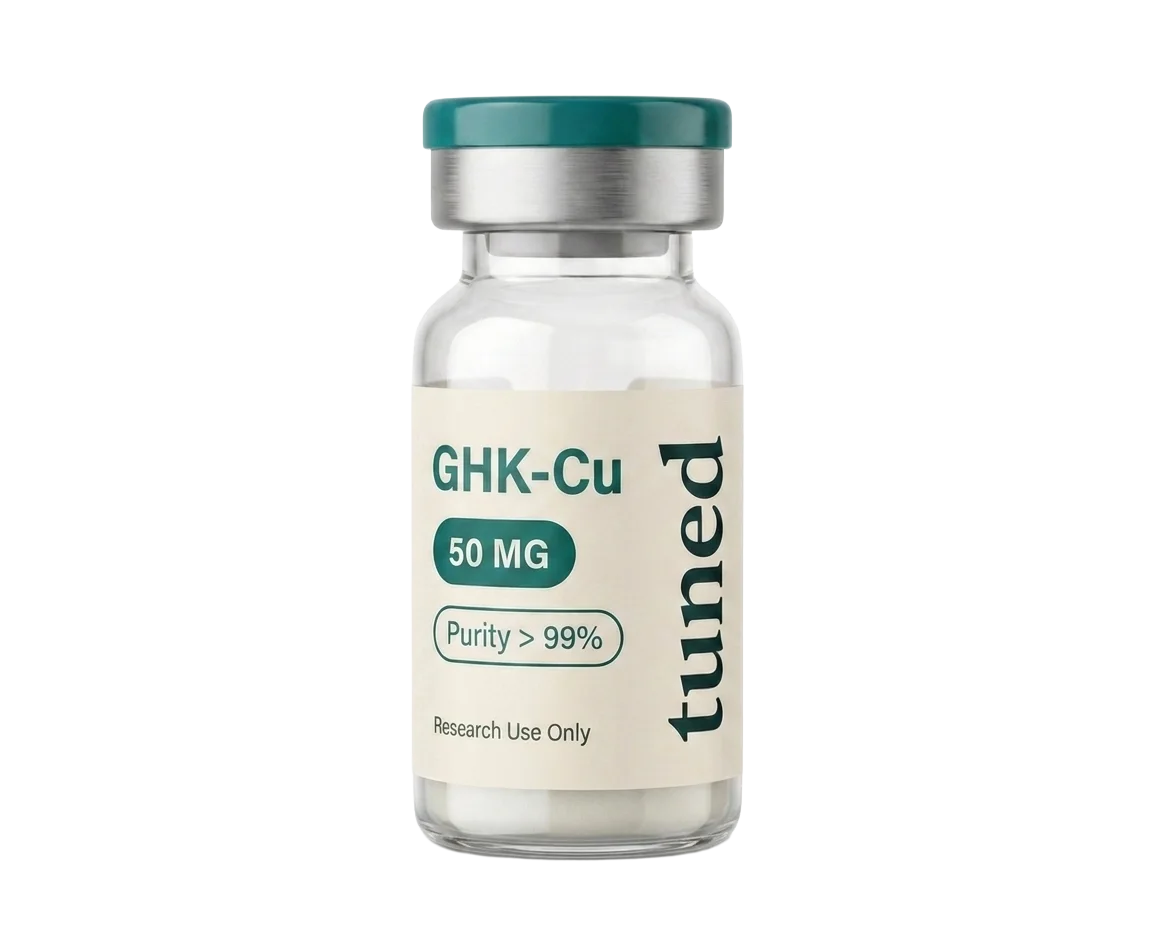
tuned GHK-Cu
For laboratory research use only · available to researchers. Specifications, pricing & Certificate of Analysis on the product page.