What is GHK-Cu?
GHK-Cu is a tiny copper-carrying peptide — three amino acids holding onto a copper atom. Your body makes it naturally, but levels fall as you age. In research it's best known for signalling skin to rebuild collagen and repair tissue, which is why it's studied for skin firmness, wound healing, and hair.
What is GHK-Cu, exactly?
GHK-Cu is the small peptide GHK — glycine, histidine and lysine — bound to a copper atom. The "Cu" is copper's chemical symbol.
What makes it interesting is that it isn't foreign to the body. GHK occurs naturally in human blood, where it grabs and ferries copper — a metal your cells need to build and repair tissue. The catch is that it fades with age: blood levels sit around 200 ng/mL at age 20 and drop to roughly 80 ng/mL by age 60, and that decline lines up with the body's slower repair as we get older.[2]
It was discovered in 1973 by researcher Loren Pickart, who found that something in human blood made aged liver tissue behave like younger tissue again — that "something" turned out to be GHK.[1]
What does GHK-Cu do?
What GHK-Cu does, above all, is tell skin to rebuild itself. It signals skin cells to make more of the building blocks that keep skin firm and elastic — collagen, elastin, and the cushioning molecules called glycosaminoglycans — while also helping clear out damaged, worn material so fresh tissue can take its place.[2]
Underneath that, a few overlapping jobs do the work:
- Delivers copper into cells, where it's needed to build and repair connective tissue.
- Calms inflammation and mops up free radicals — in lab studies it reduced inflammatory signalling and acted as an antioxidant.[3]
- Helps remodel tissue by balancing the enzymes that break down and rebuild the skin's support structure.[2]
- Shifts gene activity — gene-mapping work found GHK can turn the activity of thousands of human genes up or down, nudging cells toward a more youthful, repair-ready state.[2][3]
What GHK-Cu does for collagen
The headline action is collagen: GHK-Cu signals skin's fibroblasts to produce more collagen and elastin and to remodel worn, sun-damaged tissue[2] — the structural basis for the firmer, smoother skin it's known for.
What is GHK-Cu used for?
GHK-Cu is used in research mainly for skin, wound healing and hair — though the strength of the evidence varies a lot by use. Here's the honest picture:
- Skin firmness & aging. The best-developed area. Most human data come from topical skincare research — creams and serums reporting firmer skin, smoother fine lines, better elasticity and improved repair. Researchers tie this back to GHK-Cu's collagen-stimulating and antioxidant actions, which is why it's a long-standing cosmetic ingredient.
- Wound healing. The deepest mechanistic evidence, going back to Pickart's earliest work, where GHK-Cu improved the speed and quality of tissue repair.[1] This is the area with the strongest biological rationale, even if it's largely from cell and animal models rather than large human trials.
- Hair. The most preliminary. Some research suggests GHK-Cu supports hair-follicle activity and the surrounding tissue, often studied alongside other hair approaches rather than on its own.
The pattern is consistent: wherever the body needs to rebuild connective tissue, GHK-Cu keeps coming up. Each of these has its own deeper guide — see the benefits, hair and topical pages.
Worth being clear: the credible peer-reviewed human evidence is overwhelmingly topical/cosmetic. Injectable GHK-Cu has not been validated in controlled human trials — it's used in research and compounding contexts, not as a proven treatment.
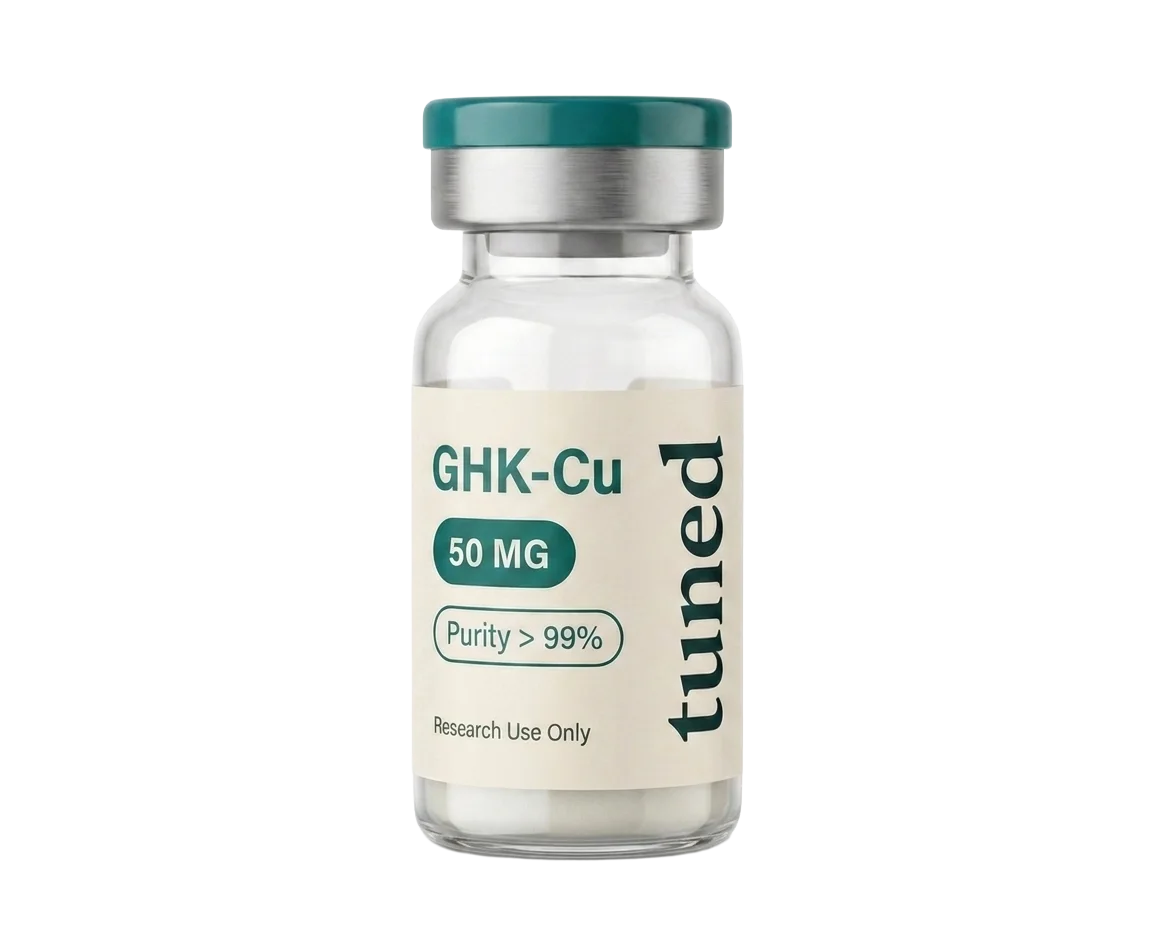
tuned GHK-Cu
For laboratory research use only · available to researchers. Specifications, pricing & Certificate of Analysis on the product page.
How does GHK-Cu work?
GHK-Cu works largely as a delivery system and a signal. The peptide part binds copper tightly and carries it where the body can use it; copper is a required ingredient for the enzymes that cross-link collagen and elastin into strong, springy tissue.
At the same time, GHK acts as a messenger. Even at very low, nanomolar amounts it switches on the skin's repair programs — prompting fibroblasts (the cells that build the skin's scaffolding) to lay down fresh collagen and support molecules, while dialling down the inflammation and oxidative stress that age tissue.[2][3]
There's also the gene-level angle. When researchers mapped GHK's effect on gene activity, they found it influences thousands of human genes at once — shifting cells away from a worn, inflamed state and toward an active repair state.[2] That "reset" framing is a big part of why a single small peptide shows up across so many different kinds of tissue research.
The copper connection
The "Cu" isn't incidental: copper is a required cofactor for the enzymes that cross-link collagen and elastin, and GHK's role is to carry it where it's needed.[1] That delivery job is a big part of why such a tiny peptide has such broad effects.
Is GHK-Cu the same as "copper peptides"?
Mostly, yes. When skincare talks about "copper peptides," it's almost always referring to GHK-Cu — it's the original and most-studied one. "Copper peptide" is the everyday name; GHK-Cu (or its cosmetic label, copper tripeptide-1) is the specific molecule.
| "Copper peptides" | GHK-Cu specifically | |
|---|---|---|
| What it means | General term in skincare | The exact tripeptide + copper |
| Research base | Mostly built on GHK-Cu | Decades of Pickart-led studies |
| Also called | — | Copper tripeptide-1, GHK-Cu |
So if a product lists "copper tripeptide-1," that's GHK-Cu.
What is GHK-Cu's half-life?
Honestly, this one isn't well pinned down. There's no reliable peer-reviewed figure for GHK-Cu's half-life in the blood, and the numbers floating around online come from vendor pages, not studies — so we won't quote one as fact. What is known is that free GHK is broken down quickly by enzymes in the blood, which is part of why so much of the research focuses on local, topical use rather than long-lasting systemic levels.
Why purity is the part that matters
For a research peptide, the biggest real-world variable isn't the molecule — it's the quality of the material. GHK-Cu's value depends on it actually being GHK-Cu, at the stated amount, free of contamination.
That's why tuned tests every batch by UPLC and mass spectrometry, confirms identity, screens endotoxin, and ships a batch-specific Certificate of Analysis — so you can see exactly what's in the vial you're holding.
Is GHK-Cu safe?
In the research that exists, GHK-Cu has a reassuring safety profile: it occurs naturally in the body, is active at tiny (nanomolar) amounts, and has been used in topical cosmetics for decades without notable problems.[2] That track record, though, is mostly about topical use — the safety of injected GHK-Cu has not been established in controlled human trials, and it's not an approved drug.
As with any research peptide, the biggest real-world risk usually isn't the molecule — it's the quality of the material: contamination, the wrong potency, or a mislabelled vial. That's why third-party testing and a Certificate of Analysis matter as much as the compound itself. For the full picture, see the GHK-Cu side effects guide.
GHK-Cu research evidence, uses & more
This page is the overview. For the specifics, these guides go deeper on the questions people ask most:
Common questions
What is GHK-Cu?
What does GHK-Cu do?
Is GHK-Cu the same as copper peptides?
Is GHK-Cu FDA approved?
How do I know the GHK-Cu is pure?
Is GHK-Cu safe?
Related research peptide guides
References
- Pickart L, Thaler MM. Tripeptide in human serum which prolongs survival of normal liver cells and stimulates growth in neoplastic liver. Nature New Biology, 1973;243(124):85–87. PMID 4349963.
- Pickart L, Vasquez-Soltero JM, Margolina A. GHK Peptide as a Natural Modulator of Multiple Cellular Pathways in Skin Regeneration. BioMed Research International, 2015;2015:648108. PMID 26236730.
- Pickart L, Margolina A. Regenerative and Protective Actions of the GHK-Cu Peptide in the Light of the New Gene Data. International Journal of Molecular Sciences, 2018;19(7):1987. PMID 29986520.
- Glycyl-L-histidyl-L-lysine (GHK). PubChem CID 73587 — molecular weight 340.38 g/mol. NIH / NCBI.
Every figure on this page traces to a source above. These are reported research findings, not medical or use guidance.
For research use only. Not for human consumption. This page summarises published research for educational purposes. It is not medical advice and is not intended to diagnose, treat, cure, or prevent any disease. Consult a qualified professional before making decisions about any compound.