GHK-Cu for hair
GHK-Cu is of genuine research interest for hair — copper peptides support the scalp environment a follicle needs, and GHK-Cu boosts blood-vessel growth, collagen and anti-inflammatory signalling around the follicle.[1] But direct evidence for hair growth is preliminary: there's no large human trial of GHK-Cu for hair loss, and it's usually studied or used alongside other treatments, not on its own.
Does GHK-Cu help hair growth?
GHK-Cu has a plausible, mechanism-based case for supporting hair growth — but the direct human evidence is still thin.
The interest is real and not just hype: the same actions behind GHK-Cu's skin and wound-repair work are relevant to the scalp, where a healthy follicle depends on good blood supply, intact surrounding tissue, and low inflammation.
How GHK-Cu might support hair
Three of GHK-Cu's documented actions line up with what a follicle needs: it promotes new blood-vessel growth (better delivery of nutrients to the follicle), it stimulates collagen and remodels the surrounding tissue (a healthier scalp matrix), and it's anti-inflammatory (chronic scalp inflammation is linked to hair thinning).[1][2] Copper itself is also a cofactor in enzymes involved in hair-shaft structure.
What the evidence actually shows
Here's the honest limit: those are mechanisms, not proof of regrowth. There's no large, controlled human trial of GHK-Cu for hair loss, and much of what circulates is from copper-peptide hair products and user reports rather than rigorous studies. So GHK-Cu for hair sits at "promising rationale, limited proof" — treat dramatic hair claims as anecdotal. It's the kind of compound that may help set the stage for healthier hair rather than force regrowth on its own.
Where the research interest sits
GHK-Cu's hair research interest centres on follicle and scalp biology. Commercial product claims and combination approaches are not substitutes for controlled evidence, and no validated application method has been established for the research material sold here.
GHK-Cu for hair loss
For hair loss specifically, GHK-Cu is best thought of as a supporting player aimed at scalp health, not a proven hair-loss treatment in its own right. It doesn't act on the hormonal driver (DHT) behind the most common type of hair loss, so it's a different lever than the established options.
Pattern hair loss — androgenetic alopecia — is driven largely by DHT gradually shrinking follicles, and GHK-Cu doesn't touch that pathway, which is why framing it as a primary cure overstates what it does. Where it could plausibly contribute is the secondary picture: scalp inflammation, blood supply, and the quality of the tissue around follicles that are still viable. That's a meaningful supporting role in theory — but a supporting one.
GHK-Cu vs minoxidil & other approaches
Minoxidil and finasteride are the approaches with regulatory approval and large trials behind them for pattern hair loss; GHK-Cu has neither. Where GHK-Cu is discussed is as a complement — supporting the scalp environment alongside those treatments — rather than a replacement. Any "GHK-Cu vs minoxidil" comparison that frames it as an equal, proven alternative is overstating the evidence.
Topical vs injectable for hair
For hair, the topical/scalp route is what most research and product use is built around — GHK-Cu's hair interest grew out of copper-peptide scalp formulations. Injectable or mesotherapy use for hair is discussed in communities but isn't backed by controlled trials, so treat it as anecdotal.
Is the combination evidence established?
No controlled trial has established combined GHK-Cu and minoxidil effects. Claims about complementarity are mechanistic speculation rather than validated evidence.
What results to expect
If GHK-Cu does anything for hair, the biology says it would be gradual and supportive — improving the scalp environment over months rather than rapidly regrowing hair. Hair cycles are slow, so any genuine change shows up over a typical growth cycle, not weeks.
How long for hair results?
Hair biology operates over long growth cycles, so dramatic short-term transformation claims are not supported by the underlying mechanism. No controlled GHK-Cu trial establishes a results timeline.
Specific "before and after" timelines for GHK-Cu and hair are anecdotal — there's no trial-derived results timeline to quote. Expect a supporting role, not a standalone cure for hair loss.
Common questions
Does GHK-Cu help hair growth?
Is GHK-Cu good for hair loss?
GHK-Cu vs minoxidil — which is better?
How do I know the GHK-Cu is pure?
References
- Pickart L, Margolina A. Regenerative and Protective Actions of the GHK-Cu Peptide in the Light of the New Gene Data. International Journal of Molecular Sciences, 2018;19(7):1987. PMID 29986520.
- Pickart L, Vasquez-Soltero JM, Margolina A. GHK Peptide as a Natural Modulator of Multiple Cellular Pathways in Skin Regeneration. BioMed Research International, 2015;2015:648108. PMID 26236730.
The cited sources support GHK-Cu's mechanisms (angiogenesis, collagen, anti-inflammatory); they are not hair-loss trials. Hair-specific growth claims are preliminary/anecdotal and not from these sources. Not medical advice.
For research use only. Not for human consumption. This page summarises published research for educational purposes. It is not medical advice and is not intended to diagnose, treat, cure, or prevent any disease, including hair loss.
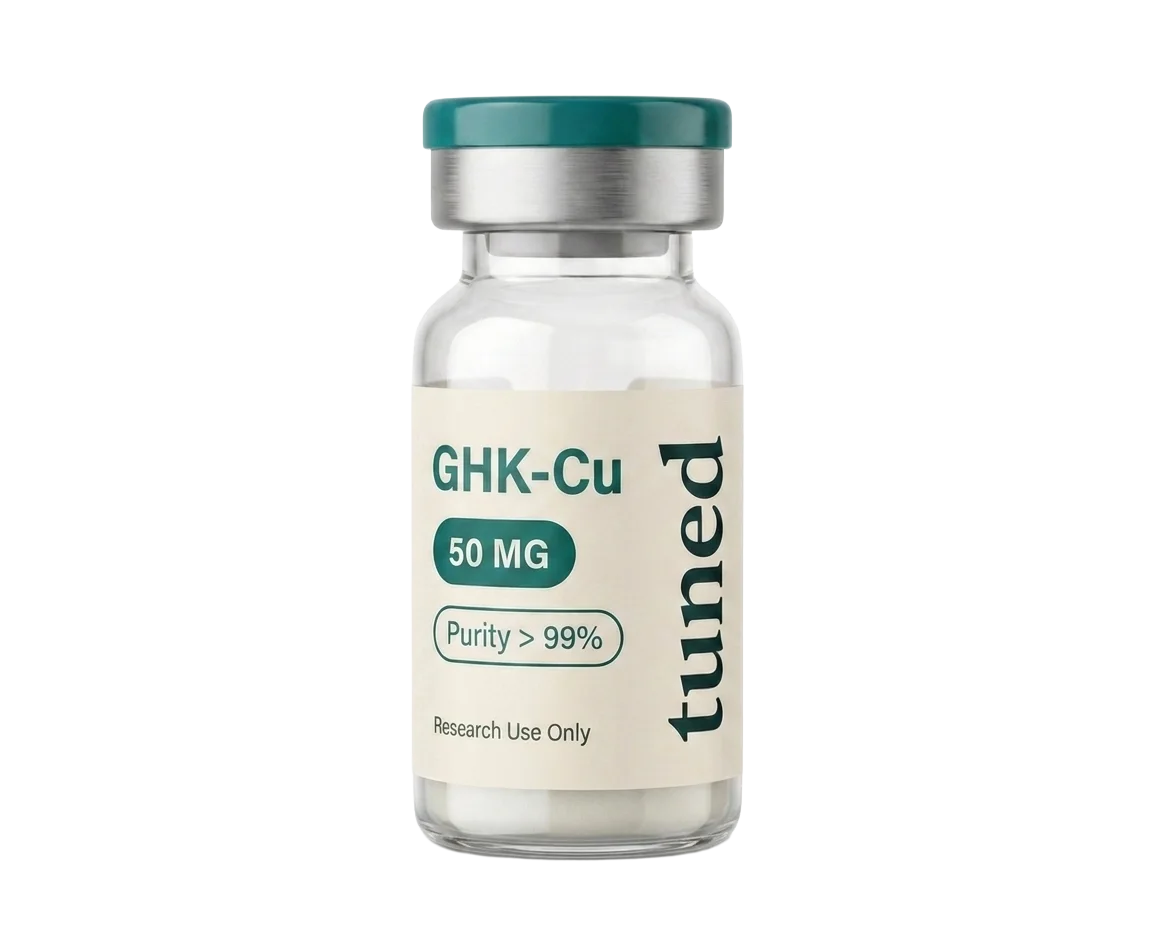
tuned GHK-Cu
For laboratory research use only · available to researchers. Specifications, pricing & Certificate of Analysis on the product page.