GHK-Cu side effects & safety
GHK-Cu has a reassuring safety profile in research — it occurs naturally in the body, works at tiny amounts, and has decades of topical cosmetic use without notable problems.[1] Reported side effects are mostly mild and local (skin or injection-site irritation). The bigger real-world risk usually isn't the peptide — it's the quality of the material. It's not an FDA-approved drug.
What are the side effects of GHK-Cu?
Reported GHK-Cu side effects are generally mild and local, and serious effects haven't been documented at the amounts studied.[1]
Most of the safety record comes from topical cosmetic use, where GHK-Cu has been used for decades. The effects that do come up are the kind you'd associate with the skin or the injection itself rather than the molecule being toxic:
| Reported effect | Context |
|---|---|
| Skin irritation, redness, itching | Topical use — usually mild, in sensitive skin |
| Injection-site reactions | Redness or soreness at the site, common to any subcutaneous injection |
| Temporary tightening / dryness | Reported with some topical formulations |
GHK-Cu injection side effects
For injectable use specifically, there's no controlled human trial cataloguing side effects, so the honest position is that they aren't formally characterized. The reactions discussed are the general ones for subcutaneous injection — local redness, swelling or soreness — plus whatever risk comes from the material itself (see below).
Copper and GHK-Cu
Because GHK-Cu carries copper, a theoretical concern with heavy or prolonged use is copper accumulation. At the tiny amounts GHK is active at, this hasn't been flagged as a practical problem in the literature,[1] but it's the mechanism-based reason "more is better" doesn't apply here.
Allergic or sensitivity reactions
As with any peptide or skincare ingredient, individual sensitivity is possible — most often showing up as localised redness, itching or a rash rather than anything systemic. Patch-level irritation is the typical pattern reported with topical copper-peptide products, and it's the reason small-area testing is the norm before wider use in cosmetic research.
The biggest GHK-Cu risk is material quality
For research peptides, the most important safety variable usually isn't the compound — it's what's actually in the vial. Two products with the same name can differ in purity, contain the wrong amount, or carry contamination that never appears on a label.
Contamination & endotoxin
Bacterial endotoxin and impurities are the realistic risks with lower-grade material, and they're exactly what proper testing screens for. That's why a batch-specific Certificate of Analysis — UPLC purity, mass-spec identity, endotoxin screening — does more for safety than any community rule of thumb. If a supplier can't show you a recent, lot-matched CoA, that absence is itself a risk signal: it means the single most important safety variable is unverified. The flip side is reassuring — when purity, identity and endotoxin all check out on the exact lot you receive, the largest avoidable risk is already off the table.
Is GHK-Cu safe?
In the research that exists, GHK-Cu is considered low-risk: it's a molecule the body already makes, it's active at nanomolar amounts, and its decades of topical cosmetic use haven't surfaced notable safety problems.[1] No deaths or serious toxicity have been reported in the preclinical literature, and the long topical track record is largely uneventful.
What we can't claim
That reassuring picture is mostly about topical use. The safety of injected GHK-Cu hasn't been established in controlled human trials, so "is GHK-Cu safe" can't be answered with a clean yes for systemic use — it simply hasn't been studied that way. Treat confident safety claims about injectable GHK-Cu as unverified.
Theoretical cautions in research
One mechanism-based caution is worth noting: GHK-Cu promotes new blood-vessel growth (angiogenesis), part of how it aids repair. That same property is why reviews flag contexts such as active cancer as areas for caution in principle, since tumours also depend on blood-vessel growth.[1] There's also no safety data in pregnancy. These are theoretical, research-framed cautions — not findings of harm, and not medical advice.
Is GHK-Cu FDA approved?
No — GHK-Cu is not an FDA-approved drug. It has no approved therapeutic indication and isn't authorised for systemic or injectable human use.
Cosmetic vs drug status
Where GHK-Cu is established is as a cosmetic ingredient, listed under the name copper tripeptide-1 and used in topical skincare. That's a different regulatory lane from an approved drug. Compounded injectable GHK-Cu has been flagged by the FDA as a safety concern given the limited human data — which is why tuned sells it strictly for research use only, not as a treatment.
Common questions
What are the side effects of GHK-Cu?
Is GHK-Cu safe?
Is GHK-Cu FDA approved?
What's the biggest risk with GHK-Cu?
Who should avoid GHK-Cu?
How do I know the GHK-Cu is pure?
References
- Pickart L, Margolina A. Regenerative and Protective Actions of the GHK-Cu Peptide in the Light of the New Gene Data. International Journal of Molecular Sciences, 2018;19(7):1987. PMID 29986520.
- Pickart L, Vasquez-Soltero JM, Margolina A. GHK Peptide as a Natural Modulator of Multiple Cellular Pathways in Skin Regeneration. BioMed Research International, 2015;2015:648108. PMID 26236730.
Safety statements reflect the cited research, which is predominantly topical. Injectable-specific side-effect and safety data are not established in human trials — claims to the contrary are unverified. Not medical advice.
For research use only. Not for human consumption. This page summarises published research for educational purposes. It is not medical advice and is not intended to diagnose, treat, cure, or prevent any disease.
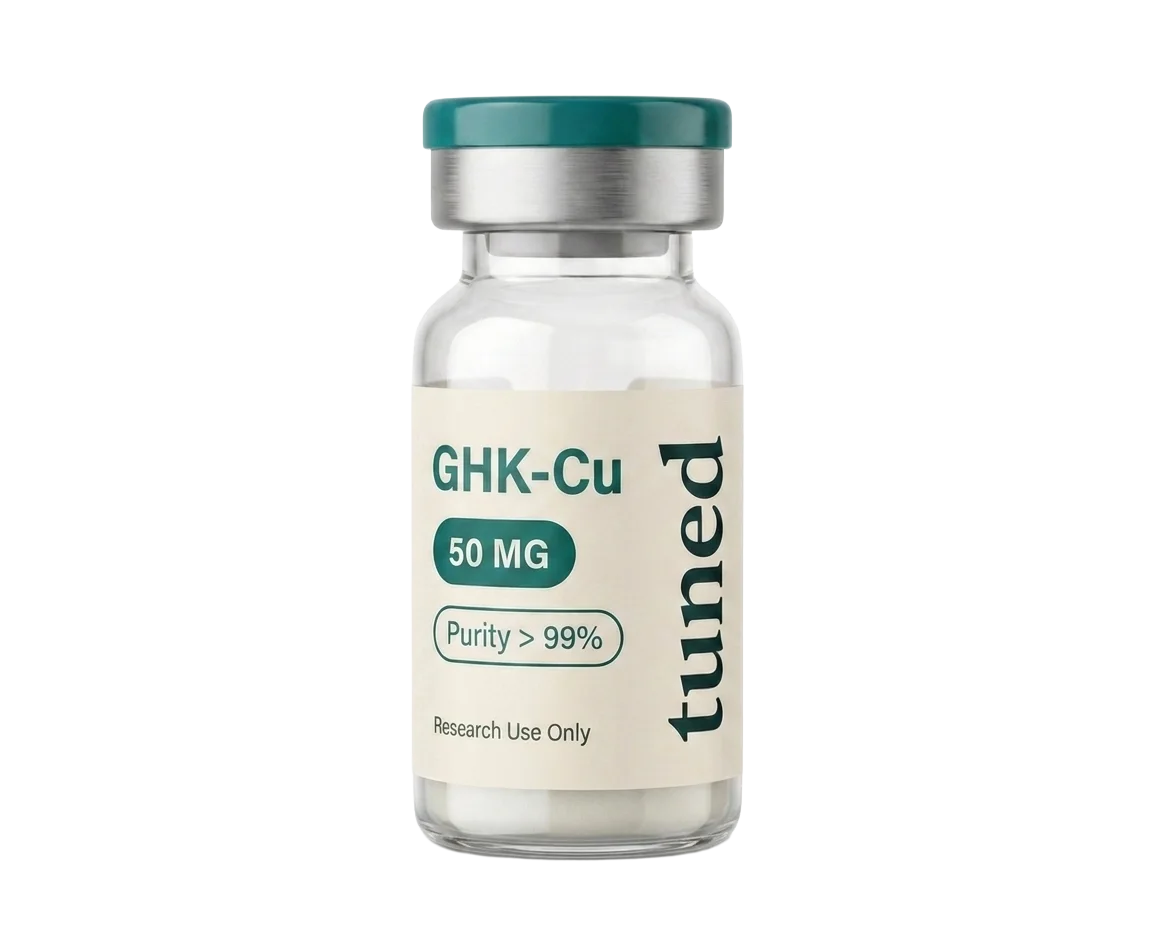
tuned GHK-Cu
For laboratory research use only · available to researchers. Specifications, pricing & Certificate of Analysis on the product page.